


An Alabama lease agreement sets the tone for the entire rental relationship from the first signed page to the last. It gives landlords and tenants one place to confirm rent details, lease dates, responsibilities, property rules, maintenance expectations, and move-in terms before anyone picks up the keys.
The good news? You don’t need to turn a lease into a legal headache. A buttoned-up lease agreement keeps the terms clear, practical, and easy to follow. With the right details in place, landlords can start the tenancy on a solid footing and spend less time untangling unclear lease terms.

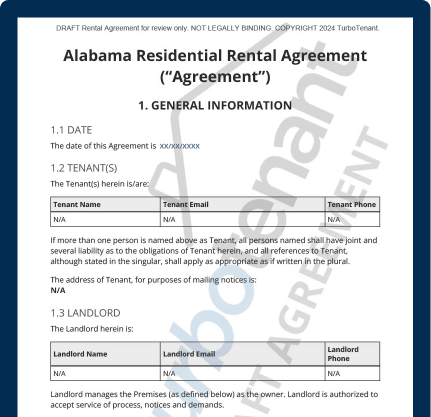
Alabama Residential Lease Agreement
Current PageCreate a compliant Alabama lease agreement in 15 minutes with TurboTenant's rental contract builder.
Alabama Month-to-Month Lease Agreement
Learn MoreBuild your Alabama month-to-month lease agreement in 15 minutes.
Room Rental Agreement Alabama
Learn MoreConsidering renting out your spare room? Make it official with an Alabama room rental agreement.
Required Landlord Disclosures (2)
Landlords must legally disclose certain aspects of a rental unit to tenants, and these disclosures vary significantly from state to state. Alabama landlords must disclose the following to tenants:
- Lead paint: Landlords must inform tenants of any known lead-based paint or lead-based paint hazards in most units built before 1978. They must also provide the required federal lead-based paint disclosure form and EPA-approved pamphlet (42 U.S.C. § 4852d).
- Landlord/agent name and address: Landlords must disclose, in writing at or before the tenancy begins, the name and business address of the person authorized to manage the property and the owner or the person authorized to act on the owner’s behalf for service of process and receiving notices (Ala. Code § 35-9A-202).
Security Deposit Regulations
Maximum security deposit amount: Alabama landlords may collect a security deposit equal to 1 month’s periodic rent, excluding additional deposits for pets, property changes, or increased liability risks (Ala. Code § 35-9A-201(a)).
Receipt of deposit: Alabama law does not require landlords to provide tenants with a deposit receipt.
Interest: Alabama landlords do not have to pay tenants interest on security deposits.
Deduction tracking: Landlords may withhold funds from the security deposit for accrued rent or damages caused by the tenant’s noncompliance with the lease. They must give the tenant a written, itemized list of deductions (Ala. Code § 35-9A-201(b)).
Returning a tenant’s security deposit: Landlords must return the deposit, or any remaining balance, within 60 days after the tenancy ends and the tenant delivers possession. If the landlord does not mail the refund or itemized accounting within 60 days, the landlord must pay the tenant double the original deposit amount (Ala. Code § 35-9A-201(b), § 35-9A-201(f)).
Landlord’s Access to Property
Advance notice: Alabama landlords must give at least 2 days’ notice before entering a tenant’s unit, except as the law allows or when notice is impracticable. They may enter only at reasonable times (Ala. Code § 35-9A-303(c)).
Immediate access: Landlords may access a property without the tenant’s consent in an emergency (Ala. Code § 35-9A-303(b)).
Landlord harassment: Landlords may not enter a property unlawfully, enter lawfully in an unreasonable manner, or make excessive demands for entry that unreasonably harass the tenant. If they do, the tenant may seek an injunction to stop the conduct or terminate the lease, and may recover actual damages (Ala. Code § 35-9A-442(b)).
Rent Payment Laws
Grace period: Alabama law does not require a grace period for rent, so landlords do not need to include one in an Alabama lease agreement.
Late rent fees: Alabama law does not set a specific limit on late rent fees. The rental agreement should clearly state, however, when the fee applies and how much the tenant must pay.
Tenant’s right to withhold rent: Alabama tenants may not stop paying rent for repairs while they still live in the rental unit. If a landlord fails to make required repairs that materially affect health and safety, the tenant may give written notice and terminate the lease if the landlord does not fix the issue within 14 days (Ala. Code § 35-9A-401, § 35-9A-164).
Breach of Rental Agreement
Missed rent payment: Alabama landlords may issue a 7-Day Notice to Pay or Quit after rent goes unpaid when due. The notice must give the tenant at least 7 business days after receipt to pay the overdue rent and any late fees, or the lease may terminate (Ala. Code § 35-9A-421(b)).
Lease violation: The landlord must provide a 7-Day Notice to Cure or Quit for certain lease violations. A tenant may not cure a lease violation more than 2 times in 12 months unless the landlord gives written consent. For certain noncurable defaults, the landlord may terminate the lease with a 7-Day Notice to Quit (Ala. Code § 35-9A-421(a), § 35-9A-421(d)).
Self-help evictions: Alabama does not allow self-help evictions, and landlords should never attempt them. A landlord who unlawfully ousts a tenant, cuts off services, or locks the tenant out may owe the tenant up to three months’ rent or actual damages, plus attorney fees. Always follow the legal eviction process (Ala. Code § 35-9A-407).
Lease abandonment: If the tenant abandons the property, the landlord must make reasonable efforts to re-rent it at a fair rental. Alabama law also considers property abandoned if electric service has been discontinued for 7 consecutive days. If the landlord re-rents the unit before the original lease ends, the original lease ends when the new tenancy begins (Ala. Code § 35-9A-423(c), § 35-9A-423(e)).
Ending a Lease
Month-to-month: Alabama landlords must give tenants at least 30 days’ written notice before the periodic rental date when they intend to end a month-to-month lease (Ala. Code § 35-9A-441(b)).
Fixed-term: To legally end a fixed-term lease early and without penalty, a tenant must demonstrate a qualifying legal reason. These reasons may include entering active military duty under the federal Servicemembers Civil Relief Act (50 U.S.C. § 3955), uninhabitable conditions (Ala. Code § 35-9A-401), or landlord harassment (§ 35-9A-442(b)).
Property abandonment: If a tenant leaves property in the rental unit for more than 14 days after the lease ends, the landlord has no duty to store or protect the property and may dispose of it without obligation (Ala. Code § 35-9A-423(d)).
Renewing a Lease
Required renewals: Alabama landlords do not have to renew a tenant’s lease when the rental period ends unless the lease says otherwise.
Required notice: For month-to-month leases, the landlord must give written notice at least 30 days before the periodic rental date listed in the notice. Week-to-week tenancies require at least 7 days’ written notice (Ala. Code § 35-9A-441).
Alabama Residential Lease Agreement FAQs
Does a landlord have to provide a copy of the lease in Alabama?
Alabama law does not require landlords to give tenants a copy of the lease after signing. Landlords should still give tenants a signed copy of the lease, including any renewal changes, so that both parties can refer to the same terms.
What is the grace period for rent in Alabama?
Alabama law does not require a specific grace period for rent. Rent becomes due on the date listed in the lease unless the rental agreement gives the tenant extra time to pay.
Can a landlord refuse to renew a lease in Alabama?
Yes. Alabama landlords do not have to renew a lease when the term ends unless the lease says otherwise. For month-to-month leases, the landlord or tenant must give at least 30 days’ written notice before the periodic rental date listed in the notice (Ala. Code § 35-9A-441).
Does an Alabama lease need to be notarized?
Most standard Alabama residential leases do not require notarization to create a legally binding rental agreement between the landlord and tenant.
Can you withhold rent for repairs in Alabama?
No. Alabama tenants may not withhold rent while they remain in possession of the rental unit. Tenants with repair concerns should follow the remedies available under Alabama law (Ala. Code § 35-9A-164).
Disclaimer: TurboTenant does not provide legal advice. This material has been prepared for informational purposes only. All users are advised to check all applicable local, state, and federal laws and consult legal counsel should questions arise.