


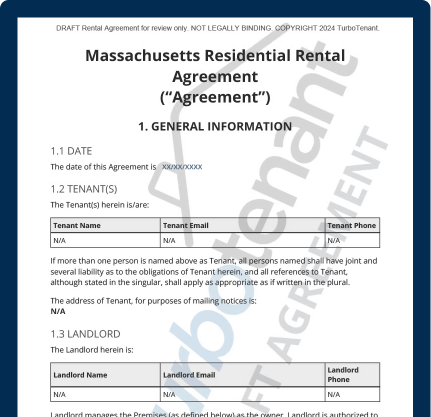
A Massachusetts lease agreement protects landlords and tenants in rental contracts. They include state-specific language, guidelines, and common language that most of us are familiar with.
Since lease agreements are legal contracts, it’s imperative to ensure adherence to state and local guidelines. Leases that don’t follow Massachusetts law could be void, so landlords should consider using TurboTenant’s property management software to build a compliant rental contract in just 15 minutes.

Massachusetts Residential Lease Agreement
Current PageCreate a compliant Massachusetts lease agreement in 15 minutes with TurboTenant's rental contract builder.
Massachusetts Month-to-Month Lease Agreement
Learn MoreBuild your Massachusetts month-to-month lease agreement in 15 minutes.
Room Rental Agreement Massachusetts
Learn MoreUse a TurboTenant Massachusetts room rental agreement to legitimize your house hacking endeavors.
Required Landlord Disclosures (6)
Disclosures are state or federally mandated components of lease agreements. They enable landlords to inform tenants about important information about the property or the rental contract.
Massachusetts requires the following disclosures:
- Lead-based paint: The existence of any lead-based paint or lead-based paint hazards for all units built before 1978 must be disclosed to tenants. It’s is the only federally mandated disclosure required.
- Movie-in checklist: Massachusetts landlords must provide tenants with an inventory of the unit’s condition within 10 days of moving in. This disclosure should list any existing damage and the current condition of the property or any furnishings. It should use the language provided by the state (MGL 186 § 15B(2c)).
- Fire insurance: Landlords must provide information on the unit’s fire insurance policy within 15 days of receiving a tenant’s written request. The disclosure must include the insurance company’s name, the coverage amount, and the person who would receive payments (MGL 186 § 21).
- Shared utilities: If tenants pay for water in multi-unit buildings, the rental contract must include language and certifications from the landlord around compliance and how water is billed to them (MGL 186 § 22f).
- Security deposit: If a security deposit is collected, landlords must provide a receipt within 30 days that states the deposit amount, the name of the person receiving it, the date it was collected, and a description of the unit. The receipt must also disclose the institution holding the funds and the account number (MGL 186 § 15B(2b)).
- Landlord name and address: The lease must include the name and address of the landlord or person responsible for managing the property (105 CMR, § 410.400).
Security Deposit Regulations
Maximum security deposit amount: In Massachusetts, the maximum security deposit is 1 month’s rent (MGL 186 § 15B(b(iii))).
Receipt of deposit: Landlords must provide a receipt of the security deposit with all relevant information, including the amount, date, bank where it’s being held, and account number, within 30 days of receipt (MGL 186 § 15B(2b)).
Interest: Landlords must pay tenants interest if they have a tenancy lasting 1 year or longer at the rate of 5% or the percentage received from the bank (MGL 186 § 15B(3b)).
Deduction tracking: Landlords in Massachusetts are permitted to withhold funds from a security deposit for unpaid rent or repair costs that exceed normal wear and tear (MGL 186 § 15B(4)).
Returning a tenant’s security deposit: Security deposits must be returned within 30 days of moving out (MGL 186 § 15B(4)).
Landlord’s Access to Property
Advance notice: There is no specific law regarding when a landlord can enter or how much notice they must give. However, notice should be reasonable and necessary for necessary inspections or repairs.
Immediate access: Landlords in Massachusetts are legally allowed to enter a property without notice in emergencies.
Landlord harassment: Tenants can sue landlords who repeatedly enter a tenant’s unit and interfere with their “quiet enjoyment” of the property, or who engage in other forms of landlord harassment. Harassment could allow a tenant to sue for 3 months’ rent in damages or break the lease without penalty (MGL 186 § 14).
Rent Payment Laws
Grace period: Massachusetts law doesn’t set a grace period. Landlords can begin the eviction process even when the rent is only 1 day late. However, late fees and penalties cannot be charged until the rent is at least 30 days overdue (MGL 186 § 15B(1c)).
Late rent fees: There is no limit to the late fee amount; however, it must be stated in the lease and cannot be assessed until 30 days after the rent due date (MGL 186 § 15B(1c)).
Tenant’s right to withhold rent: If a Massachusetts landlord does not make required repairs or fails to fulfill their duty as laid out in the lease, tenants may withhold rent. Tenants may recover the difference between rent and costs to remedy the situation (MGL 239 § 8A).
Breach of Rental Agreement
Missed rent payment: Generally, a landlord can deliver a 14-day Notice to Pay or Quit the first day after the rent is late. They can enforce a different time period if detailed in the lease agreement (MGL 186 § 11A).
Lease violation: Since there is no legislation dictating the type of notice that must be given in the event of a lease violation, landlords should include this provision in the lease agreement.
Self-help evictions: Landlords should never attempt to evict a tenant through self-help measures. Self-help evictions are illegal and could subject the landlord to legal and civil penalties.
Lease abandonment: A landlord who suspects a tenant has abandoned their leased property should attempt to contact the tenant on two separate days, at least 3 days apart, to gather information. If no contact has been made after 14 days, the landlord may reclaim possession of the property (MGL 105A § 9).
Ending a Lease
Month-to-month: Landlords or tenants must give 30 days’ notice to end a month-to-month lease (MGL 186 § 12).
Fixed-term: Tenants in Massachusetts can end a fixed-term lease early and without penalty if they meet a satisfying condition. These include entering into active military duty, uninhabitable living conditions, landlord harassment, or if they’re the victim of domestic abuse or sexual violence (MGL 186 § 14).
Property abandonment: If a tenant has left behind property, the landlord must attempt to contact the tenant at their last known address. If they don’t hear anything after 60 days, they may dispose of it (MGL 200A § 7(a)).
Renewing a Lease
Required renewals: Massachusetts state law doesn’t require landlords to renew a tenant’s lease upon expiration of the lease term.
Required notice: No law requires the landlord to give a specific notice window if they choose not to renew a yearly lease. However, 30-60 days’ notice is common practice. For month-to-month leases, landlords must give 30 days’ notice of their intent to terminate the agreement (MGL 186 § 12).
Disclaimer: TurboTenant does not provide legal advice. This material has been prepared for informational purposes only. All users are advised to check all applicable local, state, and federal laws and consult legal counsel should questions arise.
Massachusetts Residential Lease Agreement FAQs
Does a landlord have to provide a copy of the lease in Massachusetts?
Yes, landlords in Massachusetts are required to provide a written copy of the lease agreement within 30 days of signing (940 CMR 3.17 (3)).
What is the grace period for rent in Massachusetts?
There is no specific grace period for rent. However, landlords cannot charge late fees until rent is 30 days late.
Can a landlord refuse to renew a lease in Massachusetts?
Yes, landlords can refuse to renew a lease in Massachusetts.
Does a Massachusetts lease need to be notarized?
No, Massachusetts leases do not require notarization.
Can you withhold rent for repairs in Massachusetts?
Yes, if landlords do not make necessary repairs in a reasonable timeframe, Massachusetts tenants are allowed to withhold rent and deduct the cost from a future payment (MGL 239 § 8A).