


Missouri lease agreements govern the relationship between landlords and tenants, set expectations for both parties, and establish clear rules on what tenants can and cannot do during the rental period. A strong lease gives landlords a practical way to govern rent terms, property rules, maintenance responsibilities, and other details before move-in.
A lease agreement is more than a list of expectations, however. It is a legal contract that establishes a formal relationship between the parties and holds them accountable. In this guide, we’ll discuss the laws that Missouri landlords must understand when creating their leases. To create a lease quickly, hit the “Create Document” button above.

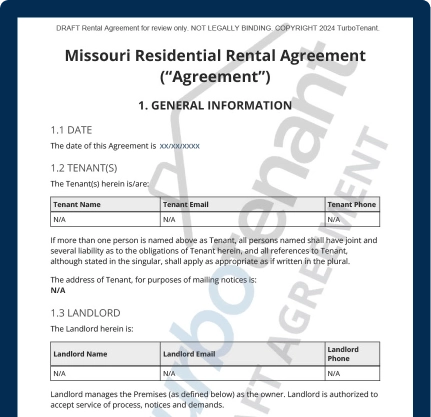
Missouri Residential Lease Agreement
Current PageCreate a compliant Missouri residential lease agreement in 15 minutes with TurboTenant.
Missouri Month-to-Month Lease Agreement
Learn MoreBuild your Missouri month-to-month lease agreement in 15 minutes.
Room Rental Agreement Missouri
Learn MoreRent your spare room with a Missouri room rental agreement today.
Required Landlord Disclosures (4)
When signing a standard residential lease agreement, Missouri law requires landlords to disclose certain information about the property and the people responsible for managing it. These disclosures include:
- Lead-based paint: Federal law requires landlords to disclose known lead-based paint or lead-based paint hazards in most rental units built before 1978. Landlords must also provide tenants with the required lead warning statement and an EPA-approved pamphlet before signing the lease (42 U.S.C. § 4852d).
- Methamphetamine production: Missouri landlords must disclose, in writing, any known prior methamphetamine production on the property. This requirement applies whenever the landlord has actual knowledge of prior production, regardless of whether anyone involved received a conviction (Mo. Rev. Stat. § 441.236).
- Radioactive or hazardous material: Missouri landlords who receive an affirmative report that the property is or was contaminated with radioactive or other hazardous material must disclose that fact in writing before the lease is executed. Failing to disclose known contamination is a class A misdemeanor (Mo. Rev. Stat. § 442.055).
- Landlord’s name and address: At or before the start of the tenancy, the lease must disclose in writing the name and address of the person authorized to manage the property, as well as the name and address of the owner or a person authorized to receive notices and service of process (Mo. Rev. Stat. § 535.185).
Security Deposit Regulations
Maximum security deposit amount: Missouri landlords can charge up to 2 months’ rent for a security deposit (Mo. Rev. Stat. § 535.300).
Receipt of deposit: Missouri law does not require landlords to provide a receipt after accepting a security deposit.
Interest: Missouri landlords must hold security deposits in a federally insured bank, credit union, or depository institution. Any interest earned on the deposit belongs to the landlord (Mo. Rev. Stat. § 535.300).
Deduction tracking: Landlords may withhold funds for unpaid rent, damage beyond ordinary wear and tear, or losses caused by improper notice. To deduct carpet-cleaning costs, the lease must first state that the tenant may owe them (Mo. Rev. Stat. § 535.300).
Returning a tenant’s security deposit: Landlords must return the full security deposit or provide a written, itemized list of deductions within 30 days after the tenancy ends (Mo. Rev. Stat. § 535.300).
Rent Payment Laws
Grace period: Missouri law does not establish a mandatory grace period for late rent payments.
Late rent fees: Missouri law does not set a specific statewide cap on late fees for residential leases. That said, landlords should clearly state any late fee in the lease and keep the amount reasonable.
Tenant’s right to withhold rent: A tenant who has lived in the unit for 6 months, stayed current on rent, and given 14 days’ written notice may repair and deduct for a code violation that affects habitability, sanitation, or security. The cost cannot exceed 1 month’s rent (Mo. Rev. Stat. § 441.234).
Rent Payment Laws
Grace period: No laws in Missouri establish a mandatory grace period for late rent payments.
Late rent fees: Late fees must be “reasonable,” which means $20 or 20% of the monthly rent, whichever is greater (MRS § 415.417(4)).
Tenant’s right to withhold rent: Landlords must remedy a condition that threatens the property’s habitability, sanitation, or security within 14 days of the tenant’s notice. If the landlord does not cure the problem within 14 days, the tenant may handle the repair themselves. The repair must cost less than $300 or half the monthly rent, whichever is greater. Tenants must provide an itemized deduction receipt (MRS § 441.234).
Breach of Rental Agreement
Missed rent payment: Missouri landlords can file for eviction after a tenant defaults on rent (Mo. Rev. Stat. § 535.010).
Lease violation: If a tenant uses the property for specific illegal purposes, such as gambling, prostitution, or the illegal possession, sale, or distribution of controlled substances, the landlord may give 10 days’ notice to vacate and then recover possession. (Mo. Rev. Stat. § 441.040). For ordinary lease violations, such as unauthorized subletting, Missouri has no separate statutory 10-day notice period; landlords must follow the lease and may file an unlawful detainer action or a rent-and-possession action (Chapter 534).
Self-help evictions: Removing a tenant without a court order counts as an illegal self-help eviction under Missouri law, except in certain abandonment situations (Mo. Rev. Stat. § 441.233, § 441.065).
Lease abandonment: Missouri law allows landlords to treat a rental agreement as abandoned if they reasonably believe the tenant has vacated, rent has gone unpaid for 30 days, and the tenant does not respond within 10 days after the landlord posts and mails the required notice (Mo. Rev. Stat. § 441.065).
Ending a Lease
Month-to-month: In Missouri, landlords or tenants can end a month-to-month lease by giving written notice that states the tenancy will end on a rent-paying date at least 1 month after the other party receives the notice (Mo. Rev. Stat. § 441.060).
Fixed-term: To end a fixed-term lease early, a tenant must meet a qualifying condition. These include active military duty (50 U.S.C. § 3955), uninhabitable living conditions, landlord harassment, status as a victim of domestic violence, sexual assault, or stalking (Mo. Rev. Stat. § 441.920), or an early termination clause in the lease.
Property abandonment: Missouri landlords may remove or dispose of a tenant’s remaining belongings if they reasonably believe the tenant has vacated, rent has gone unpaid for 30 days, and the tenant fails to respond within 10 days after the landlord posts and mails the required notice. Signs such as the discontinuation of utilities or the removal of most belongings may support the landlord’s assertion. However, the statutory procedure still requires 30 days’ unpaid rent, the posted-and-mailed notice, and a 10-day response window (Mo. Rev. Stat. § 441.065).
Renewing a Lease
Required renewals: Missouri landlords are not required to renew a lease once the lease term ends.
Required notice: For year-to-year tenancies, either party must provide at least 60 days’ written notice before the end of the year. For a month-to-month tenancy, either the landlord or the tenant must provide written notice stating that the tenancy will end on a rent-paying date at least 1 month after the other party receives the notice (Mo. Rev. Stat. § 441.060, § 441.050).
Missouri Residential Lease Agreement FAQs
Does a landlord have to provide a copy of the lease in Missouri?
Missouri law does not appear to require landlords to provide tenants with a copy of the lease, though giving tenants signed copies is considered best practice.
What is the grace period for rent in Missouri?
Missouri law does not require a grace period for rent. Landlords can follow the rent due date and late fee terms stated in the lease.
Can a landlord refuse to renew a lease in Missouri?
Landlords do not have to renew a lease once its term ends, but they must provide proper notice when required (Mo. Rev. Stat. § 441.060).
Does a Missouri lease need to be notarized?
Missouri leases do not need to be notarized to be legally valid.
Can you withhold rent for repairs in Missouri?
A tenant who has lived in the unit for 6 months, stayed current on rent, and given 14 days’ written notice may repair and deduct for a code violation that affects the property’s habitability, sanitation, or security. The cost cannot exceed one month’s rent (Mo. Rev. Stat. § 441.234).
Can a Missouri landlord include custom terms in a lease?
Yes. A Missouri landlord can include custom terms in a lease, as long as they follow federal and state law. Use TurboTenant’s lease agreement builder to create your personalized document. Then, fine-tune details like rent timing, pet rules, parking terms, and maintenance duties.
Disclaimer: TurboTenant does not provide legal advice. This material has been prepared for informational purposes only. All users are advised to check all applicable local, state, and federal laws and consult legal counsel should questions arise.