


A Kansas lease agreement is a legal contract that allows tenants to rent a property. These contracts establish the ground rules for landlords and tenants and ensure that everyone understands their responsibilities and the consequences if either party fails to fulfill them.
While we recommend simplifying the process by using TurboTenant’s downloadable PDF samples, you should still understand the basics of creating a legally binding lease template. Read on to learn everything you should know about standard lease agreements in Kansas.

Kansas Residential Lease Agreement
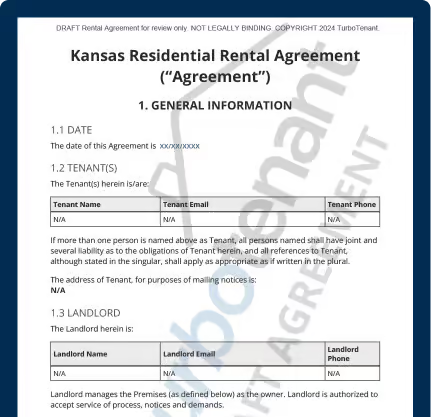
Current PageCreate a compliant Kansas lease agreement in 15 minutes with TurboTenant's rental contract builder.
Kansas Month-to-Month Lease Agreement
Learn MoreBuild your Kansas month-to-month lease agreement in just 15 minutes.
Room Rental Agreement Arkansas
Learn MoreConsidering renting out an extra room? Make it official with an Arkansas room rental agreement.
Required Landlord Disclosures (3)
When a tenant rents a unit, the landlord must disclose specific information about the rental property. Federal and state laws regulate the following requirements for rental lease agreements in Kansas:
- Lead-based paint: For housing built before 1978, federal law requires landlords to disclose any known lead-based paint or hazards, give tenants the EPA pamphlet Protect Your Family From Lead in Your Home, and include lead warning language in the lease (42 U.S.C. § 4852d).
- Landlord identification: At or before the start of the tenancy, Kansas landlords must disclose in writing the name and address of the person authorized to manage the property and of the owner or the person authorized to receive notices and service of process (Kan. Stat. Ann. § 58-2551).
- Move-in checklist: Within 5 days of the initial occupancy date or upon delivery of possession, the landlord and tenant must jointly inventory the premises and complete a written record of the property’s condition. Both parties sign the record, and the landlord gives the tenant a copy (Kan. Stat. Ann. § 58-2548).
Security Deposit Regulations
Maximum security deposit amount: Kansas caps security deposits at 1 month’s rent for unfurnished units and 1.5 months’ rent for furnished units. If the lease allows pets, landlords may charge an additional pet deposit of up to half a month’s rent (Kan. Stat. Ann. § 58-2550(a)).
Receipt of deposit: Kansas law does not require landlords to issue a receipt for security deposits or to store them in a separate, interest-bearing account.
Deduction tracking: Landlords may withhold funds from the security deposit to cover unpaid rent or repair costs for tenant-caused damage. When they do, they must give the tenant an itemized written notice documenting the deductions (Kan. Stat. Ann. § 58-2550(b)).
Returning a tenant’s security deposit: After the tenancy ends, when the tenant vacates and requests the deposit, Kansas landlords must return any remaining deposit within 30 days. If the landlord withholds funds for legally allowable charges other than rent, they must return the balance within 14 days after determining those charges, but no later than 30 days after the tenancy ends (Kan. Stat. Ann. § 58-2550(b)).
Landlord’s Access to Property
Advance notice: Kansas landlords may enter a tenant’s unit after providing “reasonable notice” and may only enter at “reasonable times” (Kan. Stat. Ann. § 58-2557(a)).
Immediate access: Kansas landlords may enter without the tenant’s consent in cases of extreme hazard that poses a potential loss of life or severe property damage (Kan. Stat. Ann. § 58-2557(b)).
Landlord harassment: If a landlord enters unlawfully, unreasonably, or repeatedly demands entry that harasses the tenant, the tenant may seek injunctive relief or terminate the lease and recover actual damages (Kan. Stat. Ann. § 58-2571(b)).
Rent Payment Laws
When rent is due: Unless the lease states otherwise, rent is payable at the dwelling unit and is due at the beginning of each month (Kan. Stat. Ann. § 58-2545(c)).
Grace period: Kansas law does not require a mandatory grace period for late rent payments.
Late rent fees: Kansas does not set a specific statewide cap on late fees for standard residential leases. Landlords should clearly state any late fee in the lease agreement and keep the amount reasonable.
Tenant’s right to terminate for habitability issues: If a serious issue affects health and safety, the tenant may deliver written notice to the landlord specifying the problem and stating that the lease will terminate in 30 days. If the landlord does not make a good-faith effort to remedy the issue within 14 days, the tenant may terminate the lease without penalty and seek additional damages (Kan. Stat. Ann. § 58-2559).
Breach of Lease Agreement
Missed rent payment: If rent goes unpaid when due, Kansas landlords can give written notice that the lease will terminate if the tenant does not pay within 3 consecutive 24-hour periods. If the landlord mails the notice, the tenant gets 2 additional days from the mailing date to pay (Kan. Stat. Ann. § 58-2564(b)).
Lease violation: If a tenant violates the terms of the Kansas residential lease agreement, the landlord may send a 30-day notice to cure or quit. The tenant then has 14 days to cure the violation. If the tenant does not cure it, they must move out within 30 days of receiving the notice. If a similar violation occurs after the initial 14-day cure period, the landlord may issue a 30-day unconditional notice to quit without offering another chance to cure (Kan. Stat. Ann. § 58-2564(a)).
Prohibited lease terms: A Kansas lease cannot require either party to waive rights or remedies under the Act, confess judgment, pay the other party’s attorney fees, or limit or indemnify liability (with a narrow exception allowing a tenant to limit the landlord’s liability for fire, theft, or breakage in common areas). Courts will not enforce these terms (Kan. Stat. Ann. § 58-2547).
Self-help evictions: Kansas landlords seeking to evict a tenant should follow the legal eviction process. Self-help evictions, like utility shutoffs and lockouts, are illegal and could expose the landlord to civil or criminal penalties.
Lease abandonment: Tenants who break their lease early without legal cause may owe rent for the remainder of the lease term. Kansas landlords must mitigate damages and make reasonable efforts to re-rent the unit at a fair rental (Kan. Stat. Ann. § 58-2565).
Ending a Lease
Month-to-month: Either the tenant or the landlord can terminate a standard month-to-month lease agreement in Kansas by providing 30 days’ written notice. A tenant in military service who must relocate on orders needs only 15 days’ notice (Kan. Stat. Ann. § 58-2570(b)).
Fixed-term: Tenants must meet certain conditions to break a rental lease agreement in Kansas early and without penalty. These include active military service under the federal Servicemembers Civil Relief Act, status as a victim of domestic violence, sexual assault, human trafficking, or stalking (Kan. Stat. Ann. § 58-25,137), uninhabitable living conditions (Kan. Stat. Ann. § 58-2559), or landlord harassment (Kan. Stat. Ann. § 58-2571).
Victim protections: A tenant who is a victim of domestic violence, sexual assault, human trafficking, or stalking may end the lease early after giving the landlord written notice and, if the landlord requests, supporting documentation. A landlord may charge a termination fee of up to one month’s rent only if the lease already includes that fee, and the lease cannot require the tenant to waive these protections (Kan. Stat. Ann. § 58-25,137).
Notice-to-vacate forms: If a landlord gives the tenant a move-out notice form that adds terms not found in the lease, the form must carry a 10-point boldface warning that signing may bind the tenant to new terms. Without that warning, the extra terms do not bind the tenant (Kan. Stat. Ann. § 58-2570(e)).
Property abandonment: If a tenant abandons or surrenders the unit and leaves personal property behind, Kansas landlords may take possession of the property, store it at the tenant’s expense, and sell or dispose of it after 30 days. At least 15 days before the sale or disposal, the landlord must publish a notice in a local newspaper and mail a copy to the tenant at the tenant’s last known address within 7 days of publication. Before the landlord sells or disposes of the property, the tenant may reclaim it by paying allowable storage, handling, and rent-related fees (Kan. Stat. Ann. § 58-2565(d)).
Renewing a Lease
Required renewals: Landlords do not have to renew a residential lease agreement upon its term ending.
Kansas Residential Lease Agreement FAQs
Does a landlord have to provide a copy of the Kansas rental contract?
No. Kansas law does not require landlords to provide tenants with a copy of the lease agreement. With that in mind, providing tenants with a signed copy is considered best practice in the industry.
What is the grace period for rent in Kansas?
Kansas law does not require landlords to provide a grace period for late rent payments. The terms of the lease agreement govern any late fees or penalties.
Can a landlord refuse to renew a lease in Kansas?
Yes. Kansas landlords may refuse to renew a lease upon its expiration. For month-to-month tenancies, landlords generally must provide at least 30 days’ notice before terminating the rental agreement.
Does a Kansas lease need to be notarized?
No. Kansas residential lease agreements do not need to be notarized to be legally enforceable. The lease becomes valid once both the landlord and tenant sign it.
Can you withhold rent for repairs in Kansas?
Not directly. Kansas does not have a “repair and deduct” law, and tenants cannot simply stop paying rent on their own. If a landlord fails to fix a condition that materially affects a tenant’s health or safety after receiving proper written notice, the tenant’s main remedy is to terminate the lease and pursue damages or a court order (Kan. Stat. Ann. § 58-2559).
Disclaimer: TurboTenant does not provide legal advice. This material has been prepared for informational purposes only. All users are advised to check all applicable local, state, and federal laws and consult legal counsel should questions arise.