Join the 1 million+ independent landlords who rely on TurboTenant to create welcoming rental experiences.
No tricks or trials to worry about. So what’s the harm? Try it today!

As tax season approaches, you might be asking yourself, “Is rental income taxable?” Or, “Do you pay tax when you sell a rental property?” The short answer is that it depends. Rental income is often taxable, but in some cases, the IRS may not require you to pay taxes on rental income or the sale of a property. But even if your rental income is taxable, there are ways to lower or defer your tax bill.
Here’s how you can reduce your tax liability and how to pay no taxes on rental income — legally.
Use our efficient and accurate real estate accounting software to streamline all of your accounting, bookkeeping, and expense tracking needs.
So, how do you pay no tax on rental income? Use the Augusta rule, which allows you to rent out your home for up to 14 days without having to report or pay tax on the income.
Follow these criteria to make sure your rental income is tax-free:
If you fail to meet any of these conditions, the August rule won’t apply to you. You’ll need to report the rental income and pay taxes on it. Don’t worry, though; there are other ways to reduce your tax liability.

Ready to reduce your tax liability for your rental property? Start by maximizing your deductions. It’s easy to skip a transaction or fall victim to a bad formula when you track your expenses on a spreadsheet. Misclassifying a purchase is a simple mistake when using generic accounting software. Those errors are small, but they’re costly come tax time because they affect your deductions.
Deductions reduce the amount of income that the IRS will tax. That’s why making the most of your deductible expenses is important.
How, you ask? Keep your books updated. Reconcile your accounts to ensure that every transaction is recorded. As a rental property owner, you can deduct these expenses:
Every deduction helps reduce your tax bill, so taking the time to review and update your books is worth it.
Did you know? Some retirement contributions, like self-directed IRAs or 401(k)s, are tax-deductible, giving you immediate tax savings. Self-directed Roth IRAs grow tax-free, plus you won’t have to pay tax on withdrawals once you retire.
Depreciation can be a significant deduction and a key part of reducing your tax liability, but many rental property owners miss out on it. So let’s clarify what depreciation is and how it works for you.
With depreciation, you can reclaim the cost of a fixed asset over the asset’s expected lifespan. These deductions account for the wear and tear on an asset and reflect the change in its value over time.
Most importantly, depreciation is a non-cash deduction, so it can significantly reduce your tax liability without incurring any additional costs. Want to lower your taxable income by tens of thousands of dollars each year? Track your depreciation and take the deduction.
The IRS allows for different types of depreciation, too. With accelerated or bonus depreciation, you can take higher deductions sooner, instead of spreading out the depreciation expense evenly over time.
Cost segregation studies are another option that allows you to reclassify your fixed assets and speed up depreciation.
Depreciation is such an important topic for rental property owners that we’ve broken this discussion down for further reading. Check out these articles for more details on how you can benefit from depreciation:
Did you know? TurboTenant Accounting includes a Tax Time Double-Check report to help you spot easily missed deductions, including depreciation.

When you sell a rental property at a profit, those profits are called capital gains — and they’re taxable. Let’s say you bought a residential rental property for $120,000, then held it for several years before selling it for $155,000. You’d owe capital gains taxes on the $35,000 profit from your investment. How much you’d owe depends on how long you owned the property before selling it.
However, you can defer those capital gains taxes, lowering your immediate tax liability. Here’s how.
With a qualified opportunity fund, you can invest the funds from the sale of your property without having to pay capital gains taxes when you sell. The IRS has guidelines for qualified opportunity funds. For instance, you must invest the proceeds within 180 days of the sale.
Note that this doesn’t eliminate your tax liability; opportunity funds can reduce or defer your tax bill, but you’ll still need to pay this tax later on. The longer you participate in the fund, the more tax breaks you’ll receive.
Another option to defer capital gains taxes is the 1031 exchange. Also known as a like-kind exchange, this tax strategy enables you to exchange one investment property for another. Most importantly, you won’t have to pay capital gains taxes right away for the property involved in the exchange.
These exchanges come with conditions and a strict timeline, but depending on how you use them, a successful exchange can provide you with several benefits:
For a deeper dive into 1031 exchange rules and the timeline, read our article “Essential 1031 Exchange Rules for 2025.”
How do you sell rental property without paying taxes? There’s a way to reduce, or even eliminate, your capital gains taxes: Convert a rental property into your personal residence before selling it.
The IRS allows homeowners to exclude a certain amount of capital gains when they sell their primary residence. How much you can exclude depends on your tax filing status. If you file as single, you can exclude up to $250,000 of profit. For married couples filing jointly, you can exclude up to $500,000.
For this strategy to work, you must pass the ownership and use test:
Did you know? Special exceptions and allowances are possible if you or your spouse is in the military, intelligence, or Foreign Service. You could pause the 5-year rule for up to a decade.
So, how much is the tax on rental income? Your capital gains tax depends in part on how long you’ve owned the property you want to sell. That’s because there are two kinds of capital gains: short-term and long-term.
The IRS taxes short-term capital gains at the same rate as your income, and properties held for a year or less count as a short-term investment. Reduced rates apply for long-term gains, though.
That means if you hold your property for at least one year, you’ll automatically reduce your tax liability.
Capital gains also depend on your property’s basis—the cost of purchasing the property plus the cost of capital improvements. For example, let’s say you bought a rental property for $150,000 and then installed a new roof. The roof cost $8,000. Your new property basis would be $158,000.
When you sell a property, the profits are your capital gains, and the lower your profit, the lower your taxable gains will be. Before you sell, ensure that you’ve adjusted the property’s basis to account for any capital improvements.
Talk with your CPA or tax advisor to estimate what your capital gains may be. It’s possible that a strategic capital improvement to the property before a sale would have a significant effect on your potential tax liability.
Remember, a higher basis equals a lower capital gain, reducing your tax burden.

Rental losses are a common occurrence for real estate investors. And unless you qualify as a real estate professional, the IRS treats rental losses and income as a passive activity. That’s different from your regular wages and salary, known as active income. Generally, the IRS doesn’t allow investors to deduct passive rental losses from regular income.
The good news is that you can use rental losses to offset your other passive income and reduce your taxable income.
Even better? You can carry rental losses over from year to year. Here’s how that helps in real life.
Let’s say you had a rental loss of −$20,000 last year, but this year, you made a profit of $30,000. You can apply that loss to your profit from this year, reducing your taxable income to $10,000. This gives you a major tax break.
You don’t need to use the full loss in a single year, either. In our example, if you’d had a $10,000 profit this year, you could apply part of the loss. That would give you no taxable income for this year, plus you could carry the remaining $10,000 loss over to use in later years.
Note: Federal and state tax laws differ. California doesn’t recognize the IRS real estate professional designation, which will affect your state tax liability. Some states, including Texas, don’t even have an income tax.
Even though the IRS has limits on how you can apply passive losses, rental property owners qualify for a special allowance. They can use up to $25,000 of rental losses to offset active income.
The allowance works like this: Say your rental property has a −$20,000 loss this year, and you also have another job, one with W-2 wages. That W-2 income is taxable, but you can lower your taxable income by applying the −$20,000 loss. You’ll pay less tax because of your lowered income. And depending on your income, this reduction could move you to a lower tax bracket, meaning you’ll qualify for a lower tax rate.
Disclaimer: Your tax bracket determines your federal income tax rate, but state and local taxes may also apply. These rates vary widely. We recommend working with a tax professional to assess your specific situation.
If you own short-term rentals (STRs), you have another option to reduce your taxable income: the Airbnb tax loophole. This strategy hinges on reclassifying income from your STRs from passive to active.
To use this strategy, you’ll need to meet IRS requirements for how you participate in the business and how the rental property is used.
For an in-depth discussion of the STR loophole, refer to this article: “The Short-Term Rental Tax Loophole (Explained for Landlords).”
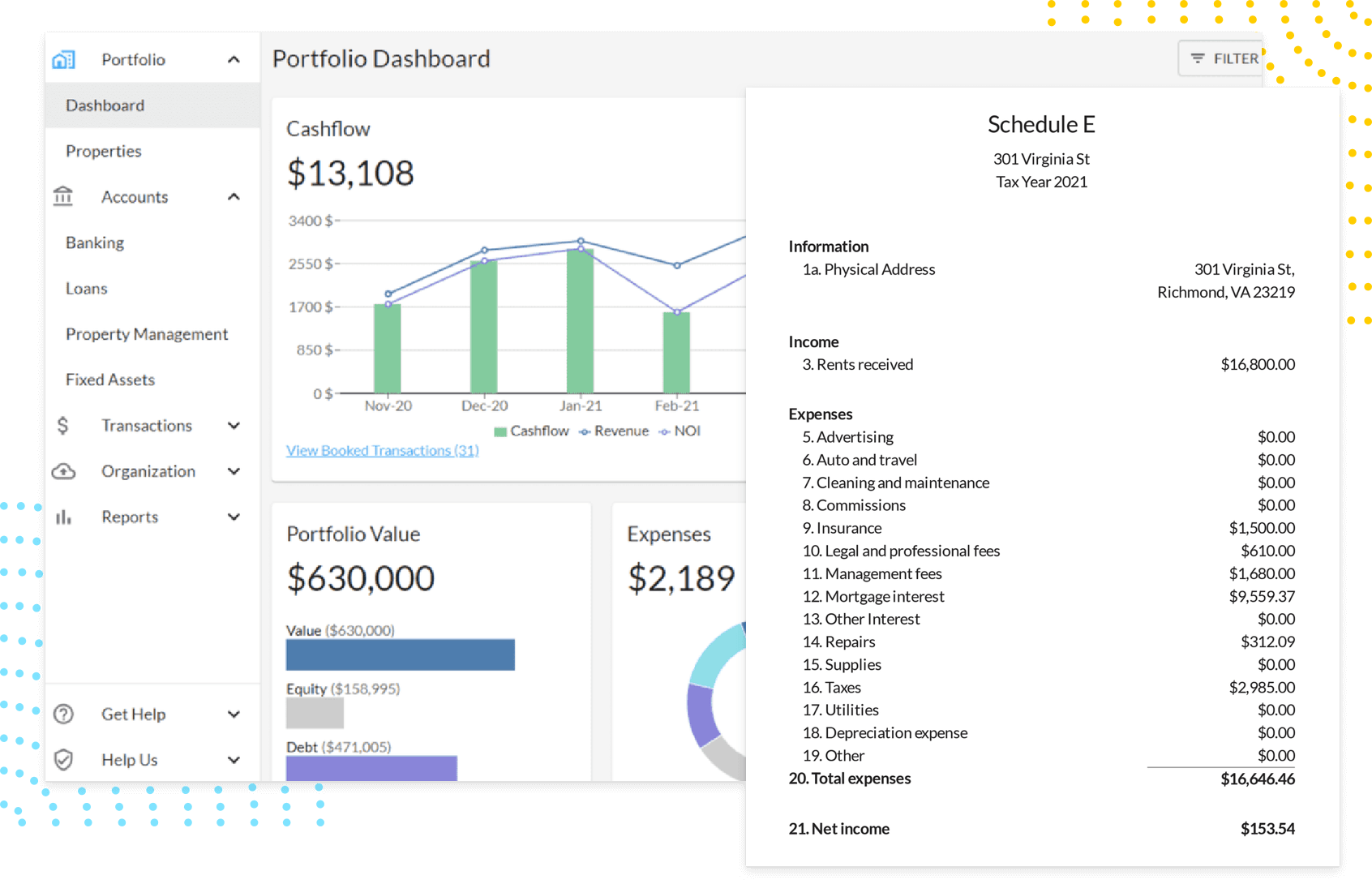
Managing rental income shouldn’t take hours or require complex spreadsheets. That’s why we designed TurboTenant Accounting specifically for landlords like you, making it easy to record rent payments, track deposits, and monitor cash flow across all your properties.
TurboTenant’s automated bank imports and ready-to-use templates help you stay organized and keep accurate books all year long. Get ready for tax time with our clear, real estate-specific reports and tax-ready records. With clear insights into your property’s finances, you’ll gain more time to focus on growing your rentals and head into tax season with confidence.
Start simplifying today, and sign up for your free TurboTenant account!
Disclaimer: This blog is for informational purposes only and is published by TurboTenant. It is not legal, financial, or tax advice. Laws and regulations for landlords vary by state and locality and may change over time. Always consult a qualified attorney, accountant, or local housing authority before making decisions related to your rental property. The publisher and authors assume no responsibility for actions taken based on the information provided.