


When your mortgage interest climbs, and operational costs increase, you’re probably wondering, “How much can a landlord raise rent?” Well, like many things, it’s all about location. Each state sets its own legal guidelines surrounding rent adjustments. Here’s everything you need to know about rent increase laws, notice periods, and how requirements vary across the U.S.
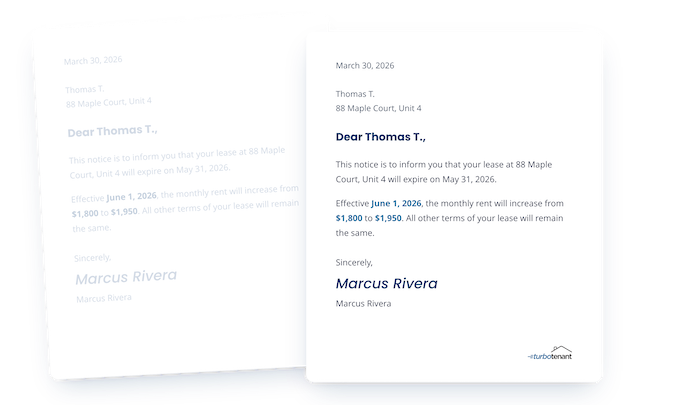
State Laws Regarding Rent Increases
Legal Landscape: Rent Control Limit vs. Fair Market States

States with Rent Control Limits
These states usually define a maximum percentage or tie it to the Consumer Price Index (CPI). Let’s look at a few examples:
California: CA law caps rent increases at 5% plus CPI or 10%, whichever is lower (Cal. Civ. Code § 1947.12).
Oregon: OR landlords can raise rent up to the lesser of 7% plus the annual change in the CPI or 10% (Or. Rev. Stat. § 90.323, 90.324).
Washington: In WA, you can increase rent up to 7% plus the CPI or 10%, whichever is less (Wash. Rev. Code § 59.18.700 et seq.).
Washington, D.C.: Landlords of rent-controlled units in D.C. can raise prices by up to CPI plus 2%, up to 10% (D.C. Code § 42-3502.08).
Fair Market States
On the other hand, market-rate states don’t cap rent increases. Because there’s no set limit, state law allows landlords to determine their own price adjustment. To stay competitive, most landlords reference their market rate to consider the property’s size, features, and local demand.
Landlord-friendly states with no legal limit include AZ, CT, MT, PA, and WV.
A Word on Local Enforcement
In addition to state guidelines, local governments often enforce rent control or stabilization laws at the city or county level, including:
- Los Angeles, CA (Los Angeles, Cal., Mun. Code § 151)
- Montgomery County, MD (Montgomery County, MD, Code § 29-57)
- Portland, ME (Portland, Maine, Code § 6-232)
Did You Know? A few states, such as Florida (Fla. Stat. § 83.425, § 125.0103) and Nebraska (Neb. Rev. Stat. § 13-331), have laws that outright ban rent control.
Notice Requirements: How Landlords Must Inform Tenants

Lease Lengths and Notice Requirements
Even if your state doesn’t set a specific legal cap, all landlords must comply with notice period laws.
Typically, notice periods depend on the length of the lease agreement. As a result, you generally have different timelines for fixed-term and month-to-month agreements. In most cases, states require 30 days’ notice. However, some areas require up to 90 days’ notice. Here are a few quick examples:
Month-to-Month
- Nebraska: 60 days (Neb. Rev. Stat. § 76-1490)
- Rhode Island: 30 days (R.I. Gen. Laws § 34-18-16)
- New Jersey: 30 days (N.J. Stat. § 2A:18-61)
Fixed-Term
- Oregon: 90 days (Or. Rev. Stat. § 90.323)
- Washington, D.C.: 60 days (D.C. Code § 42-3509.04)
- Maryland: 90 days for fixed-term leases longer than 1 month (Md. Code, Real Prop. § 8-209)
Keep in Mind: Even if you rent out a spare room in your apartment or home, follow the same guidelines for room rental agreements based on the lease’s length.
When is a rent increase illegal?

Know the Rules
Keep your price adjustment process compliant by avoiding all forms of illegal rent increases, including:
- Exceeding price caps: If your state sets a ceiling for rent increases, never go above it.
- Failing to provide notice: Always provide proper, legal notice according to your state’s laws.
- Retaliating against tenants: Each state sets its own landlord retaliation laws. Overall, most jurisdictions prohibit landlords from raising rent to punish tenants for reporting habitability violations, joining a tenant union, or requesting reasonable accommodation.
- Discriminating against tenants based on protected classes: Although the HUD is reviewing “disparate impact” standards, the Fair Housing Act prohibits landlords from offering unfair rental terms or discriminating based on federally-protected traits, including race, color, religion, and sex (Fair Housing Act).
Did you know? Receipts can be used by tenants as income or housing verification for loans, beneifts, or assistance programs.
Price Gouging During Emergencies

Disasters, Emergencies, and You
To protect tenants, natural disasters and housing emergencies often trigger automatic rent freezes.
For example, California caps rent increases at 10% during emergencies (Cal. Pen. Code § 396). Additionally, local governments in Texas can implement rent control in emergency situations (Tex. Prop. Code § 214.902).
Pro tip: California landlords must provide their tenants with a rent receipt upon request.
Algorithm-Based Price Fixing

Get a Comp in These States
In 2026, many property managers and landlords use third-party software to price their units. As part of the new legal frontier, certain state laws prohibit you from using pricing algorithms, such as:
Did you know? Rent receipts can support tax reporting and expense tracking for both landlords and tenants.
So, when can a landlord raise rent?

Time it Right
Now that we’ve discussed rent increase laws, let’s cover when rental owners can adjust their prices. Here’s when you can raise rent:
- When renewing a fixed-term lease: Wait until you’re discussing the renewal to propose your new rate. And don’t forget to follow your state’s notice period, if any.
- During month-to-month tenancies: When increasing rent for tenants at will, always give proper notice and wait for the beginning of a new rental period.
Remember, you can’t raise rent in the middle of an active fixed-term tenancy unless your agreement specifically allows it. Doing so breaches your lease.
Pro tip: The IRS recommends storing receipts for at least three years. With TurboTenant, they’re always in your dashboard.
How to Respond to a Rent Increase (For Tenants)

Don't Stress
Tenants, here’s what to do when you receive a rent increase letter from your landlord:
- Review your lease to check rate adjustment protocols.
- Read your state and local rent increase laws to verify the notice period, rent cap, and local protections.
- Negotiate by requesting a lower rate, longer lease, or other concessions.
- Decide to renew or move based on your specific situation.
Did you know? Collecting rent with TurboTenant is free for landlords — no matter how many units you have.
Best Practices for Landlords

The Bottom Line
Landlords, follow these pro tips to keep your rent increase process compliant, easy, and organized:
- Follow state laws governing notice periods, rent increase letter delivery methods, and price caps.
- Always provide proper notice.
- Keep increases reasonable by referring to your local market rate.
- Document everything and keep a detailed paper trail.
With this helpful guide, you won’t have to wonder, “How much can a landlord raise rent?” ever again.
Did you know? Landlords don’t pay a dime to collect rent with TurboTenant. Sign up for a free account.

Watch the video
How To Raise Rent Without Losing Your Best Tenants
Tired of Printing Rent Increase Letters?
Raise the rent, not your stress. Create a TurboTenant account and make rent simple.
Join the 1 million+ independent landlords who rely on TurboTenant to create welcoming rental experiences.
No tricks or trials to worry about. So what’s the harm? Try it today!

How Much Can a Landlord Raise Rent FAQs
Can a landlord raise rent by $300?
Check your local laws and consider your current rent amount.
For example, in CA, the initial rate would need to be between $3,000 and $6,000 to merit a $300 increase (Cal. Civ. Code § 1947.12). And because NY law deems anything over 5% plus inflation as extreme, the starting rent would need to be around $6,000 (N.Y. Real Prop. Law §§ 210–216).
In market-rate states like CT and PA, consider the property’s size, features, and local demand to determine if a $300 increase is reasonable.
Can I say no to a rent increase?
While rent increase laws vary by state, landlords can generally raise prices every year. Just be sure to provide proper notice and keep the adjustment within legal limits.
Do landlords need a reason to raise rent?
As long as the increase isn’t retaliatory, landlords don’t need a defense when raising rent. However, price adjustments must be fair and consistent across all tenants to avoid discrimination.
Can rent be doubled?
We don’t recommend it. Even if your state doesn’t enforce rent control, courts would probably consider doubling rent as an unreasonable increase.