






For landlords, finding a great tenant who pays rent on time and doesn’t cause problems can feel like catching lightning in a bottle. But as the end of their lease draws closer, what’s next? If you don’t want to deal with the tall task of replacing your upstanding tenant, you’ll probably want to offer them a lease renewal.
Lease renewals are exactly what they sound like: creating and signing a new lease agreement to keep a tenant in your rental property, rather than letting the lease expire and watching them move out. But as simple as lease renewals may seem, there are a host of factors to consider before moving forward.
If one of your tenants is approaching the end of their lease and you’re deciding whether to renew, this guide will help you weigh your options. Here, we’ll go over the basics of lease renewals, the pros and cons of re-signing a renter, the steps to renewing, and more.
Create a custom lease agreement
Set up customizable lease agreements right in your TurboTenant account! Purchase a single lease agreement on subscribe and receive unlimited lease agreements, plus electronic signatures and landlord forms.
What is a lease renewal, actually?
A lease renewal is a new rental contract that a landlord and tenant sign near the end of a lease term to carry forward the housing agreement. Lease renewals often include updated terms, like rent, lease duration, and property rules.
Depending on local laws regulating lease renewals, landlords and tenants typically begin the renewal process 2 to 3 months before the end of the lease term. Alternatively, leases with automatic renewal clauses will keep rolling over into a new lease period until either party gives proper notice to terminate the agreement.
Of course, these processes assume that the landlord chooses to offer a lease renewal in the first place. But unless a rental property exists in an area that legally mandates lease renewals, most landlords in the U.S. are not obligated to renew leases. With that in mind, you’ll need to review all your options (and your local landlord-tenant laws) before you decide what to do next.
Your Options at the End of a Lease
When a tenant’s lease nears its end, you’ll have a few different choices as to how you can proceed. Here’s what to know about each of the most common paths forward available to landlords:
Fixed-Term Renewals
First (and most commonly), you can renew the tenant’s lease for a fixed term, typically between 6 and 24 months. This approach offers landlords greater stability and a guaranteed income, but will limit how much they can raise the rent, since the terms remain in place for the duration of the lease. Fixed-term renewals also hinder both parties’ flexibility to pivot to Plan B if circumstances change.
Month-to-Month Renewals
Many landlords choose to transition a fixed-term lease to a month-to-month agreement, which offers greater flexibility for both parties. Instead of locking into another long-term contract, you can continue the tenancy with the flexibility to adjust terms every month as conditions change.
For instance, in a high-demand market, a month-to-month setup gives you more opportunities to raise rent in line with current pricing (as long as you follow local notice requirements). It also makes it easier to respond to unforeseen circumstances, whether that means you intend to sell the property, move back in, or make major upgrades.
Letting the Lease Expire
Last but not least, landlords can simply allow the lease agreement to expire without renewing it. We’ll cover specific reasons why below, but in some situations, it ultimately makes more sense to find a new tenant who better fits your current goals or pricing strategy. As always, review your local landlord-tenant laws before going this route to confirm you’re not required to offer a renewal or provide advance notice. In some states, just-cause eviction laws require landlords to renew leases unless there’s a qualifying reason not to, like taking the unit off the market or the landlord or an immediate family member moving in.
Lease Renewal Pros and Cons
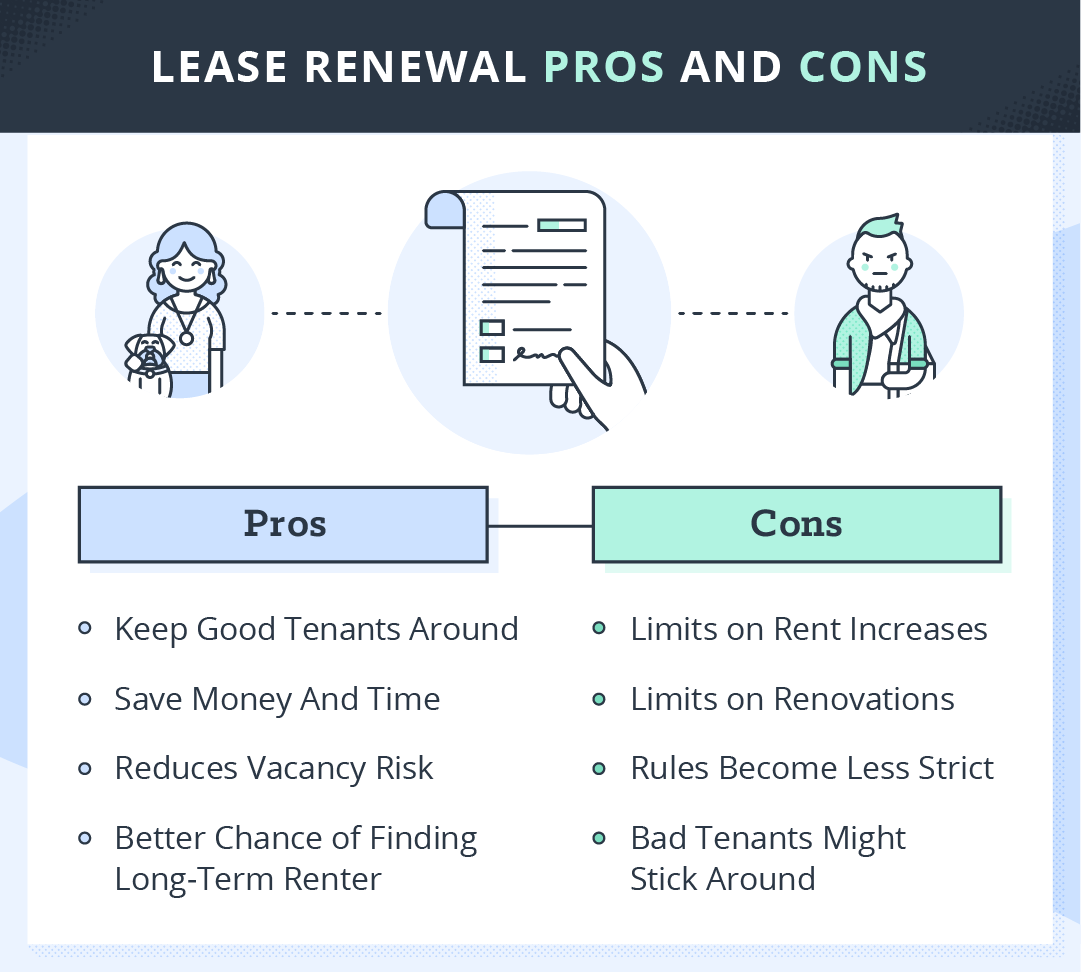
Renewing a lease has its ups and downs, so landlords need to carefully consider their unique circumstances before deciding whether to move forward. Here are a few key pros and cons to keep in mind when mulling over a renewal.
Pros
Maintains reliable cash flow: If you renew a tenant’s lease, you already know that they have a strong history of paying rent on time. A lease renewal will help you keep that cash flowing in for the foreseeable future, without interruptions caused by a vacancy or a new, less reliable renter.
Keeps good tenants in your rentals: A tenant who pays rent on time, takes care of the unit, and avoids issues with you and their neighbors can be tough to find. By offering a lease renewal, you can hold on to these high-quality tenants rather than roll the dice on someone unknown.
Saves money on tenant turnover: Cleaning, repainting, carpet replacement, and other turnover-related maintenance can cost landlords thousands of dollars out of pocket (not to mention lost rent during a vacancy). By keeping your current tenant, you can avoid these pesky turnover expenses.
Reduces administrative workload: Beyond its associated costs, tenant turnover is a major hassle for landlords. Rental advertising, showings, applications, and tenant screenings are just a few of the time-consuming tasks on the turnover to-do list. Thankfully, offering a lease renewal can help you postpone these duties and keep your momentum with a proven tenant.
Cons
Postpones renovations: If your rental needs repairs or maintenance (such as fixing the roof or repairing leaky pipes), a vacancy is often the best time to complete the work. But without the downtime that turnover provides, accessing the rental unit and scheduling repairs becomes increasingly difficult.
Limits rent increases: Renewing a lease can restrict how much you can raise rent. Tenants may push back on price hikes, and many states also regulate rent increases. Renting to a new tenant, however, allows you to set a new market-based rate without prior pricing expectations getting in the way.
Locks in problematic tenants: Carefully evaluate each tenant before offering a renewal. If they have a history of causing issues or paying rent late, renewing the lease can allow those problems to persist, leading to more complaints, missed payments, and ongoing property management challenges.
Delays tenant turnover: Your tenants may also have valid reasons for not renewing their leases (like getting married, moving for a new job, or buying a house). If they renew anyway but plan to break the lease and leave soon after, you may be left with a vacancy during a slower leasing season.
How to Renew a Lease as a Landlord
When it comes to lease renewals, landlords should never assume that the current lease agreement will simply “roll over” and continue without any changes. Here’s what you’ll need to do to ensure you and your tenant are aligned on both the current terms and the next lease period.
1. Review the Current Tenancy
Before you make a renewal offer, you’ll need to decide whether it’s in your best interests to renew the tenant’s lease. Review the tenant’s history in your rental unit and watch for major issues like lease violations, failure to pay rent on time, and complaints from neighbors or other tenants.
While renting to a new tenant may be risky, you should carefully evaluate your existing tenant’s behavior and whether you want them to stay long-term. If the answer is no, you can generally let the lease agreement expire without offering a renewal (depending on where you rent, of course).
2. Dial In Your Renewal Offer
If you choose to proceed with a lease renewal offer, you’ll need to come up with a set of new terms that work for both you and your tenant. Perhaps most importantly, you should look at comparable nearby properties and factor in any improvements or renovations you’ve made to support a fair rent increase.
While increasing rent to keep pace with inflation and local market values is a necessary part of being a landlord, your tenant may feel cheated if you try to raise their monthly rent significantly. Depending on your location, they may decide to look at other rentals on the market rather than renew their current lease.
Beyond how much rent you’ll charge for the next lease term, you’ll also have to decide whether to use a fixed-term agreement or go month-to-month, and revisit your policies on utilities, parking, pets, and more. Your renewal offer should be well-defined and address as many details as possible.
3. Send a Lease Renewal Notice
Between 2 and 3 months before the lease expires (again, depending on local laws), send your renter a lease renewal notice reminding them that their lease is nearing its end. This nudge will give your tenant time to decide whether to renew (and you time to find a new tenant).
The lease renewal notice should include the date the current lease expires and the terms of your renewal offer, like start and end dates, the new rent amount, and any updated policies.
4. Create a New Lease Agreement
If your tenant agrees to the terms of your renewal offer, you’ll need to create an entirely new lease agreement for the next term. Though some landlords use an addendum instead, a fresh lease makes the updated terms clearer for both parties and helps prevent misunderstandings surrounding the renewal.
Like any contract, the new lease should include all essential details, like the names of both parties, the rental property address, and local and state disclosures. Make sure the agreement also includes the policies you’ve decided to update, along with the new rent amount and start and end dates.
5. Negotiate (If Necessary)
There’s a chance your tenant wants to renew their lease but disagrees with the terms. You can often show a little flexibility by renegotiating the rent amount within reason, or adding perks like discounted parking. However, you should also know when to stand your ground on a renewal offer.
Remember, it may be in your best interests to let a lease agreement expire rather than make excessive concessions to accommodate your tenant’s requests or compromise your long-term rental strategy. Ultimately, the goal should be to reach a solution that works for both you and your renter.
6. Sign the New Lease Agreement and Store Documents
Once you and your tenant agree, proceed with signing your new lease as you would with any new tenant. As part of the renewal process, consider sending your tenant a breakdown highlighting any changes to rent, policies, or lease terms.
After both parties sign the new agreement, don’t forget to store copies of the lease securely for future reference. A proper paper trail can serve as valuable proof if any disputes arise surrounding the updated lease terms, so you’ll want to keep both old and new leases safe and readily accessible.
Legal Considerations During a Lease Renewal

Remember those ever-important landlord-tenant laws we mentioned earlier? Some states have regulations that restrict how and when landlords can offer a lease renewal (or whether landlords can let a lease expire at all). Always check your local laws on the following topics:
Notice Timing
Many states require landlords to notify tenants before the lease ends, regardless of whether they offer a renewal. The exact timeline can vary by location, though. For instance, some states only require landlords to give 1 month’s notice, while others require at least 3 months to give the tenant enough time to find new housing.
Additionally, the potential size of a rent increase often affects the timing requirements for notice. In California, for example, landlords must notify tenants 30 days before raising rent by less than 10% and 90 days before raising rent by more than 10% (Cal. Civ. Code § 827).
Fair Housing
Under the federal fair housing laws, landlords cannot discriminate against rental applicants or tenants based on religion, sex, color, race, familial status, national origin, or disability. This law also applies to lease renewals, prohibiting landlords from engaging in unfair and discriminatory renewal practices (42 U.S.C. §§ 3601–3619).
In other words, landlords cannot legally refuse to renew a tenant’s lease based on any of the aforementioned traits. Landlords can only decline to renew a lease for valid reasons, such as lease violations, nonpayment of rent, property damage, or other poor conduct during the tenancy.
Rent Control and “Just Cause”
When determining the new rent amount for your lease renewal offer, check for any local rent control laws. Jurisdictions like Oregon and Washington, D.C., restrict how much landlords can raise rent at the end of a lease term, often capping the increase at a specific percentage (sometimes tied to the Consumer Price Index) or amount.
Some states also require landlords to have “just cause” before refusing to renew a lease. For example, in California and New York, landlords can only let a lease expire for specific reasons, like a major remodel or plans to occupy the property as a primary residence.
Handle Lease Renewals the Right Way with TurboTenant
When a tenancy nears its conclusion, landlords should weigh their options carefully before offering a lease renewal. Re-upping a tenant’s lease allows landlords to retain high-quality renters while maintaining steady cash flow and avoiding the administrative work associated with tenant turnover.
Of course, a lease renewal won’t always be the right option. Landlords may choose not to renew a lease for several reasons, including the tenant’s past behavior or plans to significantly renovate the property. Tenants, meanwhile, may turn down a lease renewal offer because they’re simply ready to move on.
Overall, a lease renewal isn’t a decision that either party should rush into. But with the right property management software, landlords can easily renew leases, store documents, collect rent, and manage every step of the process.
Sign up for a free TurboTenant account today to simplify your next lease renewal.
Lease Renewal FAQs
How far in advance should a landlord offer a lease renewal?
Most landlords should send a lease renewal offer 2 to 3 months before the lease expires, though local laws may require specific notice periods. Providing early notice gives tenants time to decide and allows landlords to plan ahead if they need to find a new renter.
Is a landlord required to renew a tenant’s lease?
In most cases, landlords aren’t obligated to renew a tenant’s lease. However, some states and cities have “just cause” laws that limit when a landlord can decline a renewal. Always check local regulations to confirm whether you must offer a renewal or provide a valid reason for non-renewal.
What’s the difference between a lease renewal and a lease extension?
A lease renewal creates a new lease agreement with updated terms (like rent, lease length, or policies). A lease extension typically continues the existing lease under the same terms for a shorter period. Renewals offer more flexibility to make changes, while extensions are usually simpler and more temporary.
Can a landlord change lease terms during a renewal?
Yes, a lease renewal presents an opportunity to update terms, including rent, lease length, and property policies. However, any changes must comply with local laws, and tenants must agree before signing the new lease. Being upfront about changes helps reduce friction during negotiations and increases the landlord’s chances of a successful renewal.
Can a landlord raise rent during a lease renewal?
Yes, landlords can typically raise rent during a lease renewal, as long as they follow local laws and provide proper notice. Some areas have rent control or notice requirements that limit increases, so it’s important to confirm what you’re legally permitted to do before adjusting the rent for the next lease term.