


Whether you’re a landlord or a tenant in the Centennial State, it’s crucial to understand all aspects of Colorado landlord-tenant law. These regulations govern the rental relationship, allowing landlords and tenants to make informed decisions about Colorado lease agreements, security deposits, property management software, and other aspects of property rental.
So, keep reading for both parties’ legal obligations to help you better understand Colorado tenant rights and how they relate to Colorado’s laws on tenant screening, rent control, and more.
Marketing. Applications. Leases. Payments.
Key Findings: Landlord-Tenant Rights & Responsibilities
Both landlords and tenants have certain rights and responsibilities that form the foundation of the landlord-tenant relationship and the rental agreement itself.
The key points are:
Colorado landlords have the right to:
- Charge an application fee to cover the costs of processing applications, assuming the tenant doesn’t provide a portable tenant screening report
- Charge a security deposit to cover unpaid rent and damages
- Charge rent and late fees for delayed rent payments
- Enter the property if needed, as long as they provide proper notice or in cases of emergency
- Evict tenants who do not pay rent or who break the terms of the lease
Colorado landlords are responsible for:
- Making mandatory disclosures to tenants and applicants at the time of lease signing
- Maintaining dwelling unit in safe, habitable condition
- Maintaining provided appliances in good working condition
- Returning unused portions of the security deposit within 30 days of tenant move-out, though 60 days is acceptable if established in the lease
- Adhering to the terms of the lease
Colorado tenants have the right to:
- Safe, habitable housing regardless of gender identity, race, religion, or other factors.
- Request repairs from landlords
- Deduct the costs of repairs from rent if not completed by the landlord
- Receive notification of the landlord’s intent to terminate or not renew a lease
- Receive unused portions of the security deposit within 30 (or 60 if specified in the lease) days
Colorado tenants are responsible for:
- Paying rent in full and on time
- Maintaining dwelling unit in a clean, habitable condition
- Allowing the landlord reasonable access to the dwelling unit
- Not disturbing neighbors’ peaceful use of the premises
- Adhering to the terms of the lease
Best Practices for Screening Prospective Tenants

Colorado landlord-tenant laws allow landlords to charge a rental application fee only if they use the entire amount to cover application processing under Colo. Rev. Stat. § 38-12-903.
Although no laws limit the amount landlords may charge, landlords must provide a receipt and return any unused portions of the fee to the applicant. Tenants may also provide a portable tenant screening report in lieu of an application fee, as provided in Colo. Rev. Stat. § 38-12-904.
Colorado landlords can inquire about a tenant’s background check to determine whether to enter into a rental contract. However, landlords may consider only convictions from the past 5 years and must assess the nature of those convictions.
Also, a new Colorado landlord-tenant law, SB 23-184, heavily restricts landlords from using credit scores in the rental application process. Instead, they can use income to determine rental eligibility.
To thoroughly screen prospective tenants, try TurboTenant’s tenant screening software and rent with confidence to trustworthy tenants. Our software will give you the tools to stop worrying about legal compliance and help you avoid discrimination lawsuits.
Compliance with Fair Housing Laws in Colorado
Both federal and state fair housing laws apply in Colorado, allowing tenants to seek housing without fear of discrimination based on race, sex, religion, color, or other protected characteristics. In fact, Colorado’s fair housing laws are the oldest in the nation.
What actions are considered housing discrimination?
Housing discrimination includes refusing to rent to a protected class member, harassing or discouraging prospective tenants from applying to rent, or using harsher lease terms for certain tenants. Discrimination also covers biased advertising, such as an advertisement stating that applicants of a certain race or familial status should not apply.
If found guilty of housing discrimination, landlords face significant civil penalties and may also lose good tenants.
How can landlords avoid discrimination in rental practices?
To avoid discrimination in rental practices, landlords must apply all rental-related activities equally to applicants and tenants, including advertising, screening, selection, and lease terms. Additionally, Colorado tenant rights require landlords to allow and pay for reasonable modifications to a dwelling unit for tenants with disabilities.
In addition to avoiding fair housing violations themselves, landlords must thoroughly train all employees on fair housing practices, as property owners will be held liable for any discriminatory acts committed by staff.
What are the repercussions for fair housing violations?
Landlords who violate fair housing policies may face civil litigation and fines of up to $2,500 in addition to court costs and other economic damages. Landlords accused of fair housing violations should document all evidence to the contrary and consult a licensed attorney for further guidance.
Colorado Lease Agreements
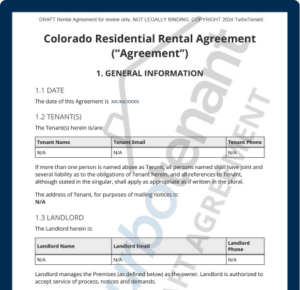 Colorado landlord-tenant law requires landlords to provide a written rental contract, also known as a lease, for any rental agreement lasting longer than 12 months. Regardless of the time period, we highly recommend written residential lease agreements to clarify the terms of the rental and ensure both landlords and tenants are aware of their rights and responsibilities.
Leases typically operate on a week-to-week, month-to-month, or fixed-term basis. Week-to-week and Colorado month-to-month leases renew automatically at the end of each week or month until either party terminates the agreement. Fixed-term contracts, meanwhile, expire on a specific date, at which point they may be renewed or terminated.
Keep in mind that landlords in Colorado must offer lease renewals to tenants unless the tenant commits a substantial lease violation. They may also not offer lease renewals for one of six no-fault eviction reasons outlined in HB 1098, including demolition of the unit or if the landlord or a family member is moving into the unit.
Which lease terms are legally required in Colorado?
Leases in Colorado must include the name and address of the landlord and/or the landlord’s authorized agent, if any. Additionally, under Colo. Rev. Stat. § 38-12-801, landlords must provide a source-of-income nondiscrimination statement with the lease.
What constitutes legal renting in Colorado?
Colorado state law does not require landlords to possess a rental license; however, certain cities, such as Denver, do. All rental units must comply with housing, zoning, and safety ordinances. Colorado tenant rights also prohibit landlords from establishing occupancy limits on residential rental properties based on whether occupants are related, per HB-1007.
Furthermore, rental agreements may not contain terms that waive a landlord’s responsibilities or require a tenant to pay a landlord’s legal fees. Read HB23-1095 for a complete list of prohibited terms.
What tenant documentation is required?
Tenants typically provide a valid ID and proof of income or savings to rent a dwelling unit. Landlords may also request references, a tenant’s Social Security number, and a signed consent form for a background check.
Both landlords and tenants should maintain records of all transactions related to the rental agreement for use as evidence in the event of future disputes over the lease.
What are the mandatory landlord disclosures in Colorado?
Landlords in Colorado must disclose the presence of bedbugs and radon within the past eight months. Federal law also requires landlords to disclose the presence of lead-based paint in any dwelling unit built before 1978.
For premises located within the City and County of Denver, Landlords must attach the Denver Tenant Rights and Resources Handbook. Effective January 1, 2025, lease agreements must contain language explaining how and where a tenant can report and deliver written notification of an unsafe or uninhabitable living condition. Responsible parties must display this notice in English and Spanish.
Failure to make these disclosures could result in civil legal penalties and financial consequences, such as fines and personal injury lawsuits.
Using our lease agreement generator is a great way to take the guesswork out of your Colorado lease agreements. With it, you can craft a lease agreement that meets all the legal marks in 10 minutes or less.
Security Deposits in Colorado

Landlords can and should charge a Colorado security deposit to cover any unexpected damages and unpaid rent. The landlord will hold the sum for these purposes only and must return any unused portions to the tenant upon termination of the residency.
What are the guidelines for collecting security deposits?
Starting in 2026, Colorado landlords may charge no more than 1 month’s rent as a security deposit. Landlords and tenants will benefit from using a walk-through checklist upon payment of the security deposit. This report documents the property’s condition at move-in, preventing tenants from being unfairly charged for damages.
Though Colorado law does not require landlords to notify tenants where their deposit is held, landlords may want to provide a receipt that includes the name and location of the financial institution used for the deposit. This receipt confirms the payment of the security deposit and its amount, preventing potential conflicts.
When can deductions be made from security deposits?
Landlords may deduct from security deposits to cover unpaid rent or property damage that exceeds normal wear and tear. Within 30 days of the tenant’s move-out, the landlord must provide an itemized statement detailing any deductions made from the deposit.
You can stipulate in the lease agreement that the security deposit may be held for up to 60 days.
How should security deposits be returned?
Landlords must return any unused portions of the security deposit to the tenant within a month after the tenant’s move-out date. In some Colorado cities, such as Boulder, security deposits accrue interest, and landlords are required to pay the tenant the interest upon move-out.
Landlords should communicate any security deposit deductions as they occur to prevent disputes at move-out.
Maintenance Responsibilities of Landlords
Under Colorado tenant rights, landlords must maintain the dwelling unit in a safe, habitable condition. This includes making necessary repairs to the dwelling unit and appliances to ensure all are in good working order.
What are the legal standards for property conditions?
Landlords must ensure that their rental units meet safety and health standards. Colorado operates under a modified warranty of habitability that outlines the specific requirements to keep a property livable.
This law requires all rental units to be structurally sound and free of health hazards, including mold, rodents, and insect infestations. Landlords in Colorado must also provide functional running water, heating, and electricity.
What is the proper protocol for repairs?
Under the recently passed SB24-094, landlords must address a repair request within 7 to 14 days, depending on the nature of the repair. If landlords do not make the requested repairs within the given time frame, tenants may conduct the repairs independently or with professional assistance and deduct the cost from future rent payments.
Do landlords need to give tenants advance notice before accessing a rental property?
Landlords should give tenants reasonable notice before entering a rental property for non-emergency reasons such as maintenance. Colorado law does not specify the exact time frame for this notice, but 24 hours or more is generally considered reasonable.
Since Colorado law does not require a specific time frame, landlords may not face state penalties for failing to give adequate notice. However, tenants may sue for invasion of privacy or terminate the lease early for harassment.
Late Rent Fee Regulations
After a 7-day grace period, landlords in Colorado may charge late fees for overdue rent payments. Additionally, the lease agreement must list any late rent fees. These fees may not exceed either $50 or 5% of the past-due amount.
Rent Control in Colorado
Rent control laws strictly cap the rent that landlords may charge, while rent stabilization laws allow specific incremental increases. Neither Colorado rent control laws nor rent stabilization exists.
As a result, landlords in Colorado may raise rent by any amount deemed fit. However, landlords may increase rent only after a lease term and may not raise it more than once in a 12-month period of continuous tenant occupancy.
Lease Renewal and Termination
Colorado landlord-tenant law requires landlords to automatically renew rental agreements at the end of each term unless there is a substantial reason not to do so. In this case, landlords must provide tenants with a 90-day notice of intent not to renew the lease.
If a landlord or tenant seeks to terminate a lease, they must provide notice depending on the lease’s term. Here’s a breakdown.
1-year or longer leases: 91 days’ notice
6-12 months leases: 28 days’ notice
Month-to-month leases: 21 days’ notice
Weekly leases: 3 days’ notice
Should a tenant move out before the end of a lease term, aka break the Colorado lease, the tenant must typically continue to pay rent until the end of the original term. However, breaking a lease may not carry financial penalties in certain situations, such as active-duty military service, if the tenant is a victim of domestic violence, or if the dwelling unit is unsafe for habitation.
Landlords may also terminate a lease agreement before its expiry date or decline to renew it for several reasons, such as demolition of the property or the landlord’s intention to move in. In this case, they must provide a 90-day notice per Colo. Rev. Stat. § 38-12-1303.
Eviction Procedures for Colorado Landlords

Eviction should only be used as a last resort to resolve a landlord-tenant dispute. That said, landlords must know the basics of the eviction process in Colorado, should it become necessary.
What justifications exist for eviction?
Colorado’s for-cause eviction laws require a landlord to decline to renew or terminate a lease for good cause, which may include repeated non-payment of rent, violation of lease terms, or engaging in illegal activity within the dwelling unit.
Landlords should thoroughly document all violations to present as evidence in an unlawful detainer (eviction) lawsuit.
What is the eviction process?
To evict a tenant, a landlord in Colorado must take the following steps:
- Deliver a 3-day notice to quit (substantial lease violations or illegal activity) or a 10-day notice to cure or quit (non-payment of rent and other lease violations)
- File an unlawful detainer lawsuit
- Court sets a hearing date
- Landlord serves notice of lawsuit to tenant
- Landlord and tenant appear in court to present evidence and receive judgment
- The court issues a writ of restitution to the landlord within 48 hours of judgment
- Landlord brings a writ of restitution to the sheriff, who will remove the tenant
Under no circumstances may a landlord attempt a self-help eviction; the sheriff must physically remove the tenant.
How is property reclaimed after eviction?
After tenant removal, the landlord may change the locks and take other measures to secure the property against the tenant’s return. If the tenant abandons property upon departure, the landlord must notify the tenant and allow 15 days for the tenant to return and claim their property under Colo. Rev. Stat. § 38-20-116. After this 15-day period, landlords may dispose of the property however they see fit.
Local Ordinances for Landlords and Tenants
Though this article provides an overview of Colorado’s landlord-tenant laws, regulations may also vary by city or county. The official website of Colorado’s legislature offers more insights. For ordinances specific to your area, visit Municode or American Legal Publishing.
Federal Landlord-Tenant Laws
Federal laws, such as the Fair Housing Act and the Americans with Disabilities Act, also apply to rental situations across the state of Colorado.
If questions arise surrounding federal housing regulations, check with these resources for more information:
- The Consumer Financial Protection Bureau
- The Environmental Protection Agency and/or
- The Department of Housing and Urban Development
Managing Tenant Legal Disputes as a Colorado Landlord
Landlords and tenants can efficiently resolve disputes with a bit of communication. In some instances, however, either party may require legal assistance. Colorado landlords can reach out to licensed attorneys or other legal experts using the resources below:
- Legal Aid Foundation of Colorado: Provides free civil legal services to low-income Coloradans
- Colorado Housing Connects: Runs a hotline for Colorado tenant rights and landlord assistance
- Colorado Law Help: Locations across Colorado providing civil legal aid
- EZ Evict USA: Handles the eviction process for landlords and property owners
Navigate Your Landlord-Tenant Relationship with TurboTenant
Now that you know the basics of Colorado landlord-tenant law, sign up for a free TurboTenant account for even more assistance. We help landlords everywhere better manage relationships with their tenants thanks to features such as:
- Helpful rental applications to streamline the process of securing new tenants
- Thorough tenant screenings that provide crucial information about applicants
- Lease agreement templates that you can easily customize to fit your property
- Rent collection software that allows landlords to track rent payments
In short, TurboTenant’s free property management software can help you navigate Colorado tenant rights and much more.
Disclaimer: TurboTenant does not provide legal advice. This information is for educational purposes only. Always consult with a legal professional for personalized advice.
Colorado Landlord-Tenant Law FAQs
What are landlords required to provide by law?
Landlords in Colorado must provide safe, habitable housing in accordance with all housing, building, and safety ordinances and abide by all lease agreement terms.
Though Colorado state law only requires landlords to provide functioning amenities such as heating, electricity, and plumbing, tenants may expect additional amenities based on local market customs.
What is the proper notice period for lease termination?
Typically, landlords must provide a 3- to 10-day notice of intent to terminate a lease. In the case of a no-fault eviction, landlords must provide a 90-day notice.
These notice periods may vary depending on the type and length of the tenancy — for example, a month-to-month tenancy of less than 12 months may be terminated with 21 days’ notice.
What maintenance rights do tenants have?
Colorado tenant rights enable tenants to request necessary repairs from their landlords. If a landlord does not complete the request within seven days for emergency repairs or 14 days for non-emergency repairs, tenants may complete the repair and deduct the cost from future rent payments.
How should utilities be handled in rental agreements?
While most utility payments are typically the tenant’s responsibility, this must be clearly outlined in the lease agreement. If utility disputes arise, landlords may have to take tenants to court or settle directly with the utility company.
What are the eviction rules for tenants without a lease?
Certain Colorado tenant rights still apply even when a tenant has no lease. However, landlords must give 21 days’ notice to evict a tenant without a lease, after which typical eviction laws apply.
How are guests and tenants legally differentiated?
Guests may visit a dwelling unit but are not obligated to adhere to the lease terms or pay rent. Tenants live full-time in a dwelling unit and receive tenant rights in exchange for paying rent and adhering to the lease terms.
In Colorado, guests are considered tenants after spending more than 14 days at a property within six months. After a guest becomes a tenant, landlords may hold them to the terms of the lease and legally evict these new tenants if needed.