


A Texas lease agreement outlines the rights and responsibilities of landlords and tenants in a rental housing relationship. To avoid disputes and ensure compliance, the agreement should follow all Texas landlord-tenant laws, which govern disclosures, late fees, landlord obligations, lease terminations, and more.
Both parties should carefully review all terms and conditions before signing the lease, as it becomes legally binding upon execution. To help streamline the process, consider using TurboTenant’s Texas residential lease agreement builder.

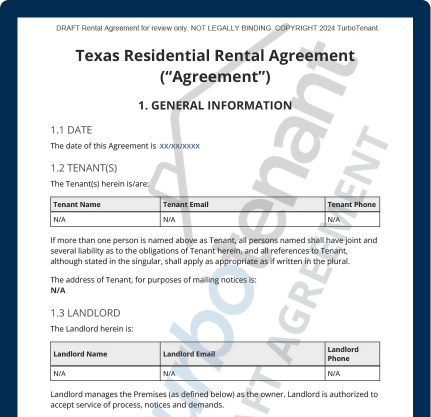
Texas Residential Lease Agreement
Current PageCreate a compliant Texas lease agreement with TurboTenant's rental contract builder in 15 minutes.
Texas Month-to-Month Lease Agreement
Learn MoreBuild your Texas month-to-month lease agreement in just 15 minutes.
Required Landlord Disclosures (9)
- Lead-based paint and hazards: Texas landlords must provide the federally required disclosures regarding lead-based paint and hazards, which apply to all houses constructed before 1978. Landlords who own homes built before 1978 must include a lead-based paint and hazard disclosure form and an EPA Pamphlet (42 U.S.C. § 4852d).
- Copy of lease: Within 3 business days of signing a new lease, landlords must provide a copy to one individual on the lease and additional copies to any other listed tenants who request a copy (Tex. Prop. Code § 92.024).
- Owner and management details: Landlords must provide the property owner’s name and address and, if applicable, the information of any off-site property management companies (Tex. Prop. Code § 92.201).
- Emergency phone number: Landlords with on-site management teams or a superintendent’s office must provide tenants with a 24-hour emergency phone number for reporting conditions that materially affect tenants’ physical health or safety. Additionally, landlords without on-site management or a superintendent’s office must provide an emergency phone number (Tex. Prop. Code § 92.020)
- Early termination clauses: Texas landlords must include language notifying tenants that they may have the right to terminate the lease early in certain circumstances, including military deployment, family violence, stalking, certain sexual offenses, or military service (Tex. Prop. Code § 92.016).
- Parking agreements: In the case of a multi-unit tenancy, landlords must provide potential tenants with a copy of any parking and vehicle towing rules and policies before signing a lease (Tex. Prop. Code § 92.0131).
- Tenant remedies: Texas leases must include language in underlined or bold print explaining tenant remedies when a landlord fails to repair conditions affecting health or safety, including the tenant’s potential right to repair and deduct under certain circumstances (Tex. Prop. Code § 92.056.g).
- Floodplain risk and history: Texas landlords must disclose whether the properties they rent lie within a 100-year floodplain. If known flooding has occurred within the past, landlords must disclose that information (Tex. Prop. Code § 92.0135).
- Late fee disclosure: Landlords must include a disclosure stating the amount of late fees charged to enforce the late fee terms (Tex. Prop. Code § 92.0135).
Security Deposit Regulations
Maximum security deposit amount: Texas state law does not set a maximum amount landlords can charge for security deposits.
Receipt of deposit: Texas landlords are not required to provide tenants with a receipt for a security deposit.
Deduction tracking: Landlords must provide tenants with a written description and itemized list of all deductions when returning a security deposit. This requirement does not apply if the tenant owes unpaid rent at the time the lease terminates and there is no dispute as to the amount owed (Tex. Prop. Code § 92.104).
Returning a tenant’s security deposit: Texas landlords must return the deposit within 30 days after the tenant surrenders the premises (Tex. Prop. Code § 92.103). That said, landlords are not required to send the deposit or itemized deduction list until the tenant provides a written forwarding address (Tex. Prop. Code § 92.107).
Landlord’s Access to Property
Advance notice: Texas law does not require landlords to provide advance notice before entering a rental property. However, 24 hours’ notice is common practice in the rental industry, and landlords may want to include clear entry and notice policies in the lease agreement.
Immediate access: In practice, landlords typically reserve the right to enter the rental unit immediately for emergencies, repairs, or other lawful purposes outlined in the lease.
Landlord harassment: Texas law does not prohibit landlord entry without notice unless the lease agreement imposes notice requirements. However, repeated or unreasonable entries could potentially support claims involving retaliation, harassment, or violations of tenant privacy rights in certain circumstances (Tex. Prop. Code § 92.331).
Rent Payment Laws
Grace period: Texas tenants may pay rent up to 2 full days late before landlords can charge a late fee (Tex. Prop. Code § 92.019.a).
Late rent fees: Texas landlords may charge a late fee after 2 days, provided the fee is reasonable and included in the lease agreement. State law generally defines reasonable fees as no more than 12% of the monthly rent for properties with 4 or fewer dwelling units, or 10% for properties with more than 4 dwelling units (Tex. Prop. Code § 92.019).
Tenant’s right to withhold rent: Texas landlords must make a diligent effort to repair conditions that materially affect a tenant’s health or safety. If the landlord fails to make repairs after receiving proper notice, tenants may pursue remedies, including repair and deduct, under limited circumstances (Tex. Prop. Code § 92.0561).
Breach of Rental Agreement
Missed rent payment: After the 2-day rent grace period, Texas landlords can charge late fees equal to 10-12% of monthly rent, depending on the number of dwelling units on the property (Tex. Prop. Code § 92.019). Alternatively, landlords may choose to issue a 3-Day Notice to Vacate (eviction notice) (§ 24.005).
Lease violation: In Texas, landlords can issue a 3-Day Notice to Vacate (eviction notice) for any lease violations, with the option to cure the violation if the lease allows the tenant to do so (Tex. Prop. Code § 24.005). If the tenant fails to vacate within 3 days, the landlord may file an eviction lawsuit with the court precinct where the property is located (§ 24.004).
Self-help evictions: Texas allows landlords to change the locks on tenants who are late on rent. However, there are strict requirements on when they can do so, and tenants must always have access to the new keys. This type of self-help eviction is temporary, highly regulated, and not a legal substitute for the full legal eviction process (Tex. Prop. Code § 92.0081).
Lease abandonment: As of 2026, if a tenant abandons the lease, Texas landlords must mitigate damages by making reasonable efforts to re-rent the property. Until a landlord finds a new tenant, the original tenant may remain liable for unpaid rent and other damages allowed under the lease agreement (Tex. Prop. Code § 91.006).
Ending a Lease
Month-to-month: Both Texas landlords and tenants may voluntarily terminate a month-to-month tenancy by providing the other party with at least 1 month’s notice (Tex. Prop. Code § 91.001.a-b).
Fixed-term: Texas tenants may be able to legally break their fixed-term lease early for several reasons. Applicable scenarios include military service (Tex. Prop. Code § 92.017), family violence (§ 92.016), security device violations (§ 92.165), maintenance violations that cause risk to the tenant’s health or safety (§ 92.056.e1), unlawful lockouts (§ 92.0081.h1), disclosure violations (§ 92.205.a5), or smoke alarm violations (§ 92.260.6).
Property abandonment: After obtaining a writ of possession, Texas landlords may remove a tenant’s remaining personal property and place it outside nearby unless weather conditions make doing so unsafe. Some municipalities may provide containers for storing property during inclement weather (Tex. Prop. Code § 24.0061.d).
Renewing a Lease
Required renewals: Texas landlords do not have to renew residential leases, though they may need to provide advance notice of termination depending on the lease type and lease terms.
Required notice: Texas landlords must provide at least 1 month’s notice before terminating a month-to-month tenancy. For leases with shorter rental periods, the required notice period is typically equal to the rental payment period (Tex. Prop. Code § 91.001).
Texas Residential Lease Agreement FAQs
Does a landlord have to provide a copy of the Texas rental contract?
Yes. Texas landlords must provide tenants with a copy of the signed residential lease agreement within 3 business days of signing. Keeping a signed copy helps both parties reference important lease terms during the tenancy (Tex. Prop. Code § 92.024).
Can a landlord refuse to renew a lease in Texas?
Yes. Texas landlords can refuse to renew a lease once it expires. However, depending on the lease terms, landlords may need to provide advance notice before ending the tenancy.
Does a Texas lease agreement need to be notarized?
No. Texas law does not require standard residential lease agreements to be notarized to be legally valid. Once signed by both parties, the lease is enforceable.
Can you withhold rent for repairs in Texas?
Yes. Texas tenants may be able to exercise repair remedies if a landlord fails to fix conditions that materially affect health or safety after receiving proper notice. In some cases, tenants may deduct certain repair costs from future rent payments, subject to statutory limits (Tex. Prop. Code § 92.0561).
What is the grace period for rent in Texas?
Texas landlords generally must wait at least 2 full days after the rent due date before charging a late fee. Rental lease agreements may provide a longer grace period, but not a shorter one (Tex. Prop. Code § 92.019(a)(3)).
Disclaimer: TurboTenant does not provide legal advice. This material has been prepared for informational purposes only. All users are advised to check all applicable local, state, and federal laws and consult legal counsel should questions arise.