


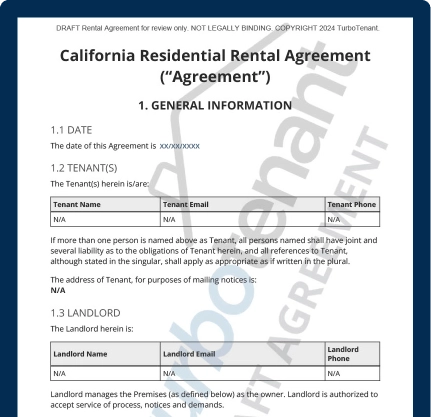

A California month-to-month lease agreement might be the ticket you’re looking for when seeking enhanced flexibility. But don’t leave it to chance. Verbal agreements are hard to enforce and often leave you, as a landlord, vulnerable. So, whether you’re in San Francisco, San Diego, or San Francisco, a written agreement helps protect you and your investment.
Navigate California Leases

California Month-to-Month Rental Agreement
Current PageBuild your California month-to-month lease agreement in 15 minutes.
California Residential Lease Agreement
Learn MoreCreate a compliant California residential lease agreement with TurboTenant's rental contract builder in 15 minutes.
California Room Rental Agreement
Learn MoreRent your spare room with a California room rental agreement today.
Required Landlord Disclosures (21)
- Lead paint: Federal law requires all landlords to disclose the presence or knowledge of any lead-based paint or lead-based paint hazards in all units built prior to 1978.
- Landlord contact info: The tenant must be provided with the person authorized to manage the property’s name, address, and phone number (Cal. Civ. Code § 1962(4)).
- Change terms notice: Landlords must provide a statement regarding rent increase limitations (Tenant Protection Act).
- Bedbugs: California landlords must inform tenants about bed bugs, including their behavior and biology. The disclosure should urge tenants to report any suspected infestations immediately (Cal. Civ. Code § 1954.603).
- Pest control: Landlords who provide pest control services must give tenants a notice from the company describing the pest they’re controlling, the chemicals used, their active ingredients, the frequency of their application, and any potential adverse effects. (Cal. Civ. Code § 1940.8).
- Demolition: Landlords must tell tenants if they intend to demolish the unit (Cal. Civ. Code § 1940.6).
- Flooding: California landlords must disclose whether the property is in a flood zone (Cal. Gov’t. Code § 8589.45).
- Mold: If a landlord knows of or suspects mold growth on the property, they must provide the tenant with informational guidelines provided by the state as soon as is reasonably practical (Cal. HSC § 26147).
- Methamphetamine/fentanyl contamination: If the property has been used to store, manufacture, or use methamphetamine or fentanyl, the landlord must provide the tenant with written notice of the remediation and a copy of the report. (Cal. HSC § 25400.28).
- Shared utilities: If utilities, such as electric or gas, are shared, the landlord must explain how they’ll split the costs between units (Cal. Civ. Code § 1940.9).
- Smoking policy: California landlords must disclose the smoking policy for all leases and whether they allow or prohibit smoking (Cal. Civ. Code § 1947.5).
- Just cause and rent limit: Landlords must make tenants aware that most properties require a landlord to provide at least 60 days’ written notice before terminating a long-term lease, must have just cause to evict a tenant, and that rent increases are capped at 5% of the local inflation rate or 10%, whichever is lower (Cal. Civ. Code § 1946.2).
- Ordinance locations: If there are any locations of former federal or state military ordinance usage within one mile of the property, landlords must make tenants aware (Cal. Civ. Code § 1940.7).
- Deaths on the property: Landlords must tell tenants about any deaths that have occurred on the property within the last three years, except for deaths related to AIDS or HIV (Cal. Civ. Code § 1710.2).
- Sex offender registry: Also known as “Megan’s Law,” landlords must provide a pre-written clause about the national sex offender registry that the Department of Justice provides (Cal. Civ. Code § 2079.10a).
- Asbestos: California landlords must disclose whether they know of potential asbestos contamination in any unit built before 1979 (Cal. HSC § 25915(a)).
- Carbon monoxide detectors: The landlord must install carbon monoxide detectors throughout the dwelling if the unit uses fossil fuel heaters or appliances (§ 17926.1).
- Water beds: If a landlord believes a tenant may use a water bed in the unit, they must provide a water bed statement (§ 1940.5).
- Carcinogenic materials: Landlords must inform their tenants if the unit contains carcinogens listed in Proposition 65 (§ 25607.34 (3)).
- Water utilities: If landlords bill rent and water separately, they must inform tenants when they’ll be billed. The least must also include a water bill estimate (§ 1954.204).
Los Angeles-specific requirements: Tenants must receive an LA Renters Protections Notice with their lease agreement.
Required Notice to Terminate Month-to-Month Agreement
Since a month-to-month rental agreement has no fixed end date, each state has different rules for terminating these leases.
Required notice for landlords: Landlords must provide at least 30 days’ written notice to terminate a month-to-month lease if the tenancy has lasted less than one year. They must provide 60 days’ written notice for tenancies lasting more than one year. In both cases, landlords must have just cause to terminate the agreement (CA. Civ. Code Sect. 1946.1)
Required notice for tenant: Tenants can terminate a month-to-month lease by providing at least 30 days’ written notice, regardless of how long they’ve lived there (Cal. Civ. Code § 1946).
Rent Increase Laws
Month-to-month rental agreements provide landlords with greater flexibility regarding rent increases. However, landlord-tenant laws govern both the amount of rent increase and the notice required. Additionally, many areas have implemented rent control laws, which limit how much landlords can increase rent.
California has passed several rent control measures statewide, and some local municipalities have their own guidelines. In general, landlords cannot raise the rent more than twice a year and cannot increase it by more than 10% (or 5% on top of the inflation rate). Depending on the amount, landlords must give tenants 30-60 days’ notice of the increase.
Create Your California Month-to-Month Lease Agreement
Ready to let TurboTenant do all the heavy lifting while you enter basic property details, rent amounts, and security deposit information? And in as soon as 15 minutes, you’ll have a legally compliant document to send for e-signature.