


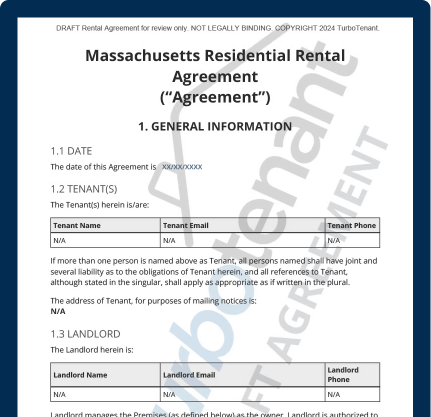

A Massachusetts month-to-month lease agreement is a flexible alternative to a fixed-term lease—perfect for landlords and tenants who want more wiggle room. It renews automatically each month and can be ended at any time with proper notice. Even without a set end date, landlords still need to provide all state-required disclosures to keep things legal and fair.
Navigate Massachusetts Leases

Massachusetts Month-to-Month Lease Agreement
Current PageBuild your Massachusetts month-to-month lease agreement in 15 minutes.
Massachusetts Residential Lease Agreement
Learn MoreCreate a compliant Massachusetts lease agreement in 15 minutes with TurboTenant's rental contract builder.
Room Rental Agreement Massachusetts
Learn MoreUse a TurboTenant Massachusetts room rental agreement to legitimize your house hacking endeavors.
Required Landlord Disclosures (6)
Disclosures are legally required components of lease agreements, mandated by state or federal law, to ensure landlords provide tenants with essential information regarding the property or rental terms.
In Massachusetts, landlords must provide the following disclosures:
- Lead-based paint: Landlords must disclose the presence of lead-based paint or any lead-based paint hazards for units built before 1978. This lead-based paint disclosure is the only federally mandated notice.
- Move-in checklist: Massachusetts landlords must provide tenants with an inventory of the unit’s condition within 10 days of moving in. This checklist should detail any existing damage and the current condition of the property or furnishings, using language specified by the state (MGL 186 § 15B(2c)).
- Fire insurance: Landlords must disclose information about the unit’s fire insurance policy within 15 days of the tenant’s written request. The notice should include the insurance company’s name, coverage amount, and the designated payee for any claims (MGL 186 § 21).
- Shared utilities: In multi-unit buildings where tenants pay for water, the lease must include specific language about compliance and how water is billed, along with certifications from the landlord (MGL 186 § 22f).
- Security deposit: If a landlord collects a security deposit, they must provide a receipt within 30 days. This receipt must include the deposit amount, the name of the person receiving it, the collection date, a description of the unit, and details of the institution holding the funds, including the account number (MGL 186 § 15B(2b)).
- Landlord name and address: The lease agreement must list the landlord’s name and address or the person responsible for managing the property (105 CMR, § 410.400).
Required Notice to Terminate Month-to-Month Agreement
Required notice for landlords: Before terminating a month-to-month lease agreement, landlords must give at least 30 days’ written notice, including the end date.
Required notice for tenants: Similarly, tenants must provide 30 days’ written notice to terminate a month-to-month lease agreement. The notice must indicate the intended move-out date.
Rent Increase Laws
Massachusetts does not regulate rent increases, meaning landlords can raise rental prices without limitation as long as they follow specific protocols. Rent hikes have been legal in Massachusetts since rent control was abolished statewide in 1994, except for Cambridge, which was grandfathered in.
While no limits exist on how much or how often landlords can increase rent, they must meet specific requirements. For example, landlords must give at least 30 days’ written notice before raising rent, and rent increases cannot take effect until the current lease term ends.
For month-to-month tenants, rent increases must take effect on the first day of a new rental cycle. Additionally, landlords cannot raise rent within 6 months of a tenant exercising certain rights. However, if a landlord does not provide proper notice, they cannot enforce a rent increase at the end of the lease term, although they may choose not to renew the lease and find a new tenant at a higher rate.
In March 2023, Boston’s City Council voted to limit annual rent increases to 10%, but neither the state legislature nor the governor approved the law.
Create Your Massachusetts Month-to-Month Lease Agreement
Provide your lease information and let our TurboTenant platform build the perfect agreement. Legally sound, beautifully formatted, and ready in minutes.