


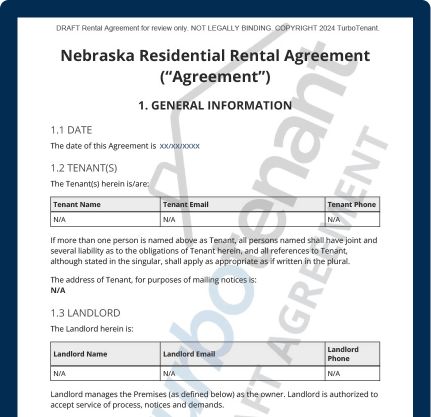

Finding the right living situation in Nebraska looks different for everyone. Maybe you’re renting a spare room in a Lincoln bungalow to save on costs or subleasing a basement near the University of Nebraska while finishing school. Shared housing can be a smart financial and social move, but it also comes with shared responsibilities. And that’s where a Nebraska room rental agreement helps.
Whether you’re a property owner, tenant, or roommate, a written lease agreement protects everyone by setting clear expectations from day one. The following guide explains what to include, how state law handles deposits and notices, and what to do if problems arise, so your living arrangement stays smooth beyond move-in day.
Navigate Nebraska Leases

Room Rental Agreement Nebraska
Current PageRent your spare room with a Nebraska room rental agreement today.
Nebraska Residential Lease Agreement
Learn MoreCreate a compliant Nebraska lease agreement in 15 minutes with TurboTenant's rental contract builder.
Nebraska Month-to-Month Lease Agreement
Learn MoreBuild your Nebraska month-to-month lease agreement in 15 minutes or less.
Types of Room Rental Contracts
Not all shared living situations look the same. Some renters in Nebraska might sign a lease directly with the property owner. In contrast, others create a contract among roommates to outline how they’ll share space and responsibilities within a home.
Room rental agreement: When a tenant rents a single room in a home, a room rental agreement spells out the rules of the space. In Nebraska, it’s smart to include:
- The rent amount, due date, and accepted payment method(s).
- How utilities are split or billed.
- Maintenance and shared-space responsibilities.
- Household rules, quiet hours, and guest policies.
Keep in mind that Nebraska law limits the security deposit to 1 month’s rent (Neb. Rev. Stat. § 76-1416(1)). Additionally, landlords must return the deposit within 14 days after move-out, including an itemized list of any deductions (Neb. Rev. Stat. § 76-1416(2)).
Roommate agreement: On the other hand, a roommate agreement in Nebraska is typically made between co-tenants rather than with the property owner. In this instance, the agreement outlines the division of rent and utilities, the sharing of household chores, and expectations regarding noise, guests, and cleaning shared spaces.
While not legally binding like a lease, a written roommate contract can help maintain peace, especially in student housing or multi-tenant homes.
Breaching Contract
Even with the best lease in place, things don’t always go as planned. When rent goes unpaid or a tenant breaks the rules, Nebraska law outlines clear steps for property owners to follow and the rights tenants have in return.
Failure to pay: If a tenant misses rent, the landlord must issue a 7-day Notice to Quit before filing for eviction (Neb. Rev. Stat. § 76-1431(2)). The notice gives the tenant one final chance to pay the full amount due within 7 days. If the renter pays on time, the tenancy will continue; if not, the landlord may begin court proceedings to recover possession.
Lease violations: For lease violations other than nonpayment (e.g., unauthorized pets or property damage), landlords must provide written notice specifying the breach and allow 14 days to fix the problem. If the tenant doesn’t comply, the lease terminates after 30 days from the date of the notice (Neb. Rev. Stat. § 76-1431(1)).
If a tenant repeats the same violation within 6 months, the landlord can end the lease with a 14-day Notice to Quit and isn’t required to offer another chance to remedy the issue (Neb. Rev. Stat. § 76-1431(1)).
Lease abandonment: When a tenant leaves without notice or stops paying rent, the landlord may reclaim possession and attempt to re-rent the property. Nebraska law requires landlords to make reasonable efforts to mitigate losses. In other words, they can’t simply leave the unit vacant and charge the former tenant for the full term (Neb. Rev. Stat. § 76-1432).
Self-help evictions: Changing locks, shutting off utilities, or removing a tenant’s belongings without a court order are illegal in Nebraska. These “self-help” evictions violate tenants’ rights and can expose landlords to damages. To remove a tenant, landlords must obtain a court-issued Writ of Restitution after the eviction process is complete (Neb. Rev. Stat. § 76-1430).
Landlord Room Access Laws
At times, landlords will need to enter a rental unit for maintenance, inspections, or emergencies. Nebraska law balances that right of entry with the tenant’s right to privacy and quiet enjoyment of their home.
Immediate access: A landlord may enter a rental unit without prior notice only in the event of an emergency. For example, when responding to a fire, a serious water leak, or other situation that threatens life or property (Neb. Rev. Stat. § 76-1423(2)).
Landlord harassment: Nebraska tenants have the right to peaceful use and enjoyment of their home. Landlords may not use entry as a form of harassment, such as repeatedly showing up, entering without cause, or arriving at unreasonable hours. Doing so can constitute a violation of the tenant’s rights under the Nebraska Uniform Residential Landlord and Tenant Act (Neb. Rev. Stat. § 76-1423(3)).
Advance notice: For non-emergency situations (e.g., repairs, inspections, or showing the unit to prospective renters), landlords must provide reasonable notice (generally 24 hours) and enter only at reasonable times. The notice should clearly state the purpose and timing of the visit. Landlords and tenants can also agree in writing to alternative arrangements (Neb. Rev. Stat. § 76-1423(3)(a)).
Create Your Nebraska Room Rental Agreement
TurboTenant enables you to quickly and easily create a Nebraska room rental agreement that meets state requirements and suits your unique property setup. The customizable, state-specific form allows you to outline rent terms, deposits, utilities, and household rules in one convenient location.