


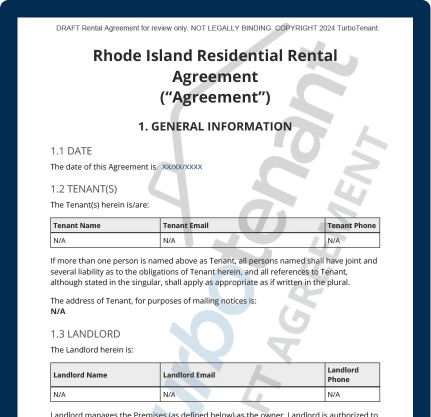

In Rhode Island, people rent for all kinds of reasons. Students in Providence sharing a triple-decker, families looking for a place near the shore, or an individual taking the top floor of a historic home. Regardless of the setup, a Rhode Island room rental lease agreement provides structure to the living arrangement and ensures everyone understands their responsibilities.
Our guide highlights the must-knows for Rhode Island room rentals, from disclosures to rent rules, so you can put together a document that works in practice, not just on paper.
Navigate Rhode Island Leases

Room Rental Agreement Rhode Island
Current PageRent your spare room with a Rhode Island room rental agreement today.
Rhode Island Residential Lease Agreement
Learn MoreCreate a compliant Rhode Island lease agreement in 15 minutes with TurboTenant's rental contract builder.
Rhode Island Month-to-Month Lease Agreement
Learn MoreCreate a Rhode Island month-to-month lease agreement in 15 minutes or less.
Types of Room Rental Contracts
Not all shared living situations in Rhode Island are the same. Some renters sign a lease directly with the landlord, while others negotiate an arrangement with their roommates to outline shared responsibilities within a home.
Room rental agreement: These agreements are formal leases between a landlord and a tenant who rents a room in a home. The room rental agreement should spell out key terms like:
- Rent amount and due date
- Utility responsibilities
- Security deposit conditions
- Maintenance duties
- Household rules
State law limits the security deposit to 1 month’s rent. Landlords must place deposits in a separate account, not commingled with their personal funds, and provide tenants with the balance plus an itemized deduction list within 20 days of move-out (R.I. Gen. Laws § 34-18-19).
Roommate agreement: Tenants typically arrange roommate agreements among themselves, rather than with the landlord. It’s a practical tool for outlining how the household will function, including:
- How roommates divide rent and utilities
- Chore and cleaning schedules
- Guest policies and quiet hours
- Other shared responsibilities
Although roommate agreements aren’t enforceable under Rhode Island’s landlord-tenant law like a lease, they help prevent misunderstandings by documenting expectations.
Rental Agreement Breaches
Rental agreements only work when both parties adhere to the terms of the agreement. In Rhode Island, landlords must follow specific steps when tenants fail to pay rent, breach the lease, or abandon the property.
Failure to pay: If a tenant misses rent payments, the landlord must issue a written demand for payment or possession. The demand gives the tenant 5 days to cure the default before landlords can initiate eviction proceedings (R.I. Gen. Laws § 34-18-35). If the tenant does not pay within this period, the landlord may file an eviction action in court.
Lease violations: For violations that harm the health and safety of those around the tenant, landlords can issue a 20-Day Notice to Cure or Quit (R.I. Gen. Laws § 34-18-36(e)). If a tenant commits the same violation within a 6-month period, landlords can provide a 20-day Notice to Quit, giving the tenant 20 days to vacate the property; landlords aren’t required to offer a chance to remedy (R.I. Gen. Laws § 34-18-36(c)).
Lease abandonment: If a tenant leaves without providing notice and stops paying rent, the landlord can reclaim possession, re-rent the space, and pursue compensation for unpaid rent and any resulting damages. Rhode Island law requires landlords to make reasonable efforts to find a new tenant rather than holding the departing tenant responsible for the full lease term (R.I. Gen. Laws § 34-18-40).
Self-help evictions: Landlords in Rhode Island can’t simply force tenants out on their own. Turning off the power, changing the locks, or taking a renter’s belongings counts as an illegal self-help eviction. Only a court order allows a tenant to be removed, and landlords who ignore the law can face serious penalties (R.I. Gen. Laws § 34-18-44).
Room Rental Landlord Access Laws
Landlords sometimes need to access a rental for repairs, inspections, or emergencies, but Rhode Island law limits how and when that access can happen.
Immediate access: A landlord may enter a rental unit without prior notice only in true emergencies, such as fire, flooding, or a suspected gas leak, where immediate entry is necessary to protect life or property (R.I. Gen. Laws § 34-18-26(b)).
Landlord harassment: Rhode Island law gives tenants the right to quiet enjoyment of their rental space. Landlords cannot misuse the right of entry to harass or intimidate tenants, for example, by showing up repeatedly without cause or entering at unreasonable hours. Such behavior is a violation of the tenant’s rights under state law (R.I. Gen. Laws § 34-18-26).
Advance notice:For non-emergency reasons, such as inspections, repairs, or showing the unit within the home to prospective tenants or buyers, landlords must give at least 2 days’ notice and may only enter at reasonable times (R.I. Gen. Laws § 34-18-26(c)). Notice should specify the purpose and timing of the entry, though landlords and tenants can agree in writing to alternate procedures.
Create Your Rhode Island Room Rental Agreement
With TurboTenant, you can quickly build a Rhode Island room rental agreement that meets state requirements. The agreement is a printable PDF form you can customize to your property, share online, and finalize with secure e-signatures, all in just a few clicks.