


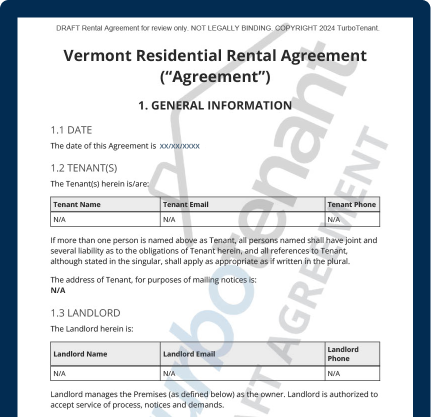

In Burlington, it’s common for students to rent a single room in a shared house near campus. In Stowe, seasonal workers might rent a bedroom for the winter ski season. And in smaller towns across the state, homeowners often open extra rooms to help cover expenses. A Vermont room rental lease agreement provides a uniform foundation for these diverse arrangements by establishing clear rules for rent, utilities, and household responsibilities.
In this guide, we’ll walk you through everything you should know about how a room rental agreement works, including the required disclosures, rent payment rules, renewal options, and how to create a simple, printable form that fits your needs.
Navigate Vermont Leases

Room Rental Agreement Vermont
Current PageRent your spare room with a Vermont room rental agreement today.
Vermont Residential Lease Agreement
Learn MoreCreate a compliant Vermont lease agreement in 15 minutes with TurboTenant's rental contract builder.
Vermont Month-to-Month Lease Agreement
Learn MoreBuild your Vermont month-to-month lease agreement in 15 minutes or less.
Types of Room Rental Contracts
In Vermont, shared housing usually falls into one of two categories. Tenants either sign a lease with the landlord or make a private agreement with their roommates.
- Room rental agreement: A room rental agreement is a binding contract between a landlord and a tenant for a specific room. It should list rent, utilities, deposit terms, maintenance duties, and house rules. By law, a deposit includes any prepaid amount refundable at lease end (9 V.S.A. § 4461). Landlords must return the deposit within 14 days of move-out, or 60 days for seasonal rentals, along with an itemized list of deductions. Failure to comply means losing the right to withhold funds, and willful violations can result in double damages plus attorney’s fees (9 V.S.A. § 4461(e)).
- Roommate agreement: Tenants create roommate agreements to cover how they’ll divide rent, utilities, chores, and other responsibilities. While not enforceable under Vermont landlord-tenant law, roommate agreements can help reduce disputes.
Ultimately, clear agreements set expectations early. Now, we’ll examine what happens when tenants or landlords breach room rental agreements.
Rental Agreement Breaches
Even with a lease in place, problems can arise. Vermont law outlines the procedures landlords must follow when handling missed rent, lease violations, or abandoned units, while also protecting tenants from unlawful evictions.
Failure to pay: If a tenant misses rent, the landlord must give a 14-day written notice to terminate the tenancy. The tenant can avoid eviction by paying the full amount before the termination date (9 V.S.A. § 4467(a)).
Lease violations: For issues like property damage, unauthorized occupants, or rule violations, the landlord must provide a 30-day written notice. If the violation involves illegal activity that poses a threat to health or safety, the landlord may instead issue a 14-day notice with no option to correct (9 V.S.A. § 4467(b)).
Lease abandonment: If a tenant leaves without providing notice or stops paying rent, the landlord may reclaim the unit. They must make reasonable efforts to re-rent it. Landlords can pursue unpaid rent and damages, but they cannot charge both the old and new tenants for the same period (9 V.S.A. § 4462).
Self-help evictions: Vermont prohibits landlords from changing locks, cutting utilities, or removing a tenant’s belongings without a court order. Only law enforcement can carry out an eviction. Tenants subject to an illegal lockout may sue for relief, damages, and attorney’s fees (9 V.S.A. § 4463).
Understanding these rules helps landlords address problems legally while giving tenants the essential protections they need. Next, we’ll look at Vermont’s access laws, which define when and how landlords may enter a rental unit.
Room Rental Landlord Access Laws
Vermont law strikes a balance between the landlord’s responsibility to maintain the property and the tenant’s right to privacy. Entry is permitted in certain situations, but Vermont uses strict rules to prevent misuse.
Immediate access: A landlord may enter without notice only if they reasonably believe there is an immediate threat to life or property, such as a fire, flooding, or a suspected gas leak (9 V.S.A. § 4460(c)).
Landlord harassment: All tenants have the right to quiet enjoyment of their homes. A landlord cannot abuse entry rights by showing up repeatedly without cause, arriving at unreasonable times, or otherwise using entry to intimidate tenants. Such behavior can violate tenant protections under state law.
Advance notice: For planned reasons such as inspections, repairs, or showing the unit to prospective new renters or buyers, landlords must give at least 48 hours’ notice. Visits must take place between 9:00 a.m. and 9:00 p.m. and must have a valid purpose agreed upon by both parties (9 V.S.A. § 4460(b)).
Following these guidelines enables landlords to maintain their properties while respecting tenant privacy.
Create Your Vermont Room Rental Agreement
TurboTenant makes it easy to draft a Vermont room rental agreement that aligns with state landlord-tenant laws. In minutes, you can create a printable PDF form, adjust it to fit your property, share it digitally with tenants, and finish the process securely with e-signatures.