


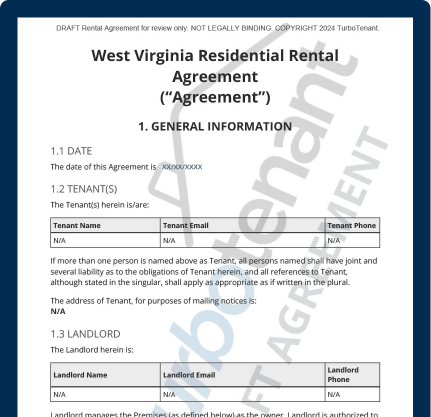

Finding the right living arrangement in West Virginia, whether near campus in Morgantown or in a neighborhood in Charleston, starts with clarity. A room rental lease agreement puts expectations in writing, ensuring clarity and transparency.
With a thorough agreement in place, tenants will understand rent, utility, and household obligations while the landlord adheres to specific West Virginia statutes.
Navigate West Virginia Leases

Room Rental Agreement West Virginia
Current PageRent your spare room with a West Virginia room rental agreement today.
West Virginia Residential Lease Agreement
Learn MoreCreate a compliant West Virginia lease agreement in 15 minutes with TurboTenant's rental contract builder.
West Virginia Month-to-Month Lease Agreement
Learn MoreCreate your West Virginia month-to-month lease agreement in 15 minutes or less.
Types of Room Rental Contracts
In West Virginia, the kind of agreement you use depends on whether you’re renting directly from a landlord or simply sharing space with other tenants. Understanding the difference helps everyone know where they stand.
Room rental agreement: Used when renting from a landlord, this agreement makes the terms legally binding once signed. It should:
- Cover rent, utilities, deposits, maintenance, and house rules.
- Outline private bedroom usage while sharing spaces like kitchens and bathrooms.
- Follow West Virginia rental laws, including rules for deposits and deductions (WV Code § 37‑6A‑2).
Roommate agreement: Created between cotenants, this agreement keeps shared living arrangements organized by:
- Outlining how rent, utilities, chores, and household rules are divided
- Helping prevent disputes, but ultimately legally unenforceable
- Adhering to the landlord’s master lease
Both agreements play a role in setting expectations. Choosing the right one helps reduce conflict and keeps rental arrangements running smoothly.
Rental Agreement Breaches
Disputes between landlords and tenants often result from missed payments, broken lease terms, or a tenant’s unexpected departure. West Virginia law establishes specific guidelines for handling each of these situations, protecting both parties from unfair treatment.
Failure to pay: In West Virginia, landlords may initiate eviction proceedings immediately, as the law does not require prior notice for nonpayment of rent or lease violations (WV Code § 37-6-19). The landlord files a Petition for Summary Relief (also known as an “Unlawful Detainer”) with the magistrate or circuit court, and the court sets a hearing, typically within a few days.
Tenants can still avoid eviction through the “Pay and Dismiss” option. If they pay all overdue rent, interest, late fees, and court costs before trial, the court must dismiss the eviction case (WV Code § 37‑6‑23).
Lease violations: Landlords may pursue eviction for lease violations, such as property damage, unauthorized pets, or disturbances, without prior notice, if the tenant breaches the lease terms (WV Code § 55-3A-1).
Abandonment and Self-Help Eviction
Lease abandonment: If a tenant abandons the property without paying rent the landlord may post a conspicuous notice and mail it to the tenant. If the tenant does not pay within 1 month, the landlord may repossess and recover unpaid rent (WV Code § 37-6-6 (a)).
Regarding abandoned personal property:
- The landlord must provide written notice before disposal or removal, which they must post on-site and mail to the tenant’s last known address (WV Code § 37-6-6 (c)).
- The tenant has 30 days to retrieve items (or 60 days if deployed in the military) before losing ownership rights (WV Code § 37-6-6 (d)).
- If the property is worth more than $300 and the tenant indicates an intention to retrieve it, the landlord must store it for an additional 30 days, provided the tenant pays reasonable storage and removal costs (WV Code § 37-6-6 (e)).
Self-help evictions: In West Virginia, landlords cannot self-evict by changing locks, shutting off utilities, or removing a tenant’s belongings. Evictions must go through the court, and only law enforcement can carry them out legally.
By following these legal steps, landlords avoid penalties and give tenants a fair chance to address problems before losing their housing.
Room Rental Landlord Access Laws
Landlords must inspect their properties to maintain them in good condition, but tenants also deserve privacy and peace of mind. Here’s how it works.
- Immediate access: Landlords may enter a rental unit without tenant consent only in emergencies, such as a fire, major plumbing failure, or other immediate threats to health or property safety.
- Landlord harassment: Under West Virginia law, tenants have a right to “quiet enjoyment” of their home. Therefore, landlords cannot repeatedly enter without cause, enter at disruptive times, or use access to intimidate the tenant. These actions may constitute harassment or breach of quiet enjoyment rights.
- Advance notice: For routine entries, such as repairs, inspections, or showings, landlords must provide reasonable notice. A notice of at least 24 hours is acceptable, unless the lease specifies otherwise or the tenant agrees to different terms. This notice may be verbal or written, allowing tenants to plan accordingly.
Clear communication about access helps landlords care for the property while giving tenants confidence that their privacy is respected.
Create Your West Virginia Room Rental Agreement
Building a lease doesn’t have to be complicated. With TurboTenant, you can generate a West Virginia room rental agreement that’s state-specific, easy to edit, and ready in a flash.. Share it online, then collect secure e-signatures in just a few clicks.