


A market in balance — and a tale of two rental markets
After years of volatility, the rental market is no longer surging, but it’s not declining either. Rent growth has slowed to a near standstill, and across much of the country, demand has stabilized. But that’s only half the story.






Behind the headlines is a different reality — one shaped by independent landlords. While large apartment operators are offering concessions and navigating rising vacancies, most independent landlords are experiencing something far more stable:
- Steady demand
- Consistent pricing power
- Low turnover
At the same time, pressure is building in a different way. Operating costs continue to rise, and most landlords are choosing not to pass those increases on to tenants.
This report analyzes responses from 2,000 landlords across the U.S. to understand what’s actually happening on the ground — and why independent landlords may be more insulated from market swings than the broader data suggests.
Key Rental Market Trend Findings
The 2026 rental market is finding balance — but not equality.

Overall demand is stable, skewing positive
More landlords report stronger demand than weaker, despite national narratives of a softening market.

Rent growth has stalled — by choice
Nearly three-quarters of landlords kept rent flat or raised it modestly.

Costs are climbing faster than rent
3 in 4 landlords report higher operating costs, creating added pressure.

Concessions are not the norm for independent landlords
90% of small landlords are not offering incentives, despite institutional operators increasing theirs.

Most landlords are holding, not offloading
More are considering buying property than selling.
A Tale of Two Rental Markets
The 2026 rental market is finding balance — but not equality.
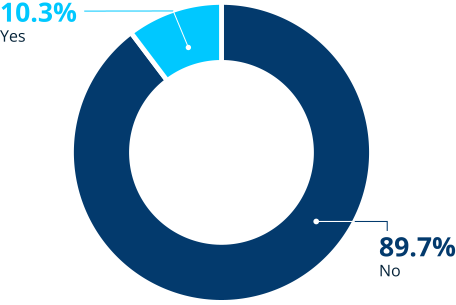
Survey Question
Are you currently offering any concessions or move-in incentives to either existing tenants or new tenants?
Landlords are all grouped into one big pile. And when tenants complain online, they’re typically bemoaning the corporate landlord who failed to make a timely repair or evicted them even after they paid rent. We’ve written about it plenty, and for more, check out our article “Blame Landlords Less and Property Managers More.”
But beyond the headlines, these two landlord subsets serve vastly different markets. One way to highlight these differences is to look at who is offering concessions and who isn’t. According to our State of the Rental Industry report, nearly 90% of independent landlords aren’t offering them. That is, no discounted first-month rent, comped parking space, or waived application fees.
When you compare that figure to national trends reported by MSN, nearly 40% of listings on the market aim to attract renters with freebies. What this difference boils down to is supply and demand.
According to Stateline, “more new apartments were built in 2024 than in any year since 1974.” And as the market absorbs these new units, large companies must offer renters deals to fill the glut of inventory that suddenly came online. The thing is, corporate investors own just 2 to 3% of single-family homes, according to Business Insider.
Survey Question
Are you currently offering any concessions or move-in incentives to either existing tenants or new tenants?
What these figures point to is a divide between small mom-and-pop landlords, who may own between one and five units, and corporate juggernauts who are more likely to own much larger apartment buildings. To drive this point home, according to Econofact, 85% of all investor-owned residential properties are owned by these smaller-scale investors.
As a result of these dynamics, the smaller landlord is typically insulated from broader market trends. In other words, they’re far less likely to experience seismic shifts in demand.
Demand Holds — Despite the Headlines
Stability is trending, and sentiment is hopeful
Survey Question
Compared to one year ago, how would you describe the demand for your rental units?
There is no shortage of data out there indicating reduced rental demand across the country. But the headline never captures the full story.
Among independent landlords in our survey, an overwhelming 81.17% reported that rental demand remained the same or increased. With demand staying the same, it’s easy to understand that what’s really at play here is more of the same: We’re often talking about two vastly different rental markets whose narratives merge into one nationwide story devoid of granular nuance.
So while the headlines shout “softening demand,” and the Federal Reserve Bank of St. Louis reports a national vacancy rate of 7.3%, market conditions at this point aren’t preventing smaller landlords from enjoying steady demand and an overall hopeful sentiment — despite what the national media may broadcast.
Survey Question
Compared to one year ago, how would you describe the demand for your rental units?
Holding the Line on Rent
Landlords are choosing stability over aggressive rent growth
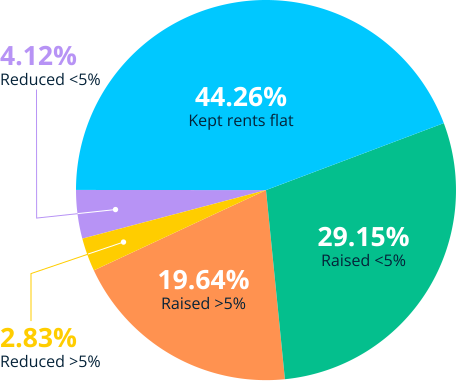
Survey Question
Over the past 12 months, have you raised, reduced or kept rents flat?
In one area where our survey breaks with broader rental market trends, we found that while the majority of rent increases remain low or flat, one in five independent landlords increased rent by more than 5%. The main point to consider is that among those we surveyed, the majority (44.26%) chose to keep rent prices the same, which is more in line with the broader market.
Speaking of the broader market, Zillow’s Rental Market Report shows nationwide rent growth at just 1.4%, aligning with our finding that among those who increased rent, 48.79% did so, with the majority (29.15%) hiking it by less than 5%.
As a common thread, these stagnant rent prices simply point to more supply. Homes for sale nationwide have spiked by 2.4% year-over-year, according to Realtor.com, resulting in 362,180 home listings added to the market. But just because there are more houses for sale doesn’t mean anyone is buying them.
Survey Question
Over the past 12 months, have you raised, reduced or kept rents flat?
In fact, Google searches for “can’t sell house” surged to an all-time high in February of 2026. The result: a surplus of new houses available for rent as homeowners put on a new hat, “accidental landlord.” With more people choosing to rent out their once-home rather than bang their heads against the wall of high interest rates, supply continues to creep up, leading to flatter rental prices overall.
The Margin Squeeze
Costs are rising — but tenants aren’t absorbing it
Survey Question
Compared to one year ago, how are your operating costs?
Significantly higher
Somewhat higher
About
the same
Somewhat lower
Significantly lower
Price pressure isn’t just something that consumers face. Inflation jumped to 3.3 percent, marking its highest level since 2024, according to Trading Economics. So while the prices of ordinary goods have climbed, the costs of running a rental business have too. But, landlords aren’t passing those costs to their renters. They’re absorbing them, which cuts into the bottom line.
In fact, 75% of landlords we surveyed reported increased costs, but rental property-specific charges likely drive that statistic. The first is landlord insurance. Premiums jumped 8% just in the first quarter of 2025, according to Bigger Pockets. The biggest reasons for the increase are higher frequency of natural disasters, more claims, and our good friend inflation.
Survey Question
Compared to one year ago, how are your operating costs?
Significantly higher
Somewhat higher
About
the same
Somewhat lower
Significantly lower
Beyond insurance, property taxes continue to rise. CBS reports that property taxes are “rising faster than inflation, with the average homeowner last year paying $4,427, up 3.7% from 2024.” Perhaps due to increased options for renters seeking the next home or reluctance to lose a good tenant, landlords have largely not passed these increased costs on to their tenants.
Vacancy Is Lower Than You Think
Many landlords didn’t need to find a tenant at all in the last year
Survey Question
Over the past 12 months, have you raised, reduced or kept rents flat?
Vacancy is one of the most stress-inducing factors any landlord can face, especially if they’re on the hook for a mortgage payment. The good news is that nationwide, vacancy rates were not statistically different from the rate in the first quarter of 2025,” according to the U.S. Census. As we mentioned, the vacancy rate sits at 7.3%. But those metrics don’t seem to impact the landlords we surveyed.
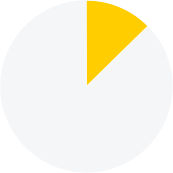
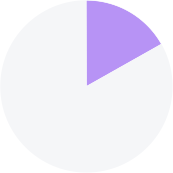
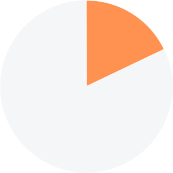
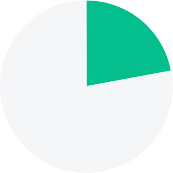
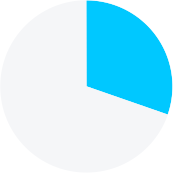
Per our study, 16.87% of landlords had no vacancy in the last year. And for those who did, 17.95% secured a lease with a tenant within 2 weeks. A larger percentage, 30.36%, faced vacancy periods of just 2-4 weeks.
On the not-so-good side of the equation, 22.13% of landlords reported needing 1-2 months to fill a vacancy. And the smallest group among them, landlords who endured vacancies of more than 2 months, comprised just 12.69% of those we surveyed. The answer to why many landlords aren’t experiencing prolonged vacancy rates is simple: Tenants are staying longer.
According to Redfin and reported on by Housing Wire, “one in six renters (16.6%) had been in their homes for 10 years or more, up from 13.9% in 2012.” Further illustrating this point, “short-term renters — those who move within 12 months — decreased to 25.2% of the renter population in 2022, down from 32.2% in 2012.”
Survey Question
Over the past 12 months, have you raised, reduced or kept rents flat?
Why Landlords Aren’t Offering Discounts
Independent landlords are not discounting to compete
90%
of independent landlords offer zero concessions
17%
had zero vacancies in 12 months
65%
didn’t notice a change in rent negotiations
68%
felt no institutional competition
Above, we mentioned that larger corporate landlords typically offer rent concessions in today’s market. We wanted to illustrate why only 10% of the independent landlords we surveyed offer them. It likely boils down to the same throughline: We’re talking about two largely different markets. Rental market trends don’t apply evenly to both.
Tenants who want to rent a single-family home want more space, privacy, and the financial flexibility that comes with renting an entire home rather than a townhouse or apartment. And as a result, 68% of landlords felt no institutional competition. Additionally, perhaps because private landlords largely operate the single-family home market, 65% didn’t even notice a change in rent negotiations.
90%
of independent landlords offer zero concessions
17%
had zero vacancies in 12 months
65%
didn’t notice a change in rent negotiations
68%
felt no institutional competition
We surmise that it’s largely due to how both large landlords and small landlords view their business. Large landlords aim to reduce the days units are on the market as much as possible, and rent concessions are a great way to do so. Mom-and-pop landlords, on the other hand, are more interested in finding the right long-term tenant to reduce stress.
Susan Cheng, from Folsom, CA, said it well, “It’s less about getting more people and more about finding the right person.” Once a landlord finds the right person, they’ll likely stay in the home long term, providing a sense of calm.
Calm, Uncertain — But Not Cracking
The market isn’t optimistic or pessimistic — it’s divided



No matter where you look across the country, rent prices are either spiking or falling off a cliff. And as you may guess, a lot of the cities experiencing spikes are coastal. For example, rent in San Francisco, CA rose 15.8% YoY. On the other side of the country, Boston’s rent increased by 2.6%.
But not all rents are rising. In general, rent growth is actually down. According to Apartment List, national rent prices are “down 1.7% compared to a year ago. Year-over-year rent growth is now at the lowest level that we’ve seen in our estimates going back to 2017.”
When you couple stagnating rent prices with the renter-friendly 7.3% vacancy rate nationwide, you begin to get a clear understanding of why the landlords we surveyed have a divided opinion on the market as a whole.
In the survey, we asked, “Which words best describe how you feel about today’s rental economy?” The top three results were, in order: uncertain (28.74%), optimistic (27.15%), and calm (27.01%). Another 23.41% identified their take on the market as concerned.
Ultimately, the market conditions an individual landlord finds themselves in dictate how they feel. And overall, roughly 88% of selections chose positive words to describe their feelings. Furthermore, ~73% of those surveyed chose negative words. Clearly, the market has landlords feeling conflicted, and finding a single rental market trend to describe everyone in it won’t bear fruit.
What Comes Next
Most landlords are staying the course
Survey Question
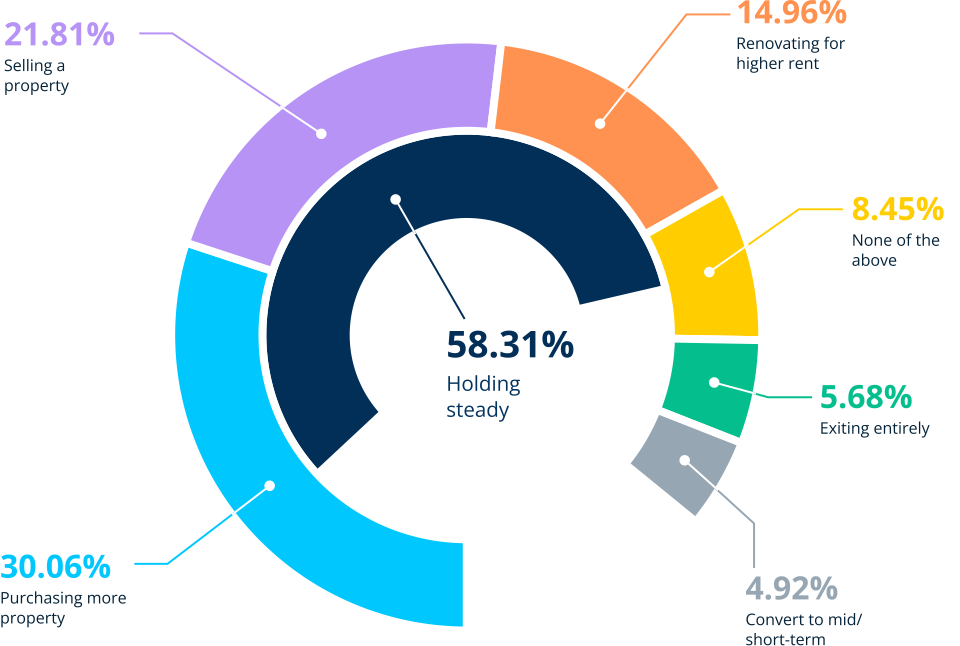
Given current market conditions, are you considering any of the following? (Select all that apply)
Given the high percentage of people feeling uncertain about the market and rising costs, nearly 60% of survey respondents report that they plan to hold steady and not purchase any additional properties. The second-largest group, at 30%, plans to purchase additional properties.
What we can glean from these two figures is that most landlords remain confident in the long-term outlook of the rental market. And even as Gen Z and millennials face the prospect of becoming lifelong renters, those who already own property aren’t facing the same hurdles.
In the end, what looks like a single unified rental market is anything but. Large, corporate-backed landlords are doing everything they can to keep units filled, while smaller landlords continue to rely on steady demand, longer tenant stays, and relationship-driven leasing.
When these two realities are compressed into a single national narrative, it’s easy to misread the market. And while the road ahead may include continued inflation and shifting supply, the fundamentals supporting small-scale landlords suggest that this segment of the rental market simply moves at its own pace.
Survey Question
Given current market conditions, are you considering any of the following? (Select all that apply)
Research Methodology
Overview
The State of the Rental Industry 2026’s rental market trends data is based on a March 2026 survey of approximately 1,200 active independent landlords recruited through TurboTenant’s in-app email network. To benchmark responses against the broader market, we also surveyed a panel of roughly 130 active U.S. residential landlords sourced through Prolific. All responses were cleaned using completion filters and an attention-check question, with incomplete or low-quality submissions removed prior to analysis.