Join the 1 million+ independent landlords who rely on TurboTenant to create welcoming rental experiences.
No tricks or trials to worry about. So what’s the harm? Try it today!

For rental property owners, net losses are common — but do you know the passive activity loss limitations? How do you handle passive activity losses, and how do rental losses affect your other income?
It all comes down to how your income is classified. The IRS categorizes income as either passive or active, and those classifications determine how much of your rental losses can offset your other income.
In this article, we’ll explain what passive activities are and what counts as a passive loss. We’ll also discuss the passive loss limitations and exceptions to those rules to help you maximize the passive losses for your rental properties.
Use our efficient and accurate real estate accounting software to streamline all of your accounting, bookkeeping, and expense tracking needs.
A passive activity is any business or trade in which you — the investor — aren’t involved on a regular, ongoing, substantial basis. In other words, you’re not a material participant in the business.
The IRS also treats rental property as a passive activity, even if the owner participates in the business regularly. However, there’s an exception for rental property owners who qualify for the real estate professional designation. We’ll get to that exception shortly.
A passive loss is a financial loss that you incur when you’re an investor, but not a material participant, in a business.
As a rental property owner, that means you did not make a profit from your property this year. In other words, your income was less than your expenditures. Note that a passive loss can also be a paper loss; that’s when your noncash expenses, like depreciation, amount to an overall loss.
Let’s say your rental income for the year is $30,000. Your operating costs were $22,000, so you made $8,000 from your property. But once you calculate your depreciation for the year, which is $13,000, you then have a paper loss of −$5,000. That loss is from a passive activity, so it’s subject to the IRS passive activity loss limitations.

In 1986, the IRS established rules that limit the amount of rental loss you can claim on your taxes. These rules prevent the use of passive losses to offset active taxable income.
So, you can use passive losses to offset passive income, but your passive losses can’t reduce or offset these forms of income:
That’s why the IRS doesn’t allow passive losses as a deduction on your tax return when you report your W-2 income.
These IRS rules mean that the limit on how much passive loss you can use depends on your passive income for the year. Let’s look at an example.
In our sample portfolio, our rental property business has two properties. Property A’s annual profit total was $45,000. Property B had a loss of $20,000. The loss from property B offsets the profit from property A, giving us a taxable passive income of $25,000.
We can use the entire loss because our passive income for the year exceeded the loss. As long as your passive income is equal to or greater than the passive loss, you can use the entire loss.
What if your losses are more than your passive income? When this happens, use as much of the loss as possible that year, then suspend the remaining loss.
Thinking about amending your tax returns? Passive losses cannot be applied to prior years’ income. You can only use them for the current tax year or carry them over to use against future passive income, helping reduce your tax liability later.
Once you sell the property associated with the loss, the passive loss carryover stops.

The IRS allows two exceptions to the passive activity loss rules, permitting deductions of passive losses against other income. The first exception is a special allowance for rental property owners to use up to $25,000 of rental loss to lower their other taxable income.
Did you know? The special $25,000 allowance can also apply to qualifying estates, not just individuals.
To qualify for the $25,000 allowance, you must meet these conditions:
Note that if you and your spouse both have ownership stakes in an investment property, the IRS uses your combined ownership for the 10% threshold measurement.
Unlike material participation, active participation does not require regular, ongoing, substantial involvement in the rental property’s operations. Active participation means that you, the property owner, take part in the business in a significant way.
For real estate investors, these activities all count as active participation:
Do you own rental property out of state? You can be an active participant for that property, even if you haven’t visited it this year.
Modified adjusted gross income (MAGI) is your adjusted gross income with particular tax deductions and exclusions, like IRS deductions or student loan interest, added to it. Your MAGI will always be higher than your adjusted gross income—and it affects the special allowance for rental property owners.
Let’s start with the rules for taxpayers who file as single or married filing jointly. The special allowance goes down if your MAGI is above $100,000. For every $2 of income above the threshold, your deduction will decrease by $1.
Here’s how it works in real life. Let’s say your MAGI is $100,000 this year. Your rental properties have a $40,000 loss, but you participated materially in the business. With the special allowance, you can use $25,000 of the loss to offset your regular income. Your taxable income will be $75,000, and you’ll carry over a passive loss of $15,000 to use in future years.
Now, let’s say your MAGI is $120,000, so you’re above the threshold by $20,000. That means you can deduct only $10,000 of the loss.
If your income is over $150,000, you can’t use the special allowance. You’ll carry your rental loss to next year instead.
If you are married and filing separately and you live apart from your spouse all year, you can deduct up to $12,500 of rental losses. If your MAGI is over $50,000, the allowance goes down, and it goes away completely if your MAGI is $75,000 or more.

If you aren’t a corporate entity, you must use Form 8582 to calculate your passive activity loss amount for the year. You’ll also use this form to report the application of unallowed passive losses from prior years.
Then you’ll use the allowed loss from the bottom of Form 8582 for Line 23 of your Schedule E.
The real estate professional designation is the second exemption to the passive activity loss rules. If you qualify for this designation, you may reduce your tax liability by offsetting ordinary income with your rental losses. This exception converts your rental income from passive to active, but the requirements are tough to meet.
Disclaimer: We recommend consulting with your CPA or tax preparer to discuss your specific situation and tax designations.
The material participation requirement is a separate test with its own criteria:
The requirements for material participation and the real estate professional designation are stringent. That’s why it is so difficult to qualify, especially if you have another job that isn’t related to real estate.
But there is good news.
If you’re married, only one spouse needs to meet the 750-hour criterion. Then, your combined total hours from both spouses count toward the material participation test requirement.
Even better, once you qualify as a real estate professional, your real estate losses can offset the income for either you or your spouse.
Pro tip: If you go after the real estate professional designation, keep a detailed log of your time. You’ll need to track the hours you spend on all rental-related tasks. Tracking your time spent on non-rental activities will help you prove that you’re spending more than half your time on rental activities.
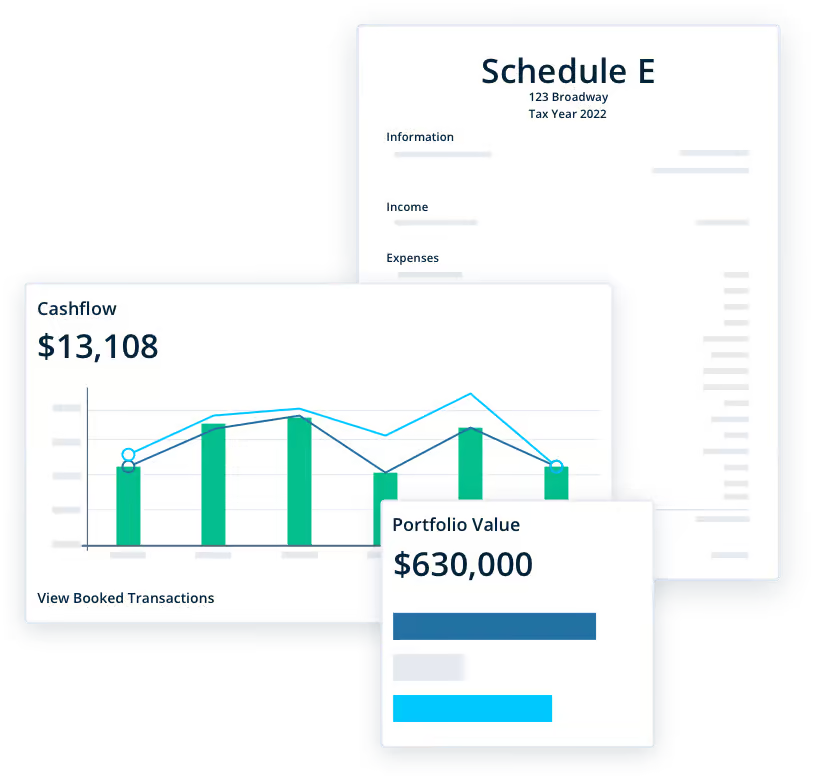
Passive rental losses can have a major impact on your tax liability, so the bookkeeping for your rental property matters. Mistakes with expense classifications, transposed digits, missing transactions, or lost documentation are costly in terms of both money and stress. At TurboTenant, we understand how important the books are for your rental property, and we know how stressful tax time can be for real estate investors like you.
That’s why we launched TurboTenant Accounting, a bookkeeping platform specifically designed for rental properties. It’s time to say goodbye to generic accounting software that requires heavy modifications and workarounds. With TurboTenant Accounting, you can skip the time-consuming setup and get started on your bookkeeping immediately.
No accounting degree? No problem.
We know accounting doesn’t come naturally to everyone, so our platform includes templates and tools to help you get — and keep — your books in order:
When you have organized, accurate books, you’ll know how your rentals are performing, and you’ll be ready to report your passive income (or losses) come tax time. Let TurboTenant Accounting help you prepare for tax season.
Sign up for a free TurboTenant account today!
And for a detailed, easy-to-understand breakdown of rental property taxes, check out our Tax Prep Guide for Rental Property Owners, 2025 Edition.
Disclaimer: This blog is for informational purposes only and is published by TurboTenant. It is not legal, financial, or tax advice. Laws and regulations for landlords vary by state and locality and may change over time. Always consult a qualified attorney, accountant, or local housing authority before making decisions related to your rental property. The publisher and authors assume no responsibility for actions taken based on the information provided.
The IRS generally considers rental property a passive activity, so most small-scale real estate investors qualify for passive activity losses. The exception is if you meet the IRS requirements for the real estate professional designation; in that case, your rental activity counts as active.
Rental property owners can potentially avoid passive loss limitations in two ways: (1) by taking advantage of the $25,000 special allowance, or (2) by obtaining the IRS real estate professional designation.
Under the at-risk rule, you can only deduct passive losses up to the amount of your at-risk investment. Therefore, your potential deduction depends on the amount of money you contribute to the activity.
Yes, short-term rentals count as passive activities and are subject to the passive loss limitations. However, if you meet the material participation requirements, your short-term rentals may qualify as an active activity. We recommend that you talk with your CPA about the requirements.