


A North Carolina lease agreement helps landlords set expectations, outline tenant responsibilities, and prevent issues once the contract begins. Without the right terms and disclosures in place, property owners may run into rent payment issues, maintenance mix-ups, security deposit disputes, or lease violations.
Before handing over the keys, landlords should understand which state and federal rules apply to their rental agreement. To get started, click the Create Document button above and build a compliant lease in minutes. To learn more about North Carolina’s legal requirements, keep reading.

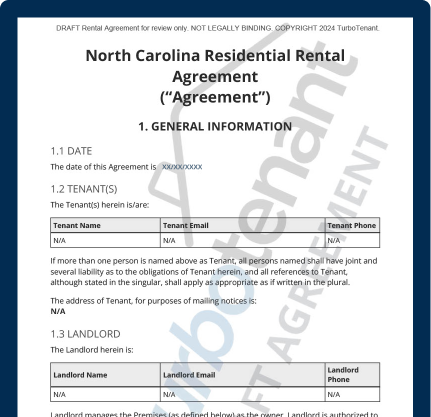
North Carolina Residential Lease Agreement
Current PageCreate a compliant North Carolina residential lease agreement with TurboTenant's rental contract builder in 15 minutes.
North Carolina Month-to-Month Lease Agreement
Learn MoreBuild your North Carolina month-to-month lease agreement in 15 minutes.
Room Rental Agreement North Carolina
Learn MoreConsidering renting out an extra room? Make it official with a North Carolina room rental agreement.
Required Landlord Disclosures (4)
In addition to the contract itself, landlords may need to provide tenants with, or have them sign, certain disclosures that cover legally required information. The following disclosures explain known property risks, security deposit details, and specific lease terms:
- Lead-based paint: If a rental was built before 1978, landlords must disclose known lead-based paint and lead-based paint hazards before leasing the property. Because federal law requires this disclosure, it applies in every state (42 U.S.C. § 4852d).
- Security deposit receipt: Within 30 days after the residential lease term begins, the landlord must notify the tenant of the name and address of the bank or institution holding the security deposit, or the name of the insurance company providing the bond (N.C. Gen. Stat. § 42-50).
- Water or sewer contaminant notice: If a landlord bills tenants for water or sewer service and knows the supply exceeds a maximum contaminant level set under state law, the landlord must notify tenants of the exceedance (N.C. Gen. Stat. § 42-42(a)).
- Accidental damage notice: North Carolina law states that tenants do not owe damages for accidental damage that occurs within a rental unit unless the lease says otherwise. If a landlord wants to make tenants liable for accidental damage, the lease must clearly state so (N.C. Gen. Stat. § 42-10).
Security Deposit Regulations
Maximum security deposit amount: For residential leases longer than a month-to-month arrangement, North Carolina landlords may charge a security deposit of up to 2 months’ rent. For month-to-month leases, they may charge up to 1.5 months’ rent, and for week-to-week leases, up to 2 weeks’ rent (N.C. Gen. Stat. § 42-51(b)).
Pet fees: The security deposit limits do not apply to pet fees. Landlords may charge a reasonable, nonrefundable pet fee in addition to the security deposit (N.C. Gen. Stat. § 42-53).
Holding and receipt of deposit: Landlords must hold the deposit in a trust account at a North Carolina bank or insured institution, or secure a bond, and must notify tenants of the bank or institution holding the deposit (or the bond company) within 30 days after the lease term begins (N.C. Gen. Stat. § 42-50).
Deduction tracking: Landlords have 30 days after the tenancy ends to provide tenants with an itemized list of deductions if they retain any portion of the security deposit. If a landlord cannot determine the full amount within 30 days, the landlord must provide an interim accounting within 30 days and a final accounting within 60 days (N.C. Gen. Stat. § 42-52).
Returning a tenant’s security deposit: In North Carolina, landlords must return a tenant’s security deposit within 30 days after the tenancy ends, minus any lawful deductions (N.C. Gen. Stat. § 42-52).
Landlord’s Access to Property
Advance notice: North Carolina law does not require landlords to notify tenants before accessing a rental property. As a courtesy, landlords should still provide at least 24 hours’ written notice before entering for maintenance, repairs, or inspections.
Immediate access: In North Carolina, landlords may enter a rental property without advance notice in an emergency or for necessary maintenance.
Landlord harassment: North Carolina law does not require landlords to provide notice before entering a rental property. However, repeated, unreasonable entries without notice or tenant consent could support a tenant’s claim that the landlord interfered with the right to quiet enjoyment. Continued harassment may give the tenant a valid reason to terminate the lease.
Rent Payment Laws
Grace period: In North Carolina, tenants have a 5-day grace period to pay rent before landlords may charge a late fee (N.C. Gen. Stat. § 42-46(a)(6)).
Late rent fees: The lease must specify the late fee that a landlord may charge. For monthly rent, the late fee cannot exceed $15 or 5% of the monthly rent, whichever is greater, and a landlord may charge it only once per late payment (N.C. Gen. Stat. § 42-46(a), § 42-46(b)).
Tenant’s right to withhold rent: A tenant cannot withhold rent in North Carolina, even for repairs, unless a court has granted the right to do so (N.C. Gen. Stat. § 42-44(c)).
Breach of Rental Agreement
Missed rent payment: When rent goes unpaid, the landlord may demand all past-due rent. If the tenant does not pay within 10 days of that demand, North Carolina law implies a forfeiture of the lease term, and the landlord may pursue summary ejectment (N.C. Gen. Stat. § 42-3).
Lease violation: If a tenant violates the lease, a landlord may pursue summary ejectment. First, the landlord must demand possession of the property, and the landlord may file a complaint in court if the tenant does not vacate by the required date (N.C. Gen. Stat. § 42-26).
Self-help evictions: North Carolina prohibits self-help evictions. Landlords must remove residential tenants only through procedures permitted by state law (N.C. Gen. Stat. § 42-25.6).
Lease abandonment: If a tenant moves out before the lease ends, the tenant may still owe rent for the remaining term. However, landlords must take reasonable steps to re-rent the property and reduce the tenant’s remaining liability.
Ending a Lease
Month-to-month: In North Carolina, tenants and landlords must give each other 7 days’ notice to terminate a residential month-to-month rental lease agreement (N.C. Gen. Stat. § 42-14).
Fixed-term: North Carolina tenants may legally break a fixed-term lease before its end date in limited situations, such as military service that requires a move at least 50 miles away, living in certain foreclosed properties, or experiencing domestic violence, sexual assault, or stalking (N.C. Gen. Stat. § 42-45, § 42-45.1, § 42-45.2, Service Members Civil Relief Act, 50 U.S.C § 3955).
Property abandonment: If a tenant leaves property behind after execution of a writ of possession, landlords generally must hold the tenant’s belongings for at least 5 days when the estimated total value is below $500, or 7 days when it meets or exceeds that amount (N.C. Gen. Stat. § 42-25.9).
Renewing a Lease
Required renewals: North Carolina landlords are not required to renew tenant leases.
Required notice: To terminate a year-to-year lease, landlords and tenants must give at least one month’s notice. Month-to-month leases require 7 days’ notice (N.C. Gen. Stat. § 42-14).
North Carolina Residential Lease Agreement FAQs
Does a landlord have to provide a copy of the lease in North Carolina?
North Carolina law does not require landlords to provide tenants with a copy of the lease. That said, issuing tenants a signed digital PDF copy helps both parties reference the rent terms, lease dates, fees, rules, and responsibilities if questions arise later.
What is the grace period for rent in North Carolina?
In North Carolina, tenants have a 5-day grace period before landlords may charge a late fee. Once that period passes, landlords may charge a late fee, provided it complies with state limits and the lease permits it (N.C. Gen. Stat. § 42-46(a)).
Can a landlord refuse to renew a lease in North Carolina?
Landlords can refuse to renew a lease in North Carolina provided they do not violate fair housing laws or retaliate against a tenant for exercising protected rights like requesting repairs or reporting code violations (N.C. Gen. Stat. § 42.31.1), or discriminate against a tenant based on their status as a victim of domestic abuse, sexual assault, or stalking (N.C. Gen. Stat. § 42-42.2).
Does a North Carolina lease need to be notarized?
North Carolina rental lease agreement templates do not require notarization to be valid. A written lease signed by both parties is typically sufficient to create an enforceable agreement.
Can you withhold rent for repairs in North Carolina?
No, tenants cannot withhold rent for repairs on their own in North Carolina. A tenant may withhold rent only with the court’s permission, so renters should follow proper legal protocols rather than stopping payment unilaterally (N.C. Gen. Stat. § 42-44(c)).
Disclaimer: TurboTenant does not provide legal advice. This material has been prepared for informational purposes only. All users are advised to check all applicable local, state, and federal laws and consult legal counsel should questions arise.