


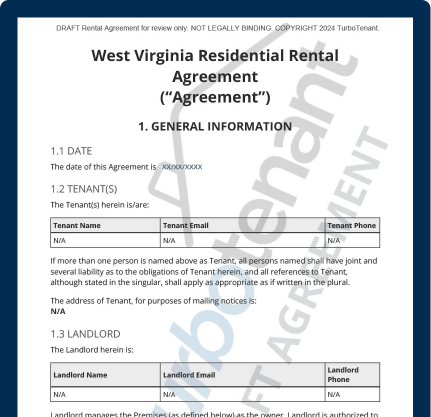
A West Virginia residential lease agreement establishes the legal relationship between a landlord and tenant when renting a residential property. The lease outlines the rights and responsibilities of both parties throughout the tenancy, including rent amount, payment terms, security deposits, maintenance obligations, property rules, landlord access, and other important rental policies. To get started, use TurboTenant to create downloadable PDF lease templates that comply with both West Virginia and federal laws.
Before signing a lease agreement, landlords and tenants should also understand the state’s required disclosures and the key provisions that help ensure a smooth rental experience.

West Virginia Residential Lease Agreement
Current PageCreate a compliant West Virginia lease agreement in 15 minutes with TurboTenant's rental contract builder.
West Virginia Month-to-Month Lease Agreement
Learn MoreCreate your West Virginia month-to-month lease agreement in 15 minutes or less.
Room Rental Agreement West Virginia
Learn MoreRent your spare room with a West Virginia room rental agreement today.
Required Landlord Disclosures (2)
Landlords must inform their tenants of important information that could affect the rental arrangement. Under federal and state law, landlords must include the following disclosures in the West Virginia residential lease agreement or provide them as a separate document altogether:
- Lead paint: Federal law requires landlords to disclose known lead-based paint or lead-based paint hazards in most rental properties built before 1978 (42 U.S.C. § 4852d).
- Non-refundable fees: West Virginia rental contracts must include written language designating any fee, such as an application fee or pet fee, as non-refundable. Without that written designation, those fees may be classified as part of the security deposit (W. Va. Code § 37-6A-1(14)).
Security Deposit Regulations
Maximum security deposit amount: West Virginia does not limit the amount landlords can charge as a security deposit.
Receipt of deposit: State law does not require landlords to provide tenants with security deposit receipts.
Deduction tracking: Landlords in West Virginia may withhold funds from the security deposit to cover unpaid rent, damages beyond normal wear and tear, unpaid utilities, costs of removing or storing a tenant’s belongings, and other damages or charges provided in the rental agreement. Landlords must itemize these deductions and deliver them to the tenant along with the remaining security deposit (W. Va. Code § 37-6A-2).
Returning a tenant’s security deposit: Landlords must return security deposits within 60 days after the tenancy ends or within 45 days after a new tenant occupies the premises, whichever is shorter (W. Va. Code § 37-6A-1, § 37-6A-2).
Landlord’s Access to Property
Advance notice: No specific West Virginia statute explains how or when a landlord may enter a tenant’s unit. However, there is a common expectation that landlords will provide reasonable notice and avoid interfering with the tenant’s quiet enjoyment of the property.
Immediate access: In an emergency, West Virginia landlords can typically enter a tenant’s unit without notice.
Landlord harassment: A landlord who repeatedly enters a tenant’s unit unreasonably may interfere with the tenant’s quiet enjoyment of the property. Tenants may be able to seek a court order to stop the behavior, recover the costs of any damages, and potentially pursue other remedies under West Virginia law.
Rent Payment Laws
Grace period: West Virginia has no mandatory grace period for late rent payments.
Late rent fees: West Virginia does not set a statewide cap for late rent fees in standard residential leases, but the rental agreement form should clearly state the late fee amount to make it enforceable.
Tenant’s right to withhold rent: West Virginia tenants cannot withhold rent or use repair-and-deduct for repairs. By law, landlords must keep rental properties fit and habitable, and tenants may pursue legal remedies if the landlord fails to make necessary repairs (W. Va. Code § 37-6-30).
Breach of Rental Agreement
Missed rent payment: West Virginia landlords don’t need to provide a pre-filing notice before beginning eviction proceedings, so they can file for eviction immediately after a tenant misses a rent payment. When filing for eviction, the landlord must always follow the court process (W. Va. Code § 55-3A-1).
Lease violation: Landlords aren’t required to allow a tenant to cure a lease violation, so they can begin eviction proceedings once the tenant violates the terms of their residential lease agreement. For a successful eviction, the landlord must prove that the tenant wrongfully occupied the property due to a lease violation (W. Va. Code § 55-3A-1).
Self-help evictions: Landlords shouldn’t ever attempt to evict a tenant on their own, as self-help evictions are illegal across all 50 states (W. Va. Code § 55-3A-1).
Lease abandonment: Tenants who break a rental lease agreement in West Virginia early and without a qualifying condition could owe unpaid rent or other lease damages. If rent remains unpaid and the tenant abandons the property, the landlord must post a written notice requiring payment within 1 month before taking possession. The landlord may also re-lease the premises and hold the original tenant responsible for the difference between the original rent and the new rent (W. Va. Code § 37-6-6, § 37-6-7).
Ending a Lease
Month-to-month: Both landlords and tenants may end a standard, month-to-month lease agreement in West Virginia with at least 1 full rental period’s written notice (W. Va. Code § 37-6-5).
Fixed-term: Tenants may be able to end a West Virginia residential lease early, without penalty, if they meet a qualifying condition. These conditions may include entering active military duty (50 U.S.C. § 3955), uninhabitable living conditions (W. Va. Code § 37-6-30), landlord harassment, landlord retaliation, or another legally valid reason.
Property abandonment: After an eviction order, landlords must preserve any personal property left behind and give the tenant 30 days to recover it. If the tenant still has not recovered the property after 30 days, the landlord may dispose of it. If the property’s value exceeds $300, the landlord must give the tenant an additional 30 days if the tenant states their intent to retrieve the items and pays reasonable storage and removal costs (W. Va. Code § 55-3A-3).
Renewing a Lease
Required renewals: West Virginia landlords do not have to renew a tenant’s lease once the term has expired.
Required notice: Landlords in West Virginia do not have to give advance notice when they do not intend to renew a standard, fixed-term rental lease agreement, unless the lease requires it. Month-to-month leases, however, require at least 1 full rental period’s written notice to terminate (W. Va. Code § 37-6-5).
West Virginia Residential Lease Agreement FAQs
Does a landlord have to provide a copy of the lease in West Virginia?
No, West Virginia law does not appear to require landlords to provide tenants with a copy of a standard residential lease agreement.
What is the grace period for rent in West Virginia?
West Virginia does not require a statewide grace period for late rent payments. Unless the lease says otherwise, landlords may enforce late-rent rules in accordance with the rental agreement.
Can a landlord refuse to renew a lease in West Virginia?
Yes. West Virginia landlords can refuse to renew a fixed-term lease after it expires, as long as they do not violate fair housing laws or other legal protections. For year-to-year tenancies, either party must provide at least 3 months’ written notice before the end of the year. For month-to-month tenancies, either party must provide notice for 1 full rental period (W. Va. Code § 37-6-5).
Does a West Virginia lease need to be notarized?
No, West Virginia residential leases generally do not need to be notarized to be legally enforceable. Once both parties sign the lease, the agreement can establish the rental terms between the landlord and tenant.
Can you withhold rent for repairs in West Virginia?
No. West Virginia law requires landlords to keep rental properties fit, habitable, and compliant with applicable housing codes. Still, tenants don’t have the legal right to withhold rent or repair and deduct (W. Va. Code § 37-6-30).
Disclaimer: TurboTenant does not provide legal advice. This material has been prepared for informational purposes only. All users are advised to check all applicable local, state, and federal laws and consult legal counsel should questions arise.