


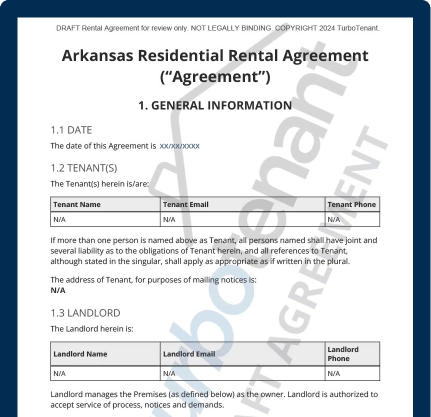
An Arkansas residential lease agreement outlines the terms and conditions of renting a property, ensuring the landlord and tenant understand their obligations. It typically includes the terms of the rental contract, the names of all parties involved, the lease agreement length, maintenance responsibilities, and information on rent, utilities, security deposits, and more.
These legal contracts help prevent disputes between landlords and tenants and establish expectations for the rental arrangement. Landlords can use PDF samples to create a downloadable lease agreement, but they should still understand the state and federal laws that apply to rental leases in Arkansas in 2026.

Arkansas Residential Lease Agreement
Current PageCreate a compliant Arkansas lease agreement in 15 minutes with TurboTenant's rental contract builder.
Arkansas Month-to-Month Lease Agreement
Learn MoreBuild your Arkansas month-to-month lease agreement in just 15 minutes.
Room Rental Agreement Arkansas
Learn MoreConsidering renting out an extra room? Make it official with an Arkansas room rental agreement.
Required Landlord Disclosures (2)
Before signing a new residential lease agreement, Arkansas landlords must disclose certain information about the rental unit to prospective tenants. Both federal and state laws regulate the following disclosures:
- Lead-based paint disclosure: The federal Residential Lead-Based Paint Hazard Reduction Act of 1992, also known as Title X, requires landlords nationwide to disclose known lead-based paint in most dwelling units built before 1978 (42 U.S.C. § 4852d).
- Move-in defect form: Arkansas landlords can satisfy the state’s implied residential quality standards by giving tenants a written form to list defects in the heating and air conditioning, plumbing, roof, electrical, and drinking water systems. Tenants should complete and return the form within 2 business days of taking possession (Ark. Code Ann. § 18-17-502).
Security Deposit Regulations
Maximum security deposit amount: Arkansas landlords may not charge more than 2 months’ rent as a security deposit. This cap does not apply to landlords who own 5 or fewer dwelling units, unless a third party manages the unit or collects rent for a fee (Ark. Code Ann. § 18-16-304, § 18-16-303, 18-16-304).
Receipt of deposit: Arkansas landlords do not have to give tenants written notice that they received the security deposit.
Deduction tracking: If a landlord deducts funds from a security deposit to cover unpaid rent or damages beyond normal wear and tear, they must document the charge and give the tenant an itemized statement of all deductions (Ark. Code Ann. § 18-16-305).
Returning a tenant’s security deposit: Arkansas landlords must return any unused portion of the deposit, along with an itemized statement of any deductions, within 60 days of the tenant’s move-out. If the landlord cannot reach the tenant after a reasonable effort, the landlord may keep the deposit after 180 days pass (Ark. Code Ann. § 18-16-305).
Landlord’s Access to Property
Advance notice: Arkansas does not require landlords to give tenants advance notice before entering the property. Industry standards usually recommend 24 hours’ notice to help prevent disputes and privacy concerns.
Immediate access: In an emergency, Arkansas landlords may enter the rental property without notice.
Landlord harassment: Arkansas has no statewide advance-notice requirement for entry, but repeated or unreasonable entry can still lead to disputes or privacy concerns. Landlords should give reasonable notice whenever possible and follow any entry terms in the lease.
Rent Payment Laws
Grace period: Arkansas landlord-tenant laws do not provide a grace period for late rent. Tenants must pay rent in full by the agreed-upon date.
Late rent fees: Arkansas does not set a statewide cap on late fees for residential leases. Landlords should state any late fee clearly in the lease and keep the amount reasonable.
Tenant’s right to withhold rent: Arkansas tenants may not offset or withhold rent for alleged or actual violations of the state’s implied quality standards. If the tenant is current on rent and the landlord fails to remedy qualifying noncompliance within 30 calendar days after proper written notice, the tenant may terminate the lease without penalty and recover any refundable portion of the security deposit (Ark. Code Ann. § 18-17-502).
Breach of Rental Agreement
Missed rent payment: If a tenant fails to pay rent when due, Arkansas law allows the landlord to begin eviction proceedings once rent remains unpaid for 5 days after the due date. Landlords may also apply the security deposit to unpaid rent at the end of the tenancy, subject to Arkansas security deposit rules (Ark. Code Ann. § 18-17-901).
Lease violation: Arkansas landlords must give tenants who violate the lease terms a Notice to Cure or Quit, allowing 14 days to remedy the violation (Ark. Code Ann. § 18-17-701).
Self-help evictions: Self-help evictions, such as utility shutoffs or lockouts, are illegal nationwide. Landlords who attempt them may face civil or financial penalties.
Lease abandonment: If a tenant moves out and stops paying rent before the lease term ends, they have abandoned or broken their Arkansas rental lease agreement. Tenants typically must keep paying rent and may face other financial consequences for the remainder of the term (Ark. Code Ann. § 18-17-703).
Ending a Lease
Month-to-month: Either the landlord or the tenant may end a month-to-month lease in Arkansas by giving the other party written notice at least 30 days before the intended termination date (Ark. Code Ann. § 18-17-704).
Fixed-term: A fixed-term lease expires on a specific date, at which point either party may terminate it. In special circumstances, such as active military duty (50 U.S.C. § 3955) or the landlord’s failure to provide safe, habitable housing (Ark. Code Ann. § 18-17-502), tenants may vacate during the lease term without penalty. Otherwise, tenants may owe the landlord’s attorney’s fees and damages from the breach (Ark. Code Ann. § 18-17-703).
Property abandonment: Arkansas landlords may dispose of a tenant’s abandoned property immediately without recourse (Ark. Code Ann. § 18-16-108).
Renewing a Lease
Required renewals: Arkansas landlords do not have to let tenants renew a residential lease unless the lease says otherwise. If the lease includes an automatic renewal clause, both parties should comply with the lease’s notice requirements.
Required notice: Arkansas law does not specify how much notice a landlord or tenant must give when they do not intend to renew a lease. Even so, landlords and tenants should consider notifying each other of non-renewal 30 to 60 days in advance.
Arkansas Residential Lease Agreement FAQs
Does a landlord have to provide a copy of the lease in Arkansas?
No. As of 2026, Arkansas law does not require landlords to provide tenants with a copy of the residential lease agreement. However, providing a signed copy is considered a best practice and can help prevent disputes later in the tenancy.
What is the grace period for rent in Arkansas?
Arkansas does not require a statutory grace period for late rent payments. Still, landlords typically cannot begin eviction proceedings until rent goes unpaid for 5 days after the due date (Ark. Code Ann. § 18-17-901).
Can a landlord refuse to renew a lease in Arkansas?
Yes. Arkansas landlords may choose not to renew a lease upon expiration of the rental term, provided they give any required notice under the lease agreement or applicable state law.
Does an Arkansas lease need to be notarized?
No. Arkansas residential lease agreements do not need to be notarized to be legally enforceable. The lease becomes binding once both the landlord and tenant sign the agreement.
Can you withhold rent for repairs in Arkansas?
No. Arkansas tenants generally cannot withhold rent because of unresolved repair issues (Ark. Code Ann. § 18-17-502). They may need to pursue other legal remedies if a landlord fails to maintain the property.
Disclaimer: TurboTenant does not provide legal advice. This material has been prepared for informational purposes only. All users should check all applicable local, state, and federal laws and consult legal counsel should questions arise.