


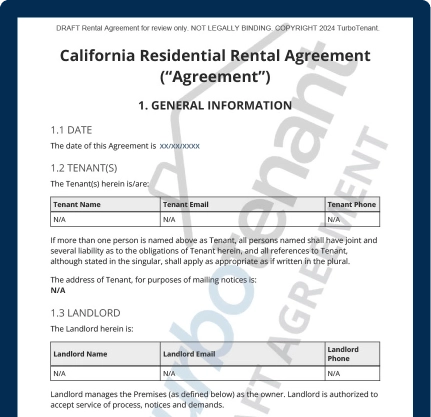

Los Angeles Residential Lease Agreement
A Los Angeles lease agreement isn’t just another paper for you to file away and never give a second thought. It’s your first line of defense as a landlord in a city where the rental market moves fast, rent control is real, and there are significant tenant protections.
A rental lease agreement contains all the essential information regarding your rental property, including rent and security deposit details, tenant and landlord expectations, due dates, lease duration, and more.
Los Angeles Landlord-Tenant Law
Landlord-tenant laws vary from state to state, and these laws will help shape how you should construct your Los Angeles lease agreement. Always review California landlord-tenant law to ensure that you understand the state laws before drafting a legally binding lease agreement.
TurboTenant’s California lease agreement template makes it easier than ever to generate a comprehensive and legally binding lease — simply fill in the blanks and you’re all set.

California Residential Lease Agreement
Learn MoreCreate a compliant California residential lease agreement with TurboTenant's rental contract builder in 15 minutes.
California Room Rental Agreement
Learn MoreRent your spare room with a California room rental agreement today.
Required Landlord Disclosures (21)
California has one of the longest lists of required disclosures for landlords:
- Lead paint: Federal law requires landlords to disclose the known presence of lead-based paint before selling or leasing most houses built before 1978 (The Lead Disclosure Rule).
- Statement on just cause requirements: Notice must be given to the tenant if a property is subject to Section 1946.2 of the Civil Code, which requires a landlord to give 60 days’ notice before terminating a long-term lease (§ 1946.2).
- Contact information: The landlord must provide the contact information for the person responsible for managing the property (Cal. Civ. Code § 1962(4)).
- Notice of change of terms: The Tenant Protection Act requires that landlords provide a statement specifying the limits of rent increases (Tenant Protection Act).
- Notice of exemption from rent limits: There must be notice in the lease if the property is exempt from rent limits and just cause requirements as specified in Section 1946.2 of the Civil Code (AB 1482).
- Waterbeds: If you believe that a tenant will bring a waterbed on the property, you must include a waterbed statement in your lease (§ 1940.5).
- Bedbugs: You must provide a statement declaring that the property is free from bedbugs, and the tenant must read and sign the document (§ 1942.5).
- Carbon monoxide detectors: Any property with fossil-fuel-based appliances or heaters must have carbon monoxide detectors in it (§ 17926.1).
- Sex offender registry: Every Los Angeles lease agreement must include a statement regarding the Megan’s Law sex offender registry (§ 2079.10a)
- Smoking policy: The lease must include any smoking restrictions in an addendum (§1947.5 (b 1)).
- Carcinogenic material: You must disclose any known carcinogenic material included on the Proposition 65 list (§ 25607.34 (3)).
- Asbestos notification: Any known asbestos must be disclosed (§ 29515.5 (a)).
- Death in the unit: Any death in the unit, excluding HIV- or AIDS-related deaths, within the past 3 years must be disclosed (§ 1710.2).
- Demolition: Landlords must disclose any demolition plans before signing a lease (§ 1940.6(a)(1)(A)).
- Flood zone: You must disclose if the property lies in a flood zone (§ 8589.45 (a)).
- Methamphetamine or fentanyl contamination: You must disclose any manufacture, storage, or use on the property, and provide proof of remediation (§ 25400.28 (b)).
- Mold: You must disclose information on present toxic mold or likely present mold until it is treated safely. You must also present tenants with a California Department of Health Services booklet (§ 26147).
- Ordinance locations: You must inform tenants that any military testing site within a one-mile radius may have live munitions (§ 1940.7 (b)).
- Pest control: If you contract with a pest control service, you must inform tenants of the pesticides used. Tenants must also receive 24 hours’ notice before pesticide applications (§ 1940.8).
- Shared utilities: If rental units share a gas or water meter, landlords must outline how tenants are billed for utilities (§ 1940.9).
- Water notice: If water is billed separately from rent, you must inform tenants when they will be billed during the rental period, and also include an estimate of the monthly water bill (§ 1954.204).
You must also include the LA Renters Protections Notice in your Los Angeles lease agreement.
Note: TurboTenant includes each disclosure with every lease agreement, making compliance easy.
Security Deposit Regulations
Maximum security deposit amount: Typically, the maximum security deposit allowed in California is 1 month’s rent; however, small landlords (owning two or fewer properties totaling four units or less) may still charge up to 2 months’ rent (Cal. Civ. Code § 1950.5).
Receipt of deposit: California does not require landlords to provide a receipt for security deposits.
Interest: California does not require landlords to pay interest on security deposits; however, in Los Angeles, you must pay interest on a security deposit if your rental property is subject to the Los Angeles Rent Stabilization Ordinance (LARSO).
Deduction tracking: California landlords must provide an itemized list of deductions, unless the deductions total less than $125.
Returning a tenant’s security deposit: Landlords must return a tenant’s security deposit within 21 days of the tenant’s move-out.
Landlord’s Access to Property
Advance notice: Landlords are required to give 24 hours’ notice before accessing the property.
Immediate access: In the event of an emergency or a court order, the landlord may enter the property without notice.
Landlord harassment: The covenant of quiet enjoyment states that landlords may not unduly interfere. If they do so, the tenant may be able to break the lease early, and the landlord may face civil penalties.
Rent Payment Laws
Grace period: California landlords are not required to provide tenants with a grace period for rent payments.
Late rent fees: Landlords are permitted to charge late rent fees, provided the lease specifies these fees. California law allows landlords to charge 5% of the unpaid rent amount or $50, whichever is less.
Tenant’s right to withhold rent: California law allows tenants to withhold rent or deduct the cost of repairs from rent if they provide the landlord with notice of unsafe property conditions and the repairs remain incomplete within 35 days.
Breach of Rental Agreement
Missed rent payment: If a tenant misses a rent payment, their landlord may give them a 3-day Notice to Vacate the property. At that point, the tenant can either pay the rent (with late fees) or move out. If they do neither, the landlord may begin eviction proceedings.
Lease violation: If a tenant violates any provision of the Los Angeles lease agreement, the landlord has the right to send them a written 3-day notice to rectify the issue or vacate the property. The landlord can pursue an at-fault eviction if the tenant does not comply.
Self-help evictions: In California, self-help evictions, where a landlord attempts to forcibly remove a tenant by shutting off utilities or changing locks, are illegal.
Lease Abandonment: If the rent is 14 days past due and a landlord believes a tenant has abandoned the property, they must provide a Notice of Belief of Abandonment.
Ending a Lease
Month-to-month: A month-to-month lease may be terminated by either a landlord or tenant with 30 days written notice, unless otherwise stipulated in the lease agreement.
Fixed-Term: If a tenant breaks a fixed-term lease illegally, they must pay the remainder of the lease unless they rent the unit again. Some conditions allow a tenant to end a fixed-term lease, such as military service, unsafe property conditions, domestic violence, landlord harassment, or privacy violations.
Property Abandonment: At the end of a lease term, if a tenant has left any property behind, the landlord must provide notice stating the costs of storage, its storage location, and the date the property will be considered abandoned. At that time, the landlord may dispose of the property if its value is less than $700; otherwise, they must sell the property. The landlord must return the proceeds to the tenant or the county treasury (minus the landlord’s costs).
For more information, visit Breaking a Lease in California.
Renewing a Lease
Required Renewals: California law doesn’t require landlords to renew a lease. If the lease term ends and the tenant stays in the property, the lease converts to month-to-month terms.
Required Notice: You must provide tenants with 60 days’ written notice if you plan to refuse renewal of the lease.
Rent Control & Stabilization
California has several rent control laws, and landlords may raise the rent by no more than 10% annually (or less, depending on the location). Landlords must provide formal written notice of a rent increase at least 30 days in advance (or 90 days’ notice if the rent increase exceeds 10%).
Los Angeles Lease Agreement FAQs
What is the grace period for rent in Los Angeles?
There is no grace period for late rent in Los Angeles.
Can a landlord refuse to renew a lease in Los Angeles?
Yes, a landlord can refuse to renew a Los Angeles lease agreement with 60 days written notice.
Can you withhold rent for repairs in Los Angeles?
California law allows you to withhold rent or deduct costs for repairs if you provide notice of unsafe conditions and the repairs are not made within 35 days.