



From the bustle of Hartford and Stamford to the shoreline of Mystic and the quiet of Litchfield County, Connecticut living comes in many forms. A Connecticut room rental lease agreement helps make renting out a room easy.
In this TurboTenant guide, we’ll break down everything you need to know about a Connecticut lease agreement, including required disclosures, state-specific rules, and how to create a simple, printable PDF form tailored to your situation.
Navigate Connecticut Leases

Room Rental Agreement Connecticut
Current PageRent your spare room with a Connecticut room rental agreement today.
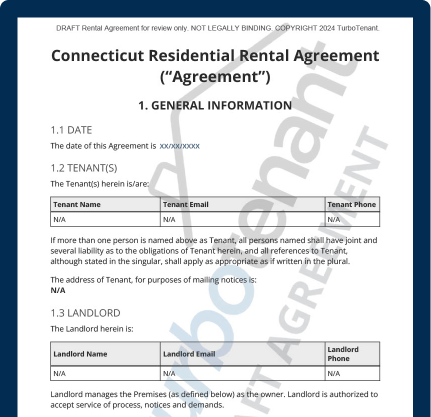
Connecticut Residential Lease Agreement
Learn MoreCreate a compliant Connecticut lease agreement in 15 minutes with TurboTenant's rental contract builder.
Connecticut Month-to-Month Lease Agreement
Learn MoreBuild your Connecticut month-to-month lease agreement in 15 minutes or less.
Types of Room Rental Contracts
- Room rental agreement: In Connecticut, a room rental agreement is a contract between a landlord and a tenant renting a single room within a property. It should spell out key details such as rent, utilities, deposits, and household rules. Tenants typically enjoy privacy in their bedrooms but share common areas such as kitchens, bathrooms, and living rooms.
- State law caps security deposits at 2 months’ rent for tenants under 62 and 1 month’s rent for those 62 or older (CT Gen Stat § 47a-21(b)). Landlords must return the deposit, plus interest, within 30 days of move-out (or 15 days of receiving the tenant’s forwarding address, whichever comes later), along with an itemized list of deductions.
- Roommate agreement: A Connecticut roommate agreement is a private contract among tenants sharing the same rental unit. It sets expectations for splitting rent, utilities, chores, and household rules. While not enforceable under Connecticut landlord-tenant law in the same way as a lease, it can help prevent disputes and provide a written record of shared responsibilities. It is also important that the document does not conflict with the landlord’s lease.
Rental Agreement Breaches
Even with a signed lease in place, situations can arise where tenants don’t meet their obligations. Connecticut law outlines clear steps landlords must follow when rent goes unpaid, when lease terms are broken, or when a unit is abandoned before the end of the rental period.
Failure to pay: If a tenant fails to pay rent, the landlord can serve a Notice to Quit. In Connecticut, this notice must give the tenant 3 days to pay the unpaid rent or vacate the unit (CT Gen Stat § 47a-23). If the tenant does not comply within the notice period, the landlord may file an eviction action (called a “Summary Process” case) through the housing court system.
Lease violations: For lease violations, such as property damage, unauthorized occupants, or repeated violations of house rules, landlords must provide a 15-day written notice identifying the breach and, in many cases, allowing the tenant to correct it (CT Gen Stat § 47a-15). If the tenant doesn’t cure the violation within 15 days, or if the breach is serious, such as creating a nuisance or engaging in illegal activity, the landlord may proceed directly with eviction.
Lease abandonment: If a tenant abandons the unit before the lease ends without notice or payment, the landlord must make reasonable efforts to re-rent the property. They may recover unpaid rent and damages, but cannot collect double rent for the same period from multiple tenants. Connecticut law also requires landlords to handle abandoned personal property in good faith. They must provide notice and store items for a reasonable period before disposing of them (CT Gen Stat § 47a-11b).
Self-help evictions: Connecticut strictly prohibits “self-help” evictions. Landlords may not change locks, shut off utilities, remove tenant belongings, or use threats to force tenants out. Only the court can order an eviction, and only a state marshal or authorized official may physically remove a tenant (CT Gen Stat § 47a-43).
Understanding these rules helps landlords respond appropriately while protecting tenants from unlawful practices. With that foundation in place, the following section covers landlord access laws, which strike a balance between the right to enter a rental property and the tenant’s right to privacy.
Room Rental Landlord Access Laws
Immediate access: Landlords may enter a rental unit without prior notice only in true emergencies, such as a fire, major water leak, or suspected gas leak, that threaten life, health, or property (CT Gen Stat § 47a-16(b)).
Landlord harassment: Connecticut tenants have the right to quiet enjoyment of their home. Landlords may not misuse the right of entry to harass or intimidate tenants, for example, by entering repeatedly without cause, arriving at unreasonable hours, or using entry as a form of retaliation. Such actions may violate both the lease and state law (CT Gen Stat § 47a-13).
Advance notice: For routine, non-emergency purposes, like repairs, inspections, or showing the property to prospective tenants, landlords must provide reasonable notice and may only enter at reasonable times (CT Gen Stat § 47a-16). While the statute does not specify an exact timeframe, 24 hours’ notice is generally considered a reasonable practice. Notice should include:
- The date of intended entry
- An approximate time window during normal hours
- The purpose of the entry
Providing a heads-up in advance ensures tenants have adequate warning, while allowing landlords to perform necessary duties.
Create Your Connecticut Room Rental Agreement
Save time and reduce stress by generating a Connecticut room rental agreement with TurboTenant. Our state-specific template offers a simple, printable PDF form that you can customize for your property, share online, and finalize with secure e-signatures.