


A Florida lease agreement is a legally binding contract between a landlord and tenant that outlines the terms and conditions of a rental arrangement. Once both parties sign the agreement, it becomes the governing document for the tenancy and establishes the rights and responsibilities of each party.
Standard lease agreements typically include details such as the rent amount and due date, security deposit terms, pet policies, and which expenses the rent covers, including utilities and trash collection.
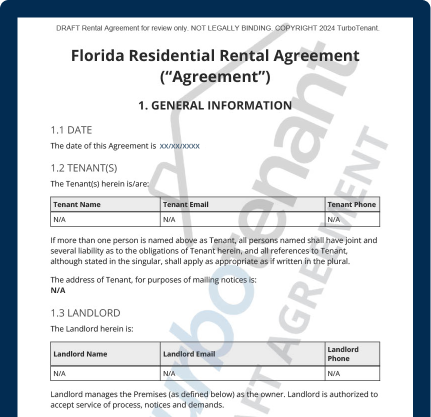
Below, we’ll explain the provisions landlords should include to help ensure compliance with Florida law. For a faster path to compliance, consider using TurboTenant’s customizable Florida rental agreement; we have carefully reviewed it to ensure compliance with Florida’s 2026 laws.

Florida Residential Lease Agreement
Current PageCreate a compliant Florida residential lease agreement with TurboTenant's rental contract builder in 15 minutes.
Florida Month-to-Month Lease Agreement
Learn MoreCreate your Florida month-to-month lease agreement in just 15 minutes.
Room Rental Agreement Florida
Learn MoreRent your extra room with a TurboTenant Florida room rental agreement.
Required Landlord Disclosures (5)
In addition to signing the residential lease agreement, tenants need to review and sign the disclosures required by state and federal law. These disclosures inform the tenant of certain aspects of the rental unit so they are aware of any hazards before moving into the property.
Failing to include legally required disclosures could result in denial of eviction, fees, or other legal penalties.
- Lead paint: Any unit built before 1978 must include a lead-based paint and lead-based paint hazard disclosure, along with the EPA’s lead hazard pamphlet. This is a federal requirement under 42 U.S.C. § 4852d.
- Radon gas: Florida landlords must include the state’s prescribed radon gas warning at or before signing any rental agreement. The requirement applies to all buildings and excludes only transient occupancy of 45 days or less (Fla. Stat. § 404.056(5)).
- Security deposit receipt: Florida landlords who rent five or more units must inform tenants, in writing, how they hold the deposit, the name and address of the bank, whether the account is interest-bearing, and whether the tenant receives interest in the lease or within 30 days of receiving the deposit (Fla. Stat. § 83.49(2)).
- Landlord’s name and address: Landlords must disclose, in writing, the name and address of the landlord or an agent authorized to receive notices, at or before the start of the tenancy (Fla. Stat. § 83.50).
- Flood disclosure: For any lease of 1 year or longer, Florida landlords must give tenants a separate written flood disclosure at or before signing. It states the landlord’s knowledge of prior flooding, flood insurance claims, and federal flood assistance (Fla. Stat. § 83.512).
Security Deposit Regulations
Maximum security deposit amount: Florida law does not set a maximum security deposit amount.
Receipt of deposit: Florida landlords with five or more rental units must give tenants written notice within 30 days after receiving the security deposit. The notice must identify where the landlord holds the deposit and whether the account earns interest (Fla. Stat. § 83.49(2)).
Deposit held separately: Florida landlords cannot commingle security deposit funds with personal funds. They must hold the deposit in a separate non-interest-bearing account, an interest-bearing account, or secure it with a surety bond (Fla. Stat. § 83.49(1)).
Interest: Florida landlords do not have to place security deposits in interest-bearing accounts. However, if a landlord holds the deposit in an interest-bearing account, the landlord must pay the tenant either 75% of the annualized average interest rate or 5% simple interest per year (Fla. Stat. § 83.49(1)).
Fee in lieu of security deposit: Florida landlords may offer tenants the option to pay a nonrefundable fee instead of a security deposit. If a tenant accepts, the landlord must use a written agreement containing the statute’s required disclosure language (Fla. Stat. § 83.491).
Deduction tracking: If a Florida landlord intends to deduct any portion of the security deposit, the landlord must provide written notice within 30 days after the tenant vacates the property. The notice must state the amount withheld and the reason for the deduction. Tenants then have 15 days to object in writing (Fla. Stat. § 83.49(3)).
Returning a tenant’s security deposit: Landlords must return the deposit within 15 days after the tenant moves out if they make no claim, or within 30 days after notifying the tenant of any deductions (Fla. Stat. § 83.49(3)(a)).
Landlord’s Access to Property
Advance notice: Florida landlords must give at least 24 hours’ notice before entering for repairs and may enter only between 7:30 a.m. and 8:00 p.m. (Fla. Stat. § 83.53(2)).
Immediate access: Florida landlords may enter a rental unit without advance notice in emergencies, when the tenant unreasonably withholds consent, or when the tenant is absent from the premises for a period equal to one-half the time between rental payments. However, if the rent is current, and the tenant informed the landlord of an anticipated absence, the landlord may only enter with the tenant’s consent to protect or preserve the property (Fla. Stat. § 83.53(2))
Landlord harassment: Landlords who abuse the right of access by repeatedly entering or ignoring the legal entry requirements may commit landlord harassment, which Florida law prohibits (Fla. Stat. § 83.53).
Rent Payment Laws
Grace period: Florida law does not require a grace period for rent payments, though many landlords include a reasonable grace period of 3-5 days in the lease agreement.
Late rent fees: Florida law does not set a statewide cap on residential late fees, but courts generally require the fee to be reasonable. Landlords must clearly state any late-fee terms in the lease agreement.
Tenant’s right to withhold rent: A Florida residential tenant generally cannot withhold rent unilaterally. After giving the landlord 7 days’ written notice of a material failure to maintain the unit, the tenant may terminate the lease if the landlord does not correct the issue (Fla. Stat. § 83.56(1)).
Breach of Rental Agreement
Missed rent payment: Landlords may issue a 3-Day Notice to Pay Rent or Vacate after a missed rent payment, counting only business days and excluding weekends and legal holidays (Fla. Stat. § 83.56(3)).
Lease violation: For curable violations, tenants generally have 7 days to fix the issue or vacate (Fla. Stat. § 83.56(2)(b)). For repeat violations within 12 months or certain serious conduct, landlords may give 7 days’ notice without an opportunity to cure (Fla. Stat. § 83.56(2)(a)).
Self-help evictions: Florida law prohibits removing a tenant without going through the court eviction process (Fla. Stat. § 83.67).
Lease abandonment: If a tenant abandons the lease early without legal justification, Florida landlords may recover damages allowed under the lease agreement and state law. A lease may set liquidated damages or an early-termination fee, capped at no more than 2 months’ rent, only through a separate signed addendum (Fla. Stat. § 83.595).
Ending a Lease
Month-to-month: Ending a month-to-month tenancy in Florida requires at least 30 days’ written notice, by the landlord or tenant, before the end of the monthly rental period (Fla. Stat. § 83.57).
Fixed-term: Florida tenants may legally terminate a fixed-term lease early in limited situations, including active military duty (Fla. Stat. § 83.682) or a landlord’s failure to keep the unit habitable (Fla. Stat. § 83.56(1)).
Property abandonment: Florida landlords must make a reasonable effort to notify tenants about property left behind after the tenancy ends. If the tenant does not claim the property within the statutory notice period, the landlord may dispose of it under Florida law (Fla. Stat. § 715.104).
Renewing a Lease
Required renewals: Florida landlords do not have to renew a tenant’s lease when the lease term expires.
Required notice: To end a tenancy with no fixed term, either party must give 60 days’ notice for a year-to-year tenancy or 30 days for a month-to-month tenancy (Fla. Stat. § 83.57). A fixed-term lease may require non-renewal notice of no less than 30 and no more than 60 days (Fla. Stat. § 83.575).
Florida Residential Lease Agreement FAQs
Does a landlord have to provide a copy of the Florida rental contract?
No. Florida law does not specifically require landlords to provide tenants with a copy of the signed residential lease agreement. However, both parties should keep a signed copy for their records and future reference.
What is the grace period for rent in Florida?
Florida law does not establish a mandatory grace period for rent payments. Unless the residential lease agreement states otherwise, rent is considered late immediately after the due date.
Can a landlord refuse to renew a Florida lease agreement?
Yes. Florida landlords generally do not have to renew a lease once the rental term expires, provided they follow any applicable notice requirements under the lease agreement or state law.
Does a Florida lease need to be notarized?
No. As of 2026, Florida residential lease agreements do not need to be notarized to be legally enforceable.
Can you withhold rent for repairs in Florida?
Not on your own. A Florida residential tenant who gives the landlord 7 days’ written notice of a material failure to maintain the unit may terminate the lease if the landlord does not fix the problem (Fla. Stat. § 83.56(1)). To dispute rent during an eviction, the tenant must deposit it into the court registry (Fla. Stat. § 83.60).
Disclaimer: TurboTenant does not provide legal advice. This material has been prepared for informational purposes only. All users are advised to check all applicable local, state, and federal laws and consult legal counsel should questions arise.