


A Hawaii lease agreement is a rental contract between a tenant and a landlord that outlines the tenant’s obligation to pay the landlord a set monthly amount to live at a specific property. But it isn’t a one-way street. It also guides the landlord’s responsibilities.
Once an applicant passes screening, the landlord will prepare a lease agreement for the renter to sign. Part of that process includes a number of required disclosures. We discuss those next.

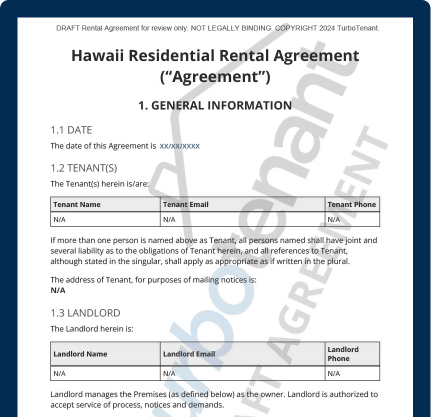
Hawaii Residential Lease Agreement
Current PageCreate a compliant Hawaii lease agreement in 15 minutes with TurboTenant's lease agreement builder.
Hawaii Month-to-Month Lease Agreement
Learn MoreBuild your Hawaii month-to-month lease agreement in 15 minutes or less.
Room Rental Agreement Hawaii
Learn MoreConsidering renting out a spare room? Make it official with a Hawaii room rental agreement.
Required Landlord Disclosures (4)
Every state has disclosures that tenants must sign during the residential lease agreement process.
Here are the disclosures required in Hawaii:
- Lead paint: Federal law requires landlords to notify tenants if a property built before 1978 has lead-based paint or lead-based paint hazards.
- Landlord and designated on-island agent information: If the landlord does not live on the island, the landlord must provide the name and address of the designated on-island agent appointed to manage or maintain the property (§521-43(f)).
- Excise tax number: Landlords must provide tenants with their excise tax number to take the necessary steps toward obtaining a low-income tax credit, if applicable (§521-43(h)).
- Move-in report: The landlord must give the tenant a report detailing the property’s condition before the tenant signs a rental contract (§ 521-42(6)).
Security Deposit Regulations
Maximum security deposit amount: A month’s rent is the maximum amount a Hawaii landlord can charge for a security deposit. If a tenant owns a pet, the landlord may charge an additional pet deposit (§ 521-44(b)).
Receipt of deposit: Landlords are not required to provide tenants with a security deposit receipt in Hawaii.
Deduction tracking: Hawaii landlords must give the tenant a written list of deductions from the security deposit, including invoices, within 14 days of the tenant’s final day living at the rental property (§ 521-44(b)(2)).
Returning a tenant’s security deposit: A landlord must return a security deposit to a tenant in Hawaii within 14 days from the last day of the tenancy (§ 521-44(b)(2)).
Landlord’s Access to Property
Advance notice: Tenants are entitled to 2 days’ notice before a landlord can access the unit (§ 521-53(b)).
Immediate access: A landlord does not have to give notice to enter in an emergency, and notifying the tenant beforehand is not an option (§ 521-53(b)).
Landlord harassment: Landlords are bound by the law not to harass tenants by entering the unit too early or too late in the day. In that vein, they must provide enough notice to enter, except in emergencies. Not giving enough notice before entry can give tenants sufficient reason to break a lease early (§ 521-53(b)).
Rent Payment Laws
Grace period: In Hawaii, tenants do not have extra time to pay after rent is due, as there is no grace period (§ 521-68(a)).
Late rent fees: Landlords can charge a late fee if desired, but it’s not required. The late fee should not exceed 8% of a month’s rent, and the Hawaii lease agreement must specify it (§521-21(f)).
Tenant’s right to withhold rent: Tenants have the right to withhold up to 1 month’s rent for repairs. If the landlord doesn’t handle critical repairs deemed essential to livability within 5 days of the tenant alerting them to the need for the repair, they can withhold rent. The tenant should obtain estimates from two companies, select the more affordable option, and commence the repair work. They must keep track of all expenses, receipts, and invoices so they can relay them to the landlord (§ 521-64(b)(2)).
Breach of Rental Agreement
Missed rent payment: Since Hawaii does not have a grace period for rent, a landlord can give the tenant a 5-day notice to end the lease (§ 521-68(a)).
Lease violation: A Hawaii landlord should first give the tenant written notice about their violation, letting them know they have 10 days to make amends. Otherwise, the rental agreement will terminate after that period (§521-72(a)).
Self-help evictions: Hawaii does not allow self-help evictions. Landlords must go through the legal eviction process (§ 521-63).
Lease abandonment: If a Hawaii tenant ends a lease early, they may be responsible for rent for the duration of the lease (§521-70(2)).
Ending a Lease
Month-to-month: In Hawaii, a landlord must give 45 days’ notice to end a month-to-month lease, while tenants must give 28 days’ notice (§521-71).
Fixed-term: Domestic violence and military service are grounds for a Hawaii tenant to break a fixed-term Hawaii lease agreement early (§521-80, §521-83).
Property abandonment: A landlord has the right to sell, store (on the tenant’s dime), or donate items a tenant has left behind. They have to try to contact the tenant beforehand. If the landlord successfully sells the tenant’s personal property, they must place the proceeds from the sale in a trust for 30 days, minus storage and advertising costs. If the tenant has not collected their items after the 30 days, the landlord retains the money made from the items (§521-56(a)(b)).
Renewing a Hawaii Lease Agreement
Required renewals: Hawaii landlords are not required to renew tenant leases.
Required notice: Hawaii landlords must give the tenant 45 days’ notice when ending a month-to-month lease. If the tenant chooses to terminate a month-to-month lease, they only have to give 28 days’ notice. For fixed-term leases, they must provide 10 days’ notice to end it. This rule applies to both parties. If the lease term lasts 12 months or more, it will end on the final day of the rental term unless the landlord and tenant have agreed to renew the lease automatically. In these cases, it may convert to month-to-month; however, it’s not a requirement in Hawaii (§521-71).
Disclaimer: TurboTenant does not provide legal advice. This material has been prepared for informational purposes only. All users are advised to check all applicable local, state, and federal laws and consult legal counsel should questions arise.
Hawaii Residential Lease Agreement FAQs
Does a landlord have to provide a copy of the lease in Hawaii?
If the lease is a written agreement, a landlord must give the tenant a copy of the lease (§521-43(2)).
What is the grace period for rent in Hawaii?
Hawaii state law doesn’t require a grace period for rent (§ 521-68(a)).
Can a landlord refuse to renew a lease in Hawaii?
Yes, landlords can refuse to renew a lease in Hawaii (§521-71).
Does a Hawaii lease need to be notarized?
A Hawaii lease does not need to be notarized.
Can you withhold rent for repairs in Hawaii?
Tenants can withhold up to 1 month’s rent for repairs if certain conditions are met (§ 521-64(b)(2)).