


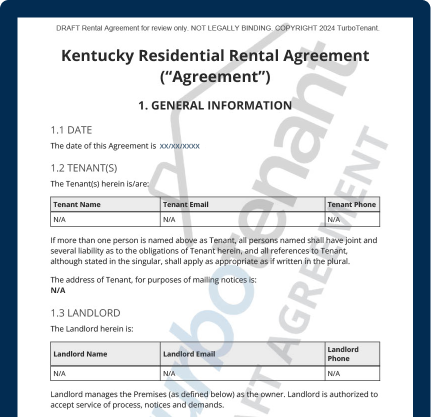

Clear expectations are key when renting out a room, whether the property is in Louisville, Lexington, or a smaller town. A Kentucky room rental agreement ensures that everyone understands the rules for rent, deposits, and utilities, helping to prevent the kinds of conflicts that can arise when
In this guide, we’ll walk you through everything you need to know about creating a Kentucky room rental lease agreement, plus how to access a simple, printable rental form tailored to your property.
Navigate Kentucky Leases

Room Rental Agreement Kentucky
Current PageRent your spare room with a Kentucky room rental agreement today.
Kentucky Residential Lease Agreement
Learn MoreCreate a compliant Kentucky lease agreement in 15 minutes with TurboTenant's rental contract builder.
Kentucky Month-to-Month Lease Agreement
Learn MoreBuild your Kentucky month-to-month lease agreement in just 15 minutes.
Types of Room Rental Contracts
Shared living can get complicated. Clear agreements help prevent disputes over money, chores, or shared spaces by putting expectations in writing.
Room rental agreement: When someone rents a bedroom in a Kentucky home, a written room rental agreement helps keep things clear. The contract should set expectations for rent, utilities, deposits, and upkeep, as well as any house rules.
As collateral, landlords may charge a security deposit of any amount in Kentucky. However, they must place it in a separate account and provide a written statement detailing the unit’s condition at the time of move-in. Landlords must return the deposit within 30–60 days, depending on whether the tenant disputes deductions (KY Rev Stat § 383.580).
Roommate agreement: A roommate agreement is a contract between co-tenants. It establishes how roommates will divide rent, utilities, chores, and other household responsibilities. While not enforceable under Kentucky landlord-tenant law in the same way as a lease, it provides a clear written record of household expectations.
By choosing the right agreement, landlords and tenants can avoid common pain points — like disagreements over cleaning duties or withheld deposits — and keep shared living arrangements running smoothly.
Rental Agreement Breaches
Disputes often arise when tenants fall behind on rent, violate lease rules, or leave without notice. Kentucky law provides clear steps for landlords to follow in the event of any of these occurrences.
Failure to pay: If a tenant fails to pay rent, the landlord can serve a 7-day Notice to Pay or Vacate. If the tenant does not pay the overdue rent within that period, the landlord can file for eviction through the court system (KY Rev Stat § 383.660(2)).
Lease violations: When tenants violate the lease, such as causing damage, keeping unauthorized pets, or disturbing neighbors, the landlord may issue a 14-day Notice to Cure or Quit. If the tenant corrects the violation within 14 days, the lease remains in effect. If not, the lease terminates at the end of the 30-day period stated in the notice. For serious or repeated violations, the landlord may proceed with eviction more quickly. If a tenant engages in illegal activity on the premises, Kentucky law allows landlords to act faster. Depending on the severity of the offense, the landlord may terminate the lease without giving an opportunity to cure (KY Rev Stat § 383.660(1)).
Lease abandonment: If a tenant abandons the rental without notice, the landlord may retake possession and must make reasonable efforts to re-rent the property. Landlords can recover unpaid rent and damages until a new tenant moves in. If the tenant leaves personal belongings behind, landlords must store the items and follow Kentucky’s abandoned property procedures before disposing of or selling them (KY Rev Stat § 383.695).
Self-help evictions: Kentucky law prohibits landlords from forcing a tenant out through lockouts, utility shut-offs, or removing a tenant’s belongings. All evictions must go through the court system. A landlord who attempts a self-help eviction risks tenant claims for damages and legal penalties (KY Rev Stat § 383.655).
By following these procedures, landlords protect themselves from costly lawsuits while tenants gain clear rights and remedies. Knowing the process upfront reduces disputes and keeps rental relationships more professional and predictable.
Room Rental Landlord Access Laws
Clear rules about when a landlord can enter a rental unit are essential for maintaining trust and respecting privacy. Tenants deserve peace of mind in their homes, while landlords need access to handle emergencies, repairs, or showings. Kentucky law seeks to accommodate both interests with specific guidelines.
Immediate access: A landlord may enter a rental unit without prior notice only in the event of an emergency, such as a fire, burst pipe, or gas leak that poses a threat to health or property (KY Rev Stat § 383.615(2)).
Landlord harassment: Tenants in Kentucky have the right to quiet enjoyment of their rental space. Landlords may not misuse their right of entry to intimidate or harass tenants. Repeated or unreasonable entries, especially at odd hours or without a valid reason, can amount to harassment (KY Rev Stat § 383.615(3)).
Advance notice: For routine entry, such as inspections, property showings, or repairs, landlords must provide at least 2 days’ notice and may only enter at reasonable times (KY Rev Stat § 383.615(1)). Entry must serve a legitimate purpose, and landlords and tenants can agree in writing to alternative notice procedures.
Create Your Kentucky Room Rental Agreement
TurboTenant gives you the tools to create a Kentucky room rental agreement that meets state requirements. In just minutes, you can generate a PDF form, personalize the terms, send it online, and collect secure e-signatures.