


A Kentucky lease agreement is a legally binding contract that allows a tenant to rent property from a landlord. It’s an essential document to any rental arrangement because it outlines the relationship between both parties, sets clear expectations for the lease term, and gathers important details in one place.
So while a lease agreement may sound simple, it carries plenty of legal nuance that landlords need to understand before handing over the keys. A clear agreement can help answer tenants’ questions, prevent avoidable mix-ups, and give both sides a reliable reference point throughout the tenancy. Let’s break it down.

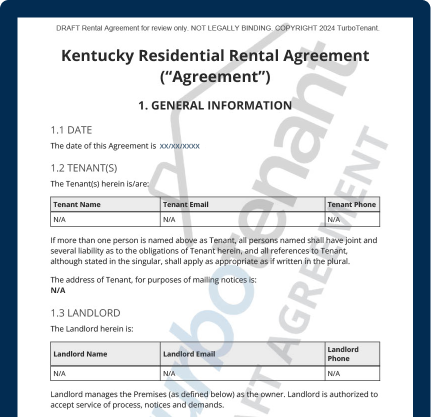
Kentucky Residential Lease Agreement
Current PageCreate a compliant Kentucky lease agreement in 15 minutes with TurboTenant's rental contract builder.
Kentucky Month-to-Month Lease Agreement
Learn MoreBuild your Kentucky month-to-month lease agreement in just 15 minutes.
Room Rental Agreement Kentucky
Learn MoreRent your spare room with a Kentucky room rental agreement today.
Required Landlord Disclosures (5)
Kentucky takes an unusual approach to landlord-tenant law. The state’s Uniform Residential Landlord and Tenant Act (URLTA), found in Ky. Rev. Stat. § 383.500 to § 383.715, applies only in the roughly 19 cities and counties that have adopted it, such as Louisville Metro and Lexington-Fayette.
Where it applies, the URLTA rules below govern. Everywhere else, the written lease and general Kentucky law control, so landlords should confirm whether their local government has opted in. The lead-based paint and methamphetamine disclosures apply statewide either way.
The following written disclosures help keep the lease compliant and give tenants important information before the tenancy begins:
- Lead-based paint: Landlords must disclose known lead-based paint and hazards in most units built before 1978, share any available records, include a Lead Warning Statement in the lease, and give tenants the EPA-approved lead hazard pamphlet. Federal law mandates this statewide (42 U.S.C. § 4852d).
- Methamphetamine contamination: Owners must disclose in writing if a methamphetamine contamination notice has been posted on the property and the property has not yet been decontaminated and released from further action. This requirement applies statewide (Ky. Rev. Stat. Ann. § 224.1-410).
- Landlord identification (URLTA jurisdictions): Landlords must disclose the name and address of the person authorized to manage the property, along with the owner or a person authorized to act for the owner to receive notices and service of process (Ky. Rev. Stat. Ann. § 383.585).
- Security deposit location (URLTA jurisdictions): Landlords must inform prospective tenants of the location and account number of the separate account where they hold the security deposit (Ky. Rev. Stat. Ann. § 383.580).
- Move-in checklist (URLTA jurisdictions): Before collecting a security deposit, landlords must give tenants a list of existing damage in the unit, and tenants may inspect the premises to confirm the list’s accuracy. At move-out, the landlord compares the unit’s condition and provides an itemized list of any damage and estimated repair costs. A landlord who fails to provide the move-in or move-out list, or to hold the deposit properly, forfeits the right to keep any of the deposit (Ky. Rev. Stat. Ann. § 383.580).
Security Deposit Regulations
Except for the cap, the rules below come from URLTA and apply in jurisdictions that have adopted it. Elsewhere, the written lease governs how the deposit is held and returned.
Maximum security deposit amount: Kentucky law does not cap the amount a landlord can charge a tenant for a security deposit, statewide.
Receipt of deposit: In URLTA jurisdictions, landlords must tell prospective tenants the location of the separate account where the security deposit is held, along with the account number. Landlords must keep the deposit in an account used only for that purpose with a bank or lending institution regulated by Kentucky or the United States (Ky. Rev. Stat. Ann. § 383.580).
Deduction tracking: Landlords may deduct from the security deposit for unpaid rent or damage beyond normal wear and tear. As noted above, landlords must provide the move-in and move-out damage lists, or they forfeit the right to retain any of the deposit (Ky. Rev. Stat. Ann. § 383.580).
Returning a tenant’s security deposit: Kentucky law does not set one simple 30-day return deadline for every situation. If the tenant leaves without paying the last month’s rent and does not demand the deposit back, the landlord may apply the deposit to amounts owed after 30 days. If the tenant leaves with a refund due, the landlord must send notice of the refund amount to the tenant’s last known or reasonably determinable address (Ky. Rev. Stat. Ann. § 383.580).
Landlord’s Access to Property
The access rules below apply in URLTA jurisdictions. In other areas, the lease sets the terms of entry, so landlords should spell them out clearly.
Advance notice: Landlords must give tenants at least two days’ notice before entering and may enter only at reasonable times, except in emergencies, under a court order, or when the tenant consents at the time of entry (Ky. Rev. Stat. Ann. § 383.615).
Immediate access: In an emergency, the landlord may enter the property without advance notice or the tenant’s consent (Ky. Rev. Stat. Ann. § 383.615).
Landlord harassment: If a landlord enters unlawfully, makes a lawful entry unreasonably, or makes repeated demands for entry that harass the tenant, the tenant may seek a court order to stop the behavior, terminate the lease, and recover damages (Ky. Rev. Stat. Ann. § 383.700).
Rent Payment Laws
Grace period: Kentucky law does not require a mandatory grace period for rent payments. Rent is due at the time and place listed in the lease unless the rental agreement gives the tenant extra time to pay.
Late rent fees: Kentucky law does not set a specific limit on late fees. If landlords charge them, the lease should clearly list the amount of the fee, when it applies, and when the tenant must pay it. Courts may still refuse to enforce a fee that is unreasonable.
Tenant’s right to withhold rent: Kentucky tenants should not stop paying rent to persuade a landlord to make repairs. With that in mind, in areas where Kentucky’s URLTA applies, tenants may have remedies when a landlord fails to provide essential services, such as heat, running water, electricity, or gas (Ky. Rev. Stat. Ann. § 383.640).
Breach of Rental Agreement
The notice procedures below come from URLTA and apply where it has been adopted. In other areas, the lease and general Kentucky law govern, though every eviction must still go through the courts.
Missed rent payment: Once a tenant misses a rent payment, landlords in URLTA jurisdictions may issue a seven-day Notice to Pay or Quit. If the tenant does not pay within seven days after receiving written notice, the landlord may terminate the rental agreement (Ky. Rev. Stat. Ann. § 383.660).
Lease violation: Landlords can deliver a 14-day Notice to Cure or Quit for lease violations. If the tenant commits substantially the same violation within six months, the landlord does not have to give another chance to cure and may terminate after at least 14 days’ written notice (Ky. Rev. Stat. Ann. § 383.660).
Self-help evictions: Kentucky does not allow self-help evictions anywhere in the state. Landlords should never try to remove a tenant themselves and should follow the legal eviction process.
Lease abandonment: Tenants who break a lease early without cause may owe rent for the remainder of the term. In URLTA jurisdictions, landlords must make reasonable efforts to re-rent the unit at a fair rental price, which relieves the tenant of the remaining responsibility once a new tenancy begins (Ky. Rev. Stat. Ann. § 383.670).
Ending a Lease
Month-to-month: In URLTA jurisdictions, either party can terminate a month-to-month lease with at least 30 days’ written notice (Ky. Rev. Stat. Ann. § 383.695). Elsewhere, the lease terms and general Kentucky law govern the notice required.
Fixed-term: Kentucky tenants may end a fixed-term lease early without penalty only in limited situations. Active-duty servicemembers who receive qualifying military orders may terminate under the federal Servicemembers Civil Relief Act (50 U.S.C. § 3955). A tenant protected by a valid domestic violence or interpersonal protective order may terminate a lease entered into or renewed on or after June 29, 2017, with at least 30 days’ written notice and a copy of the order (Ky. Rev. Stat. Ann. § 383.300). In URLTA jurisdictions, a tenant may also terminate when the landlord abuses the right of access or harasses the tenant (Ky. Rev. Stat. Ann. § 383.700).
Property abandonment: Kentucky does not provide a specific statewide process for handling a tenant’s personal property after the tenant leaves the rental. Landlords should document the property, review the lease, and give reasonable notice before disposing of any valuable items.
Renewing a Lease
Required renewals: Kentucky landlords can refuse to renew a lease for any lawful, non-discriminatory, and non-retaliatory reason.
Required notice: Kentucky law does not require landlords to provide notice of their intent not to renew a fixed-term lease unless the lease says otherwise. In URLTA jurisdictions, either party must give at least 30 days’ written notice to end a month-to-month tenancy (Ky. Rev. Stat. Ann. § 383.695). In other areas, the lease and general Kentucky law set the notice required.
Kentucky Residential Lease Agreement FAQs
Does a landlord have to provide a copy of the lease in Kentucky?
Kentucky law does not require landlords to provide tenants with a copy of the lease. Even so, giving the tenant a signed copy is good practice and prevents disputes.
What is the grace period for rent in Kentucky?
Kentucky law does not require a grace period for rent. Rent is due at the time and place listed in the lease, unless the rental agreement gives the tenant additional time to pay (Ky. Rev. Stat. Ann. § 383.565).
Can a landlord refuse to renew a Kansas lease?
Yes. Kentucky landlords can refuse to renew a lease when the term ends unless the lease says otherwise. In URLTA jurisdictions, either party must give at least 30 days’ written notice to end a month-to-month tenancy (Ky. Rev. Stat. Ann. § 383.695).
Does a Kentucky rental contract need to be notarized?
Kentucky rental contracts do not need to be notarized. Once signed, the lease binds both parties to its terms.
Can you withhold rent for repairs in Kentucky?
Kentucky tenants should not simply stop paying rent for repairs. In areas where Kentucky’s URLTA applies, tenants may have repair-and-deduct options for certain health and safety issues (Ky. Rev. Stat. Ann. § 383.635, § 383.640).
What should landlords add to a Kentucky residential lease agreement?
Landlords should add the rental terms, rent amount, security deposit details, property rules, maintenance responsibilities, and required disclosures to their Kentucky residential lease agreement. A downloadable PDF form, lease sample, or template can help organize the document before either party signs.
Disclaimer: TurboTenant does not provide legal advice. This material has been prepared for informational purposes only. All users are advised to check all applicable local, state, and federal laws and consult legal counsel should questions arise.