


A Louisiana lease agreement is one of the most important documents you’ll create when running a rental property business. Why? Because it brings the lease terms, property rules, responsibilities, disclosures, and other key details together in one place before the tenant moves in.
With a well-built lease agreement in place, landlords have a clear point of reference when tenants raise questions, disputes, or unexpected issues during the tenancy. Strong lease terms can help protect the property, support fair enforcement, and keep both sides on the same page. Let’s start with disclosures.

Louisiana Residential Lease Agreement
Current PageCreate a compliant Louisiana lease agreement in 15 minutes with TurboTenant's rental contract builder.
Louisiana Month-to-Month Lease Agreement
Learn MoreCreate a Louisiana month-to-month lease agreement in 15 minutes.
Room Rental Agreement Louisiana
Learn MoreRent your spare room with a Louisiana room rental agreement today.
Required Landlord Disclosure (1)
Disclosure requirements vary by state, and landlords should provide any required disclosures in writing before or at the time of lease signing. Louisiana does not require a state-specific disclosure for every residential lease, but landlords must still include the following federally mandated disclosure:
- Lead-based paint: Federal law requires landlords of most housing built before 1978 to disclose known lead-based paint and hazards, share any available records or reports, include a Lead Warning Statement in the lease, and give tenants the EPA-approved lead hazard pamphlet (42 U.S.C. § 4852d).
Security Deposit Regulations
Maximum security deposit amount: Louisiana law does not set a maximum security deposit amount, but landlords should keep the amount reasonable and clearly list it in the lease.
Receipt of deposit: Louisiana landlords do not have to provide tenants with a receipt for the security deposit.
Deduction tracking: Landlords may withhold deposit funds reasonably necessary to remedy a tenant’s default, such as unpaid rent or damage beyond normal wear and tear. If the landlord withholds any portion, they must give the tenant an itemized statement that explains the deductions (La. Rev. Stat. § 9:3251).
Returning a tenant’s security deposit: Landlords must return a security deposit within one month after the lease ends, unless they lawfully retain all or part of it. Tenants should give the landlord a forwarding address so the landlord can send the deposit and any itemized statement. Starting August 1, 2026, landlords who retain any portion may take up to 15 additional days after that one-month deadline to send the itemized statement (La. Rev. Stat. § 9:3251).
Landlord’s Access to Property
Advance notice: Louisiana law does not set a specific notice period for landlord entry, so landlords should address entry terms in the lease. Landlords should give reasonable advance notice and enter at reasonable times to respect the tenant’s peaceful possession of the property (La. Civ. Code art. 2682).
Immediate access: Because Louisiana law does not set specific landlord entry rules, landlords should reserve the right to enter in an emergency under the lease. In a true emergency, landlords may enter without advance notice to protect the property or address an urgent safety issue.
Landlord harassment: Louisiana does not have a specific residential entry statute, but landlords must protect the tenant’s peaceful possession during the lease. Excessive or unreasonable entry may interfere with that right and could give the tenant grounds to pursue legal action against the landlord (La. Civ. Code art. 2682).
Rent Payment Laws
Grace period: Louisiana law does not require a grace period for late rent payments. Rent is due on the date listed in the lease unless the rental agreement gives the tenant extra time to pay.
Late rent fees: Louisiana law does not set a specific limit on late fees. Before assessing a late fee, landlords should clearly state the fee amount, the due date, and the period during which the fee applies in the rental contract.
Tenant’s right to withhold rent: Louisiana tenants should not stop paying rent when they need repairs. That said, if a landlord fails to make necessary repairs within a reasonable time after the tenant demands them, the tenant may make the repairs and either deduct the reasonable cost from the rent or demand immediate reimbursement. The repair must be necessary, and the cost must be reasonable (La. Civ. Code art. 2694).
Breach of Rental Agreement
Missed rent payment: After a missed rent payment, Louisiana landlords can deliver a five-day Notice to Vacate. The notice must give the tenant at least five days from the date of delivery to vacate before the landlord continues with the eviction process, unless the tenant waived notice in the lease (La. Code Civ. Proc. art. 4701).
Lease violation: A lease violation can also lead to a five-day Notice to Vacate in Louisiana. State law does not require landlords to give tenants a chance to cure a violation before moving forward, unless the lease says otherwise (La. Code Civ. Proc. art. 4701).
Self-help evictions: Louisiana landlords should never attempt to evict a tenant on their own. Landlords should follow the court eviction process instead of changing locks, removing belongings, or using other self-help tactics.
Lease abandonment: Tenants who leave before the end of the lease may owe unpaid rent and other amounts allowed by the lease or Louisiana law. If a landlord sues for those amounts, the landlord should still make reasonable efforts to limit the losses, such as trying to re-rent the unit, because a court may reduce damages the landlord could have avoided (La. Civ. Code art. 2002).
Ending a Lease
Month-to-month: Landlords and tenants can end a month-to-month lease with written notice given at least 10 calendar days before the end of the rental month (La. Civ. Code art. 2728, art. 2729).
Fixed-term: Tenants may end a fixed-term lease early and without penalty only when they meet a qualifying legal reason, such as a qualifying military relocation or status change, domestic abuse, or sexual assault, depending on the facts and required documentation (La. Rev. Stat. § 9:3261, § 9:3261.1, § 9:3261.2).
Property abandonment: Louisiana does not provide a detailed, statewide process for handling personal property left behind by a tenant after moving out. Landlords should document the property, review the lease, and consult local counsel before disposing of any valuable items.
Renewing a Lease
Required renewals: Louisiana landlords do not have to renew a tenant’s lease upon expiration, unless the lease states otherwise.
Required notice: A fixed-term lease ends on its expiration date without notice unless the parties extend it (La. Civ. Code art. 2720). If the tenant stays past the expiration date and the landlord does not object, the lease reconducts and continues month-to-month on the same terms (La. Civ. Code art. 2721). To end a month-to-month or reconducted lease, either party must give written notice at least 10 calendar days before the end of the month (La. Civ. Code art. 2728).
Louisiana Residential Lease Agreement FAQs
Does a landlord have to provide a copy of the lease in Louisiana?
Louisiana law does not require landlords to provide tenants with a copy of the lease.
What is the grace period for rent in Louisiana?
Louisiana law does not require a grace period for rent payments. Rent is due on the date listed in the lease unless the rental agreement gives the tenant extra time to pay.
Can a landlord refuse to renew a lease in Louisiana?
Yes. Louisiana landlords can refuse to renew a lease at the end of its term unless the lease says otherwise. A fixed-term lease ends on its expiration date without notice (La. Civ. Code art. 2720).
Does a Louisiana lease need to be notarized?
Louisiana rental contracts do not need to be notarized to be legally valid. A lease may be oral or in writing (La. Civ. Code art. 2681).
Can you withhold rent for repairs in Louisiana?
Louisiana tenants should not stop paying rent to pressure the landlord into making repairs. If a landlord fails to make necessary repairs within a reasonable time after the tenant demands them, the tenant may make the repair and either request reimbursement or apply the reasonable cost to rent (La. Civ. Code art. 2694).
What goes into a complete Louisiana residential lease agreement?
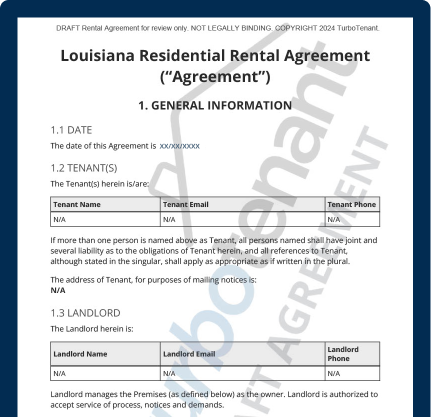
A Louisiana residential lease agreement should work as a complete rental document, not just a basic form. Landlords can start with a downloadable PDF template or sample, then add the rental terms, payment details, property rules, disclosures, signatures, and more. They should always keep a copy for their records.
Disclaimer: TurboTenant does not provide legal advice. This material has been prepared for informational purposes only. All users are advised to check all applicable local, state, and federal laws and consult legal counsel should questions arise.