


A Maryland lease agreement is a legal contract outlining the terms of renting property. In this guide, we’ll cover the required disclosures and laws applicable to the entire state. However, we will not dive into specifics regarding Montgomery County and Baltimore lease agreements.
Please note that our residential lease agreement template applies to those counties. While this guide doesn’t detail the laws in those areas, you can still build a compliant lease with TurboTenant, no matter your location in Maryland.

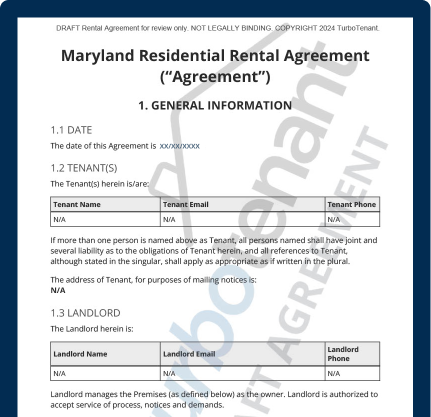
Maryland Residential Lease Agreement
Current PageCreate a compliant Maryland residential lease agreement in 15 minutes with TurboTenant's rental contract builder.
Maryland Month-to-Month Lease Agreement
Learn MoreBuild your Maryland month-to-month lease agreement in 15 minutes.
Room Rental Agreement Maryland
Learn MoreUse a TurboTenant Maryland room rental agreement to legitimize your house hacking endeavors.
Required Landlord Disclosures (6)
Disclosures are like lease addenda, providing the tenant with additional information about the rental property and allowing landlords to highlight necessary aspects of the unit.
Maryland law requires the following disclosures in residential lease agreements:
- Lead-based paint: The only federally required disclosure concerns lead-based paint and its hazards. Landlords of units built before 1978 must inform tenants of these hazards at lease signing.
- Landlord identification: Maryland landlords must provide the name, address, and phone number of the landlord or person authorized to manage the property. (MD Code, Real Property § 8-210).
- Security deposit receipt: When accepting a security deposit, landlords must provide the tenant a written receipt that lays out the Maryland rules for handling and returning the deposit, as well as the right for landlords to inspect the property with notice (MD Code, Real Property § 8-203(c)(1), 8-203.1).
- Shared utilities: If tenants split utility payments, the landlord must disclose how they’ll divide the payments among tenants (Tenant Protection Act of 2022).
- Habitability disclosure: The rental agreement must include a statement on habitability and safety. It should list any known defects and the person responsible for repair (MD Code, Real Prop. Sect. 8-212).
- Landlords must attach the 2024 Renters’ Rights and Stabilization Act to the lease.
Security Deposit Regulations
Maximum security deposit amount: As of October 1, 2024, Maryland landlords are legally allowed to charge up to 1 month’s rent for the security deposit (MD Code, Real Property § 8-203(b)(1)).
Receipt of deposit: Landlords in Maryland must provide a detailed receipt of the security deposit upon acceptance (MD Code, Real Property § 8-203(c)(1), 8-203.1).
Interest: Maryland landlords must pay interest on security deposits. In addition, they must keep them in interest-bearing accounts at a rate of either 1.5% per year or the amount based on the U.S. Treasury yield curve, whichever is greater (MD Code, Real Property § 8-203(e)(1)).
Deduction tracking: Landlords may withhold funds from the security deposit for unpaid rent or damage to the unit beyond normal wear and tear. They must provide an itemized list of reductions within 45 days of the lease end date (MD Code, Real Property § 8-203(f)(1)(i)).
Returning a tenant’s security deposit: Security deposits and an itemized list of repair reductions must be returned to the tenant within 45 days of the end date of the lease term (MD Code, Real Property § 8-203(g)(1)).
Landlord’s Access to Property
Advance notice: Landlords may enter a tenant’s property anytime for reasonable purposes, like maintenance and emergency repairs. The state does not provide specific guidelines.
Immediate access: Maryland does not specify how a landlord may enter the property. Therefore, entering the property for emergency repairs is allowed.
Landlord harassment: Although Maryland law does not dictate how a landlord can enter a tenant’s unit, excessive entry could qualify as landlord harassment. Tenants must petition the court, but they may have the opportunity to break the lease early and without penalty in cases of landlord harassment (MD Code, Real Property § 8-204).
Rent Payment Laws
Grace period: Maryland has no mandatory grace period for late rent payments.
Late rent fees: The maximum late rent fee in Maryland is 5% (MD Code, Real Property § 8-208(d)(3)).
Tenant’s right to withhold rent: Tenants may be able to withhold rent when a landlord does not repair an emergency condition within a reasonable timeframe by bringing an action of rent escrow to the court (MD Code, Real Property § 8-211(i)).
Breach of Rental Agreement
Missed rent payment: Once a rent payment is late, landlords may deliver a 10-day Notice to Pay or Quit (MD Code, Real Property § 8-401(c)).
Lease violation: Maryland landlords may deliver a 30-day notice to tenants upon noticing a lease violation. They do not have to give the tenant the option to cure (MD Code, Real Property § 8-402).
Self-help evictions: Landlords should never attempt self-help evictions. They must follow the proper eviction process in all eviction matters.
Lease abandonment: A tenant who breaks a lease early and without a qualifying reason could be subject to legal penalties and the remainder of the rent due for the lease period. However, Maryland landlords must attempt to re-rent the unit at fair market value, availing the tenant of the remainder of the rent due (MD Code, Real Property § 8-207).
Ending a Lease
Month-to-month: Maryland landlords may terminate a month-to-month lease with at least 60 days written notice. Tenants may terminate with 30 days’ notice (MD Code, Real Property § 8-402(c)(2)).
Fixed-term: Tenants can break a lease without penalty if they meet qualifying conditions. Conditions include entering active military duty, landlord harassment, domestic violence, or if the tenant dies before the end of their lease term.
Property abandonment: Maryland landlords are not obligated to attempt to return or store property left behind by tenants once they leave unit (MD Code, Real Property § 8-208(d)(6)).
Renewing a Lease
Required renewals: The law does not require landlords to renew a tenant’s lease upon expiration of the lease term.
Required notice: Maryland landlords must provide at least 60 days’ notice when they intend to terminate a tenant’s month-to-month lease. They must provide 90 days’ notice when they intend not to renew a yearly lease. The law does not require landlords to notify tenants when a fixed-term lease ends and transitions to a month-to-month agreement (MD Code, Real Property § 8-402).
Disclaimer: TurboTenant does not provide legal advice. This material has been prepared for informational purposes only. All users are advised to check all applicable local, state, and federal laws and consult legal counsel should questions arise.
Maryland Residential Lease Agreement FAQs
Does a landlord have to provide a copy of the lease in Maryland?
Landlords in Maryland must provide a written copy of the lease if the tenant requests it in writing.
What is the grace period for rent in Maryland?
Maryland state law does not establish a grace period for rent.
Can a landlord refuse to renew a lease in Maryland?
Landlords can refuse to renew a month-to-month lease by providing the tenant with at least 60 days’ written notice. Yearly leases require at least 90 days’ written notice.
Does a Maryland lease need to be notarized?
Maryland leases do not need to be notarized.
Can you withhold rent for repairs in Maryland?
Tenants may be able to withhold rent for repairs if landlords do not make necessary repairs in a reasonable timeframe and the action is brought to the court (MD Code, Real Property § 8-211(i)).