



Shared housing is common in Mississippi. Whether it involves students near the University of Mississippi, families seeking extra income in suburban neighborhoods, or workers finding temporary housing along the Gulf Coast. A room rental lease agreement helps make those living situations smoother by clearly outlining rent details, utilities, deposits, and household expectations, while ensuring the lease complies with state law.
In this guide, you will find everything you need to prepare a Mississippi room rental agreement, from disclosures to renewals.
Navigate Mississippi Leases

Room Rental Agreement Mississippi
Current PageRent your spare room with a Mississippi room rental agreement today.
Mississippi Residential Lease Agreements
Learn MoreCreate a compliant Mississippi lease agreement in 15 minutes with TurboTenant's rental contract builder.
Mississippi Month-to-Month Lease Agreement
Learn MoreCreate your Mississippi month-to-month lease agreement in 15 minutes or less.
Types of Room Rental Contracts
In Mississippi, shared housing typically falls into two categories: agreements with the landlord or arrangements made among roommates. Each serves a distinct purpose in maintaining a transparent and manageable living situation.
Room rental agreement:A room rental agreement is a formal lease signed with the property owner, also known as the landlord. It outlines rent, utilities, deposits, and house rules so all parties understand expectations from the start.. Under Mississippi law, landlords may collect a security deposit of up to 2 months’ rent (Miss. Code § 89-8-21). Deposits must be returned within 45 days after the lease ends, along with a written list of any applicable deductions. If a landlord wrongfully withholds a deposit, the tenant can recover the full amount plus damages and attorney’s fees.
Roommate agreement:Housemates use roommate agreements to maintain a sane living situation. It covers aspects of living together, including rent and utility payments, household chores, and the use of common areas. While not legally enforceable under Mississippi landlord-tenant law, a written agreement helps prevent disputes, provided it does not conflict with the landlord’s lease.
Clear agreements are the foundation of smoother living arrangements. Next, we’ll cover how Mississippi law addresses breaches, such as missed rent or other lease violations.
Rental Agreement Breaches
Failure to pay: If a tenant fails to pay rent, the landlord may serve a 3-day Notice to Pay or Quit (Miss. Code § 89-7-27). If the tenant does not pay within that period, the landlord can file an eviction action (known in Mississippi as an “unlawful entry and detainer”) in court. Only a judge may issue an order of eviction, and law enforcement is responsible for enforcing it.
Lease violations: When tenants break lease terms, such as causing damage, keeping unauthorized pets, or creating disturbances, the landlord may issue a 30-day Notice to Cure or Vacate (Miss. Code § 89-8-13(3)). If the tenant fails to correct the violation within the specified period, the landlord may proceed with eviction through the court. For serious or criminal activity that poses a threat to health or safety, the landlord may shorten the notice period to 14 days before filing for possession.
Lease abandonment: If a tenant abandons the unit without notice, the landlord may reclaim the property and attempt to re-rent it. Mississippi law requires landlords to make reasonable efforts to mitigate damages by replacing the departed tenant (Miss. Code § 89-8-13(5)). The landlord may still pursue the former tenant for unpaid rent or damages, but cannot double-charge rent during overlapping tenancies.
Self-help evictions: Mississippi prohibits landlords from bypassing the court process. Changing locks, cutting off utilities, or removing a tenant’s belongings without a court order are considered illegal “self-help” evictions. All removals must follow legal procedures, with enforcement handled only by law enforcement officers under a court-issued writ of possession (Miss. Code § 89-7-31).
By following these procedures, landlords can enforce lease terms without exposing themselves to liability. Next, we’ll review Mississippi’s rules on landlord access and tenant privacy.
Room Rental Landlord Access Laws
Mississippi law sets clear boundaries for when landlords can enter a tenant’s home. These rules balance the landlord’s need to maintain the property with the tenant’s right to privacy.
- Immediate access: Allowed only in emergencies, such as fire, flooding, or a suspected gas leak, when quick action is needed to protect life or property (Miss. Code § 89-8-25(2)).
- Landlord harassment: Tenants have the right to a quiet enjoyment of the premises. Repeated, unnecessary, or late-night entries (or entries without valid cause) may be considered harassment and violate state law (Miss. Code § 89-8-25(3)).
- Advance notice: For routine reasons, like inspections, repairs, or showings, landlords must give reasonable notice and enter at reasonable times (Miss. Code § 89-8-25(1)). While no exact timeframe is defined, most people consider 24 hours a reasonable amount of time. Written agreements may set different notice terms.
Respecting these rules helps landlords protect their properties while honoring tenant privacy. Next, we’ll look at sample lease agreements that put these requirements into practice.
Create Your Mississippi Room Rental Agreement
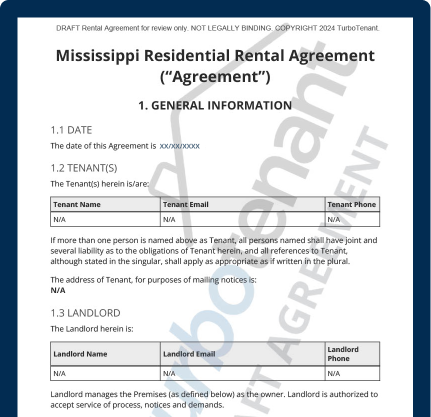
With TurboTenant, you can quickly create a Mississippi room rental agreement that meets state requirements. Generate a printable PDF form, customize it for your property, share it online, and finalize it with secure e-signatures, all in just a few clicks.