


A Mississippi lease agreement sets the terms and conditions of a rental property arrangement. This crucial contract outlines both parties’ responsibilities and helps ensure they understand and comply with applicable state and federal laws.
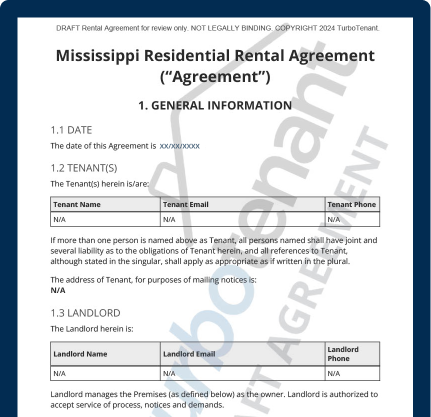
To make a rental arrangement official, landlords can download sample PDF forms from TurboTenant to create a legally binding lease agreement template. That said, they should still understand the laws governing rental lease agreements in Mississippi for 2026 and beyond.

Mississippi Residential Lease Agreements
Current PageCreate a compliant Mississippi lease agreement in 15 minutes with TurboTenant's rental contract builder.
Mississippi Month-to-Month Lease Agreement
Learn MoreCreate your Mississippi month-to-month lease agreement in 15 minutes or less.
Room Rental Agreement Mississippi
Learn MoreRent your spare room with a Mississippi room rental agreement today.
Required Landlord Disclosure (1)
Federal law requires landlords to make the following disclosure to tenants before signing a Mississippi residential lease agreement:
- Lead paint: Landlords must disclose any known lead-based paint or lead-based paint hazards on the property for all units built before 1978 (42 U.S.C. § 4852d).
The state of Mississippi does not require any additional disclosures.
Security Deposit Regulations
Maximum security deposit amount: Mississippi landlords can charge any amount they see fit for a security deposit.
Receipt of deposit: Mississippi law does not require landlords to issue a receipt for a security deposit, but landlords should maintain a paper trail of any deposits they accept.
Deduction tracking: Mississippi landlords may withhold security deposit funds for unpaid rent, cleaning, damages beyond ordinary wear and tear, or other reasonable and necessary expenses the tenant causes. Landlords must give the tenant written notice that itemizes any claimed deductions (Miss. Code Ann. § 89-8-21(3)).
Returning a tenant’s security deposit: Landlords must return any remaining portion of the security deposit, along with an itemized statement of deductions, no later than 45 days after the tenancy ends, the tenant delivers possession, and the tenant demands the deposit’s return (Miss. Code Ann. § 89-8-21(3)).
Landlord’s Access to Property
Advance notice: Mississippi law does not regulate when or how a landlord may enter a tenant’s unit, but landlords should consider giving at least 24 hours’ notice and entering only during reasonable hours.
Immediate access: In an emergency, Mississippi landlords can enter a tenant’s unit without prior notice.
Landlord harassment: Mississippi law does not require advance notice before entry, although repeated or unreasonable entry may create disputes or violate the lease terms. If either party materially breaches the lease, the non-breaching party may give notice and follow Mississippi’s lease-termination process (Miss. Code Ann. § 89-8-13).
Rent Payment Laws
Grace period: Mississippi law does not specify a grace period for late rent payments.
Late rent fees: Mississippi law does not limit them. To enforce fees, landlords must outline them in the residential lease agreement.
Tenant’s right to repair and deduct: If a landlord does not repair a specific material defect within 30 days of written notice, the tenant may make the repair and seek reimbursement, or offset the cost against future rent. The tenant must submit receipted bills, remain current on rent, and keep repair costs under 1 month’s rent (Miss. Code Ann. § 89-8-15).
Breach of Rental Agreement
Missed rent payment: If a tenant fails to pay rent, the landlord may give written notice that the rental agreement will terminate if the tenant does not pay within 3 days (Miss. Code Ann. § 89-8-13(5)).
Lease violation: Mississippi landlords may issue a 14-Day Notice to Cure or Quit, giving the tenant a chance to correct the violation. If the tenant commits a substantially similar violation within 6 months, the landlord may issue a 14-day Notice to Quit without offering another chance to cure (Miss. Code Ann. § 89-8-13(3)).
Self-help evictions: Attempting a self-help eviction by changing the locks or removing the tenant’s belongings can expose the landlord to civil or legal liability. Landlords should always follow the legal eviction process.
Lease abandonment: A tenant who breaks the lease early without cause may owe the full amount of rent due for the remainder of the lease term. Mississippi has no law limiting the amount a tenant can owe when ending a lease early, and it does not require landlords to mitigate damages by re-renting the unit as quickly as possible.
Ending a Lease
Month-to-month: Tenants or landlords may terminate a month-to-month lease agreement in Mississippi by giving at least 30 days’ written notice (Miss. Code Ann. § 89-8-19(3)).
Fixed-term: Mississippi tenants may end a lease early without penalty in limited situations, such as active military duty (50 U.S.C. § 3955), a material breach by the landlord that goes unremedied after proper notice (Miss. Code Ann. § 89-8-13), or other rights provided by the lease or applicable law. Mississippi also allows a cosigner to terminate a residential lease after the lessee’s death (Miss. Code Ann. § 89-8-29).
Property abandonment: Mississippi law addresses personal property left behind after an eviction or warrant for removal. If the tenant vacates by the court-ordered move-out date, the landlord may dispose of property that the court did not address. After a warrant for removal, the landlord must allow 72 hours of reasonable access before the law deems the ex-tenant’s remaining property abandoned (Miss. Code Ann. § 89-8-39).
Renewing a Lease
Required renewals: Mississippi landlords do not have to renew a tenant’s lease upon expiration.
Required notice: State law does not require landlords to notify a tenant in advance if they do not intend to renew a standard fixed-term lease agreement. However, month-to-month leases in Mississippi require at least 30 days’ notice to terminate (Miss. Code Ann. § 89-8-19(3)).
Mississippi Residential Lease Agreement FAQs
Does a landlord have to provide a copy of the lease in Mississippi?
No. Mississippi law does not require landlords to provide tenants with a copy of the residential lease agreement. With that in mind, providing a signed copy gives both parties clear documentation of the lease terms.
What is the grace period for rent in Mississippi?
Mississippi law does not require landlords to provide a grace period for late rent payments. The terms of the lease agreement typically govern late fees and other consequences for nonpayment.
Can a landlord refuse to renew a lease in Mississippi?
Yes. Mississippi landlords may refuse to renew a lease upon expiration of the rental term, provided the decision does not violate the 2026 fair housing laws or the terms of the existing lease.
Does a Mississippi lease need to be notarized?
No. Mississippi residential lease agreements do not need to be notarized to be legally enforceable. The agreement becomes legally binding once both the landlord and tenant sign it.
Can you withhold rent for repairs in Mississippi?
In limited situations, yes. If a tenant notifies the landlord of a repair issue that materially affects health or safety and the landlord fails to fix it within 30 days, the tenant may arrange the repair and deduct the cost from the next rent payment, or request reimbursement within 45 days (Miss. Code Ann. § 89-8-15).
Disclaimer: TurboTenant does not provide legal advice. This material has been prepared for informational purposes only. All users are advised to check all applicable local, state, and federal laws and consult legal counsel should questions arise.