



Renting a room in Montana doesn’t have to be tricky. Maintaining fairness and avoiding conflict requires careful planning, though. Whether it’s a student rental in Bozeman, a shared house in Missoula, or a room in Billings, a Montana room rental lease agreement helps solve common challenges that landlords and tenants face when living in close proximity.
In this guide, we’ll walk through the critical information you need to know, from disclosures to deposits, to help you generate a simple form that gives you peace of mind.
Navigate Montana Leases

Room Rental Agreement Montana
Current PageRent your spare room with a Montana room rental agreement today.
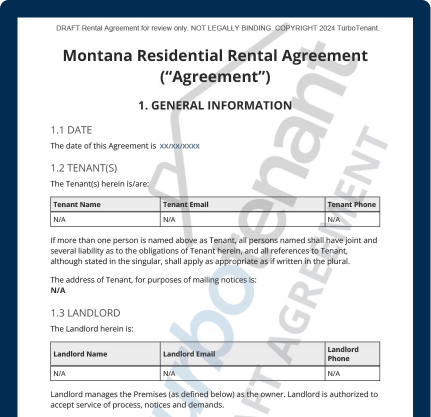
Montana Residential Lease Agreement
Learn MoreCreate a compliant Montana lease agreement in 15 minutes with TurboTenant's rental contract builder.
Montana Month-to-Month Lease Agreement
Learn MoreCreate your Montana month-to-month lease agreement in 15 minutes or less.
Types of Room Rental Contracts
When more than one person shares a living space, clear agreements help everyone keep a level head. In Montana, two types of documents can help set expectations and avoid disputes.
Room rental agreement: Homeowners interested in renting out a room create a room rental agreement with the tenant. It should detail rent, utility responsibilities, security deposit rules, maintenance duties, and house policies.
State law allows landlords to collect a reasonable security deposit but requires them to provide a written report detailing the premises’ condition at the time of move-in. Furthermore, landlords must return deposits within 10 days if no deductions are made, or within 30 days accompanied by an itemized statement if deductions are applied (Mont. Code Ann. § 70-25-201, § 70-25-202).
Roommate agreement: A roommate agreement sets ground rules for dividing rent, splitting utilities, assigning chores, and handling shared responsibilities. While not enforceable under Montana’s landlord-tenant laws in the same way as a lease, it can serve as a valuable tool to reduce conflict. These agreements must always align with the landlord’s primary lease and cannot override its terms.
Understanding the difference between these agreements helps landlords and tenants choose the right tool for their situation. Next, let’s look at what happens when tenants break their agreements.
Rental Agreement Breaches
Even with a solid lease, problems can still arise. Montana law outlines clear guidelines for how landlords must handle unpaid rent, lease violations, and abandoned property.
Failure to pay:
- The landlord can issue a 3-day Notice to Pay or Vacate.
- If unpaid, the landlord may file for eviction in court (Mont. Code Ann. § 70-24-422(2)).
Lease violations:
- For issues such as damage or unauthorized tenants, landlords typically provide a 14-day notice to rectify the problem.
- If not corrected, the lease ends after 30 days.
Repeat violations within a 6-month period can result in a 5-day Unconditional Quit Notice. - Illegal activity or threats to safety can trigger an immediate 3-day Quit Notice (Mont. Code Ann. § 70-24-422).
Lease abandonment:
- Landlords may retake possession if a tenant leaves without notice.
- They must try to re-rent to limit losses.
- Landlords must store abandoned property for at least 10 days after notice before they can sell or discard it (Mont. Code Ann. § 70-24-430).
Self-help evictions:
- Lockouts, shutting off utilities, or removing tenant belongings are illegal.
- Only the court can order eviction, and only law enforcement can enforce it (Mont. Code Ann. § 70-27-110).
By following these rules, landlords can stay compliant while protecting their property, and tenants will have clear opportunities to address any issues. Next, let’s examine the rules governing landlord access to rooms.
Room Rental Landlord Access Laws
Balancing a landlord’s need to maintain the property with a tenant’s right to privacy is a crucial aspect of any lease. Montana law spells out when and how landlords may enter a rented property.
Immediate access: According to state law, a landlord in Montana may enter a room without the tenant’s consent only in the event of an emergency, such as a fire, flooding, or a suspected gas leak that poses a threat to health or property (Mont. Code Ann. § 70-24-312(2)).
Landlord harassment: Tenants have the right to the quiet enjoyment of their rental. Montana law prohibits landlords from abusing their right of access or using it to harass tenants. Repeated, unnecessary, or intimidating entries may violate state law and give tenants grounds for legal action (Mont. Code Ann. § 70-24-312(3)(a)).
Advance notice: Outside of emergencies, Montana landlords must provide their tenants with at least 24 hours’ notice before entering and may only enter at reasonable times. The landlord can give notice in writing or by posting it on the main entry door of the rental unit. Landlords may enter for valid reasons such as inspections, repairs, providing agreed services, or showing the unit to prospective buyers, tenants, mortgagees, or contractors (Mont. Code Ann. § 70-24-312(1), (3)(b)).
By establishing these rules, Montana law safeguards both the landlord’s ability to maintain the property and the tenant’s right to feel secure in their home.
Create Your Montana Room Rental Agreement
With TurboTenant, you can create a Montana room rental agreement that complies with state landlord-tenant laws in just minutes. Generate a printable PDF form, customize the terms for your property, share it online with tenants, and complete the process securely with e-signatures, all in one platform.