


A Montana residential lease agreement is a legally binding contract that landlords and tenants sign, outlining the terms and conditions of the rental arrangement. The document typically includes essential details like the lease duration, rent amount, security deposit information, and maintenance and repair responsibilities.
While landlords can use TurboTenant to create compliant leases in just 15 minutes, understanding how rental lease agreements work in Montana is also critical. Let’s jump in.

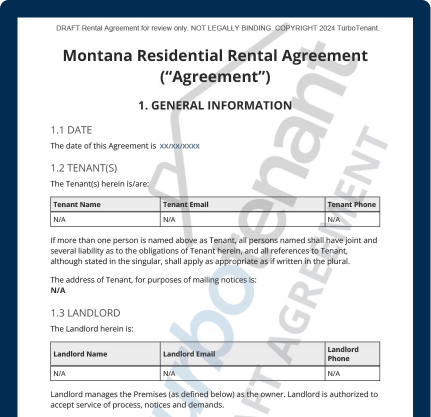
Montana Residential Lease Agreement
Current PageCreate a compliant Montana lease agreement in 15 minutes with TurboTenant's rental contract builder.
Montana Month-to-Month Lease Agreement
Learn MoreCreate your Montana month-to-month lease agreement in 15 minutes or less.
Room Rental Agreement Montana
Learn MoreRent your spare room with a Montana room rental agreement today.
Required Landlord Disclosures (6)
Both state and federal law require landlords to disclose specific information to their tenants related to the rental property. Here are Montana’s required disclosures:
- Lead-based paint disclosure: Federal law requires landlords to disclose the known presence of lead-based paint hazards in the interior of most dwellings constructed before 1978. Additionally, landlords must distribute an EPA lead hazard information pamphlet (42 U.S.C. § 4852d).
- Landlord name and address: Montana leases must include the landlord’s or authorized agent’s name and address. If the landlord’s contact information changes, they must notify the tenant. Providing this contact information ensures efficient communication of legal notices (Mont. Code Ann. § 70-24-301).
- Mold disclosure: Landlords must disclose known mold and provide the results of any prior testing. If the landlord complies, they’re immune from liability for undisclosed and genuinely unknown mold (Mont. Code Ann. § 70-16-703).
- Move-in inspection checklist: Montana landlords must provide a move-in checklist to document any existing property damage before the tenant takes possession. The checklist should detail the current condition of the rental unit, and the landlord or their authorized agent must sign it (Mont. Code Ann. § 70-25-206).
- Methamphetamine drug lab disclosure: If a Montana landlord knows that inhabitable property has been used as a clandestine methamphetamine or fentanyl drug lab, or has contamination from methamphetamine or fentanyl consumption, the landlord must notify any subsequent occupant in writing until a certified contractor remediates the property to state standards (Mont. Code Ann. § 75-10-1305).
- Default lease extension: Montana landlords should state the default extension period in the written lease. If the lease does not establish a default extension period and neither party gives 30 days’ written notice before the original termination date, the tenancy continues on a month-to-month basis (Mont. Code Ann. § 70-24-205).
Security Deposit Regulations
Maximum security deposit amount: Montana law does not limit the amount landlords can collect for a security deposit. Landlords are free to charge what they deem necessary.
Receipt of deposit: Montana does not require landlords to provide tenants with a receipt detailing the bank that holds the security deposit.
Deduction tracking: Within 30 days after the tenancy ends or the tenant surrenders the premises and the landlord accepts them, whichever occurs first, Montana landlords must provide a written list of rent due, damage charges, cleaning charges, and any remaining deposit balance (Mont. Code Ann. § 70-25-202).
Returning a tenant’s security deposit: If the inspection shows no damages, no cleaning required, no unpaid rent, and the tenant can show that no utilities remain unpaid, Montana landlords must return the security deposit within 10 days. Otherwise, they generally must provide the itemized list and any remaining balance within 30 days (Mont. Code Ann. § 70-25-202).
Landlord’s Access to Property
Advance notice: Montana law requires landlords to give tenants at least 24 hours’ notice before entering the rental premises, unless doing so is impractical. Landlords may only enter during reasonable hours (Mont. Code Ann. § 70-24-312).
Immediate access: Montana law allows landlords to enter the rental premises without providing notice during legitimate emergencies (Mont. Code Ann. § 70-24-312).
Landlord harassment: A landlord cannot make repeated demands for entry that unreasonably harass the tenant. If landlords continually demand entry, the tenant can take the landlord to court or might be able to terminate their lease early and move out without penalty (Mont. Code Ann. § 70-24-410).
Rent Payment Laws
Grace period: Landlords do not have to provide tenants a grace period for late rent payments in Montana. Rent is due on the date specified in the residential lease agreement.
Late rent fees: Montana law does not restrict the amount of late rent fees that landlords can charge. However, to avoid misunderstandings, we recommend that landlords include the late fee amount in their lease agreements.
Electronic payment fees: Montana landlords cannot charge an additional fee based on the tenant’s rent payment method, except to recover a bank fee incurred for electronic payments. Landlords should avoid lease language that adds payment-method fees beyond that limit (Mont. Code Ann. § 70-24-201).
Tenant’s right to withhold rent: Montana law allows tenants to make necessary repairs to the rental unit if the landlord fails to maintain the property in a way that affects health and safety. They must do so via written notice, and if the landlord fails to repair within a reasonable time, tenants may deduct up to 1 month’s rent from their next rent payment to cover the cost of the repairs (Mont. Code Ann. § 70-24-406).
Breach of Rental Agreement
Missed rent payment: If rent remains unpaid when due, Montana landlords may give written notice stating that the landlord intends to terminate the rental agreement if the tenant does not pay within 3 days (Mont. Code Ann. § 70-24-422).
Lease violation: If a tenant breaches the terms of their Montana residential lease agreement, the landlord must first provide written notice specifying the breach and setting a timeframe to remedy it. The required timeline varies depending on the nature of the violation (Mont. Code Ann. § 70-24-422).
Self-help evictions: Landlords must go through the court process to evict a tenant rather than shut off utilities, change the locks, or remove the tenant’s belongings. Self-help evictions are illegal in Montana.
Lease abandonment: Montana law allows landlords to seek possession of the rental unit, unpaid rent, and actual damages if a tenant breaches the lease or abandons the unit early (Mont. Code Ann. § 70-24-427).
Ending a Lease
Month-to-month: These leases automatically renew every month unless the tenant or landlord provides notice. Landlords and tenants can terminate a month-to-month lease by giving the other party at least 30 days’ written notice (Mont. Code Ann. § 70-24-441).
Fixed-term: A fixed-term Montana lease generally ends on the date stated in the lease unless the lease says otherwise or the parties agree to different terms. If the lease does not establish a default extension period and neither party gives 30 days’ written notice before the original termination date, the tenancy continues month to month (Mont. Code Ann. § 70-24-205).
Property abandonment: Montana law requires landlords to store an ex-tenant’s abandoned personal property believed to be of value for at least 30 days. Landlords must also send a notice to the ex-tenant’s last known address, informing them of the abandoned property and stating that the landlord will dispose of it if the tenant doesn’t claim it within 10 days (Mont. Code Ann. § 70-24-430).
Renewing a Lease
Required renewals: Montana landlords are not required to allow tenants to renew their rental agreements. Upon the expiration of a lease term, the landlord can either renew the lease or terminate the tenancy.
Required notice: Montana landlords and tenants may terminate a month-to-month tenancy with at least 30 days’ written notice and a week-to-week tenancy with at least 7 days’ written notice. Fixed-term leases generally end on the lease end date unless the lease or Montana’s default extension rule requires notice (Mont. Code Ann. § 70-24-441, § 70-24-205).
Montana Residential Lease Agreement FAQs
Does a landlord have to provide a copy of the lease in Montana?
Not necessarily. Montana law addresses the effect of unsigned or undelivered rental agreements, but it does not adopt the same broad lease-copy rule used in some states (Mont. Code Ann. § 70-24-204).
What is the grace period for rent in Montana?
Montana law does not require a grace period for overdue rent, meaning rent is due when the lease says it is due. If rent goes unpaid, the landlord can give 3 days’ written notice before terminating the tenancy for non-payment (Mont. Code Ann. § 70-24-201(3)).
Can a landlord refuse to renew a lease in Montana?
Yes. A landlord can choose not to renew a lease in Montana. For month-to-month tenancies, the landlord must give 30 days’ written notice, and week-to-week tenancies require 7 days’ written notice (Mont. Code Ann. § 70-24-441).
Does a Montana lease need to be notarized?
No. Montana residential leases do not need to be notarized. These legally binding contracts become effective once the landlord signs and delivers the written agreement to the tenant, who also signs it.
Can you withhold rent for repairs in Montana?
Not always. Montana law does not allow tenants to withhold rent to force repairs. Instead, if a health or safety issue exists, the tenant may give written notice and, in some situations, make the repairs and deduct the cost, recover damages, or terminate the lease under the statute (Mont. Code Ann. § 70-24-406).
Disclaimer: TurboTenant does not provide legal advice. This material has been prepared for informational purposes only. All users are advised to check all applicable local, state, and federal laws and consult legal counsel should questions arise.