


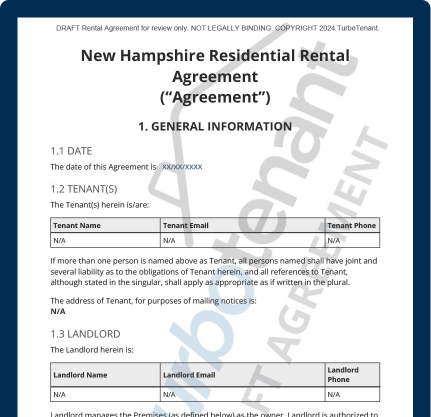

Renting a room might sound simple, but in reality, it gets complicated. Who’s on the hook for utilities? What if the tenant leaves before the lease ends? A New Hampshire room rental lease agreement clarifies those gray areas and ensures the arrangement complies with state requirements.
This guide explains what to include in your lease, from disclosures and rent rules to renewal terms, so that you can create a clear and compliant agreement.
Navigate New Hampshire Leases

Room Rental Agreement New Hampshire
Current PageRent your spare room with a New Hampshire room rental agreement today.
New Hampshire Residential Lease Agreement
Learn MoreCreate a compliant New Hampshire lease agreement in 15 minutes with TurboTenant's rental contract builder.
New Hampshire Month-to-Month Lease Agreement
Learn MoreCreate your New Hampshire month-to-month lease agreement in 15 minutes or less.
Types of Room Rental Contracts
Shared housing in New Hampshire usually falls into one of two categories. The first is a formal room rental agreement with the landlord, and the second is a private agreement among roommates. Both can help keep expectations clear, though they serve different purposes.
Room rental agreement: A legally binding lease between a landlord and a tenant renting one room within a home. It should spell out:
- Rent amount and due date
- Security deposit terms (up to 1 month’s rent or $100, whichever is greater; NH Rev Stat § 540-A:6)
- Utility and maintenance responsibilities
- House rules for shared spaces like kitchens and bathrooms
Landlords must return deposits within 30 days and provide an itemized list of deductions detailing the reasons for any deductions made. If they withhold funds without justification, tenants may recover double the deposit plus attorney’s fees.
Roommate agreement: A private contract between tenants sharing the same unit, separate from the landlord’s lease. It usually defines:
- Rent and utility responsibilities
- Division of chores
- Rules for guests, pets, or quiet hours
Although not legally enforceable under New Hampshire landlord-tenant laws, a written agreement helps prevent misunderstandings as long as it doesn’t conflict with the primary lease.
Having the right agreement in place creates a foundation for smoother living arrangements. Next, let’s look at how New Hampshire addresses rental agreement breaches and what landlords and tenants can expect in the event of a violation.
Rental Agreement Breaches
Even with a signed lease, conflicts can arise when tenants miss rent payments or ignore lease terms. New Hampshire law lays out specific procedures landlords must follow before ending a tenancy.
Failure to pay: If a tenant fails to pay rent, the landlord may serve a 7-day demand for rent (NH Rev Stat § 540:3, II). The notice must state the amount due and inform the tenant of their right to avoid eviction by paying the amount in full within 7 days. If the tenant does not pay, the landlord may file an eviction action (writ of possession) in court.
Lease violations: For lease breaches, such as property damage, unauthorized occupants, or disturbing other tenants, the landlord must give the tenant a 30-day notice to quit (NH Rev Stat § 540:2, II(a)). The notice must clearly describe the violation and provide the tenant with sufficient time to correct it. However, if the tenant engages in illegal activity, such as drug-related offenses or creating a threat to health or safety, the landlord may issue a 7-day notice to quit and proceed more quickly with eviction (NH Rev Stat § 540:2, II(b)).
Lease abandonment: When a tenant vacates without providing notice, the landlord may recover unpaid rent and damages but must make reasonable efforts to re-rent the unit to minimize losses. New Hampshire law also requires landlords to handle abandoned tenant property carefully: they must store it for at least 7 days after giving written notice before selling or disposing of it (NH Rev Stat § 540-A:3, VII).
Self-help evictions: Landlords in New Hampshire can not force tenants out by changing locks, shutting off utilities, or removing belongings. All evictions must follow the court process, and only the sheriff is authorized to enforce a writ of possession. Any attempt at self-help eviction can result in landlord liability for damages and penalties (NH Rev Stat § 540-A:4).
Understanding these rules protects both landlords and tenants by ensuring evictions follow due process.
Room Rental Landlord Access Laws
New Hampshire law protects tenants’ rights to privacy while granting landlords the necessary access to maintain the property. The rules vary depending on whether the situation is an emergency or a routine request.
- Immediate access: Landlords may enter without notice only in true emergencies that threaten health, safety, or property, such as a fire, burst pipe, or gas leak (NH Rev Stat § 540-A:3, IV and IV-a).
- Landlord harassment: Tenants are entitled to quiet enjoyment of their home. Landlords may not use entry rights to harass, intimidate, or repeatedly disrupt tenants. Excessive or unjustified entries qualify as harassment under state law (NH Rev Stat § 540-A:2, 540-A:3).
- Advance notice: For non-emergency situations, such as repairs, inspections, or showings, landlords must provide reasonable notice. While the statute does not specify a timeframe, 24 hours is a good rule of thumb. Entry must occur at reasonable times and for a valid purpose (NH Rev Stat § 540-A:3, IV).
By following these access rules, landlords respect tenant rights while ensuring the adequate maintenance of their properties.
Create Your New Hampshire Room Rental Agreement
TurboTenant makes it easy to create a New Hampshire room rental agreement that meets state requirements. In just minutes, you can generate a printable PDF form, adjust the terms to fit your property, share it digitally with tenants, and complete the process with secure e-signatures.