


A New Hampshire residential lease agreement is a legally binding contract that outlines the terms and conditions of the rental relationship. As such, landlords should carefully draft lease agreements to follow all local laws and regulations that apply to rental properties.
Both landlords and tenants should carefully review rental lease agreements in New Hampshire before signing. And while landlords can use downloadable PDF sample leases from TurboTenant to create a template, they should also fully understand the laws that regulate these documents.

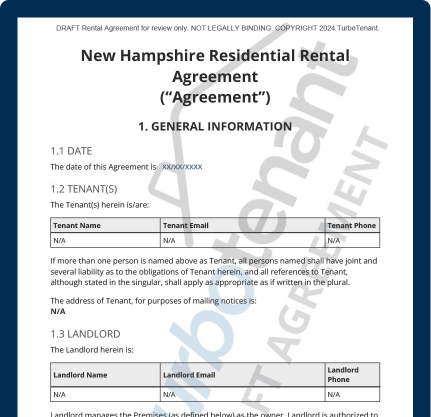
New Hampshire Residential Lease Agreement
Current PageCreate a compliant New Hampshire lease agreement in 15 minutes with TurboTenant's rental contract builder.
New Hampshire Month-to-Month Lease Agreement
Learn MoreCreate your New Hampshire month-to-month lease agreement in 15 minutes or less.
Room Rental Agreement New Hampshire
Learn MoreRent your spare room with a New Hampshire room rental agreement today.
Required Landlord Disclosures (6)
New Hampshire residential lease agreements must include certain important information required by state and federal law. Before signing a new lease, New Hampshire landlords must disclose the following information to tenants:
- Lead-based paint and hazards: Landlords who own homes built before 1978 must include a lead-based paint and hazard disclosure form and provide an EPA-approved pamphlet (42 U.S.C. § 4852d).
- Written lease copy: New Hampshire landlords must deliver a copy of the written lease to the tenant within 30 days after all parties sign it (N.H. Rev. Stat. Ann. § 477:7-b).
- Move-in conditions: New Hampshire landlords who collect a security deposit must notify tenants in writing that they should give the landlord a written list of any rental unit conditions requiring repair or correction within 5 days after occupancy begins. If a receipt is required, the landlord must include that notice on the receipt (N.H. Rev. Stat. Ann. § 540-A:6-I-b).
- Security deposits: New Hampshire landlords who collect a security deposit must provide a signed receipt stating the deposit amount and where the deposit or bond will be held, unless the tenant pays by personal check, bank check, or certain agency checks. If the landlord holds the deposit for 1 year or longer, the tenant may request the bank name, account number, deposit amount, interest rate, and security deposit records (N.H. Rev. Stat. Ann. § 540-A:6-I-b, IV).
- Methamphetamine production: Before signing a lease or rental agreement, New Hampshire landlords must disclose in writing if they know methamphetamine production occurred on the property and the property has not yet met remediation cleanup standards (N.H. Rev. Stat. Ann. § 477:4-g).
- Public utility tariff disclosure: Before signing a lease or rental agreement, New Hampshire landlords must disclose in writing whether they know that any metered public utility service the tenant may be billed for is subject to unamortized or ongoing charges for energy-efficiency or renewable-energy improvements. The disclosure should include the remaining term and amount of those charges and any available savings estimates or documentation (N.H. Rev. Stat. Ann. § 477:4-h).
Security Deposit Regulations
Maximum security deposit amount: New Hampshire landlords may charge a security deposit of up to $100 or 1 month’s rent, whichever is greater (N.H. Rev. Stat. Ann. § 540-A:6-I-a).
Receipt of deposit: New Hampshire law does not require a security deposit receipt if the tenant pays by personal check, bank check, or certain agency checks. In all other cases, landlords must provide a receipt stating the total amount and the financial institution where the deposit is held (N.H. Rev. Stat. Ann. § 540-A:6-I-b, c).
Interest: After holding a security deposit for 1 year or longer, New Hampshire landlords must pay tenants interest equal to the standard savings account interest rate at the financial institution holding the deposit. Interest begins the day the landlord receives the deposit (N.H. Rev. Stat. Ann. § 540-A:6-IV-a).
Deduction tracking: New Hampshire law requires landlords to provide a written, itemized list of any damages, unpaid rent, unpaid charges, or taxes they deduct from the security deposit. Each damage-related line item should include evidence, such as receipts for materials, labor estimates, or repair invoices (N.H. Rev. Stat. Ann. § 540-A:7-I, II).
Returning a tenant’s security deposit: In New Hampshire, landlords must return security deposits and any interest due within 30 days after the tenancy ends (N.H. Rev. Stat. Ann. § 540-A:7-I).
Landlord’s Access to Property
Advance notice: New Hampshire landlords must obtain their tenants’ consent to access a property, but no law requires a mandatory notice period. Standard practice is 24 to 48 hours (N.H. Rev. Stat. Ann. § 540-A:3-IV).
Immediate access: In emergencies, including rodent or insect infestations such as bedbugs, New Hampshire landlords can enter their rental properties without the tenant’s consent (N.H. Rev. Stat. Ann. § 540-A:3-IV-a, V-d).
Landlord harassment: New Hampshire law prohibits landlords from violating a tenant’s “right to quiet enjoyment of his tenancy.” Repeated illegal entries may qualify as harassment and allow tenants to break their lease early without penalty (N.H. Rev. Stat. Ann. § 540-A:2).
Rent Payment Laws
Grace period: No. New Hampshire law does not establish a grace period for overdue rent, though landlords may voluntarily include one in their residential lease agreement.
Late rent fees: New Hampshire does not set a statewide cap on residential late rent fees. Landlords who charge late fees should clearly state the amount, timing, and any grace period in the lease and avoid imposing unreasonable or punitive charges.
Tenant’s right to withhold rent: New Hampshire tenants may avoid termination for nonpayment if they had to pay utilities the landlord agreed to provide, the rent owed does not exceed the utility payments, and the tenant has proof of payment (N.H. Rev. Stat. Ann. § 540:2-VI).
Electronic payment restrictions: New Hampshire landlords cannot require tenants or prospective tenants to pay any amount due under a residential lease, renewal, or extension agreement by electronic funds transfer only. The landlord must allow at least 1 non-electronic payment option (N.H. Rev. Stat. Ann. § 540-A:3).
Breach of Rental Agreement
Missed rent payment: New Hampshire landlords can issue a 7-Day Notice to Pay or Quit to tenants who miss their rent payment. If the tenant receives three eviction notices for nonpayment within 12 months, they lose the right to pay within 7 days to avoid eviction (N.H. Rev. Stat. Ann. § 540:3, § 540:9).
Lease violation: If a tenant violates their lease agreement, New Hampshire landlords can issue a 30-Day Notice to Quit. If the violation involves nonpayment of rent, substantial property damage, or behavior that affects the health or safety of the landlord or other tenants, the landlord can issue a 7-day notice instead (N.H. Rev. Stat. Ann. § 540:3).
Self-help evictions: Self-help evictions are illegal in New Hampshire, and landlords should not attempt them. Examples include lockouts and shutting off utilities (N.H. Rev. Stat. Ann. § 540-A:3-I, II).
Lease abandonment: In New Hampshire, landlords may consider a rental property abandoned if they serve the required abandonment notice and at least two of the following conditions apply: tenants have given written notice of abandonment, have returned all keys, have removed most personal possessions, or have failed to pay rent for more than 91 days. Tenants may forfeit their security deposit for owed rent and remain liable for any additional rent not covered by the deposit (N.H. Rev. Stat. Ann. § 540-A:4-XII).
Ending a Lease
Month-to-month: New Hampshire landlords can only terminate a month-to-month lease with good cause, such as a lease violation that allows the landlord to issue a 7- or 30-Day Notice to Quit (N.H. Rev. Stat. Ann. § 540:2, § 540:3). Tenants can terminate a standard month-to-month lease agreement in New Hampshire with 30 days’ notice (§ 540:11).
Fixed-term: New Hampshire tenants can legally break a fixed-term lease early for several reasons, including military service orders (N.H. Rev. Stat. Ann. § 540:11-a), landlord harassment (§ 540-A:2), or landlord failure to maintain health and safety standards (§ 48-A:14).
Property abandonment: New Hampshire law requires landlords to store a tenant’s possessions for 7 days after the tenant leaves the property, whether voluntarily or through eviction. Tenants must be able to claim their possessions during those 7 days free of charge. After that, landlords can dispose of them at will (N.H. Rev. Stat. Ann. § 540-A:3-VII).
Renewing a Lease
Required renewals: New Hampshire requires landlords of restricted property to renew leases unless they have good cause to deny the renewal. Good cause may include tenant lease violations or their refusal to accept a rent increase, as long as the landlord provides 30 days’ notice (N.H. Rev. Stat. Ann. § 540:2-II).
Required notice: As an extension of New Hampshire’s prohibition on denying lease renewals without good cause, there is no separate required notice period related to renewals of standard rental lease agreements in New Hampshire. However, landlords must provide a proper eviction notice if they intend to end the tenancy (N.H. Rev. Stat. Ann. § 540:3).
New Hampshire Residential Lease Agreement FAQs
Does a landlord have to provide a copy of the lease in New Hampshire?
Yes. New Hampshire landlords must deliver a copy of the written lease to the tenant within 30 days after all parties sign it. Landlords should keep proof of delivery with the lease file” (N.H. Rev. Stat. Ann. § 477:7-b).
What is the grace period for rent in New Hampshire?
New Hampshire state law does not establish a mandatory grace period for late rent. If a landlord wants to give tenants extra time before charging a late fee or initiating eviction proceedings, they should clearly include the policy in the lease.
Can a landlord refuse to renew a lease in New Hampshire?
Landlords in New Hampshire may refuse to renew a rental lease agreement only with good cause, which may include prior lease violations or the tenant’s refusal to accept a rent increase after the landlord provides proper notice (N.H. Rev. Stat. Ann. § 540:2-II).
Does a New Hampshire lease need to be notarized?
No. Rental lease agreements in New Hampshire do not need notarization. A lease can become legally binding once both parties review, agree to, and sign the agreement.
Can you withhold rent for repairs in New Hampshire?
Yes, but the rule is limited. New Hampshire tenants may withhold the cost of utilities from rent if the landlord agreed to provide and maintain those utilities and failed to do so. Tenants should keep proof of payment and confirm the rent owed does not exceed the amount they paid for utilities (N.H. Rev. Stat. Ann. § 540:2-VI).
Disclaimer: TurboTenant does not provide legal advice. This material has been prepared for informational purposes only. All users are advised to check all applicable local, state, and federal laws and consult legal counsel should questions arise.