


A New York residential lease agreement is a legally binding contract between a landlord and tenant that grants the tenant temporary use of a property in exchange for rent payments. The lease outlines key details of the arrangement, including rent amounts, lease duration, tenant responsibilities, and property rules.
New York has numerous laws governing standard lease agreements in 2026, so stay tuned to learn everything you need to know.

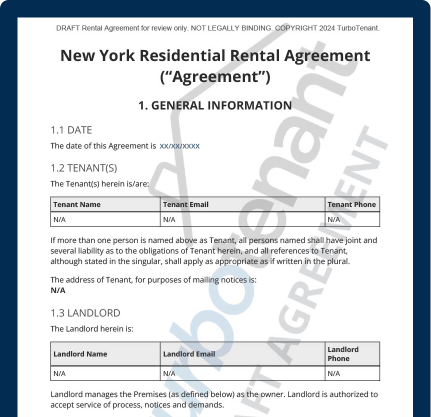
New York Residential Lease Agreement
Current PageCreate a compliant New York lease agreement with TurboTenant's rental contract builder in 15 minutes.
New York Month-to-Month Lease Agreement
Learn MoreBuild your New York month-to-month lease agreement in just 15 minutes.
Room Rental Agreement New York
Learn MoreRent out your spare room with a TurboTenant New York room rental agreement.
Required Landlord Disclosures (10)
During lease signing, landlords typically ask tenants to sign additional forms, known as disclosures, that address essential details about the property and any potential health and safety risks.
In New York, landlords must have tenants sign disclosures for the following:
- Lead-based paint: For properties built before 1978, landlords must inform tenants of any lead-based paint or lead-based paint hazards before leasing the property. This regulation is the only federally required disclosure for all 50 states (42 U.S.C. § 4852d).
- Security deposit receipt: New York landlords who place security deposits in a banking institution must notify tenants in writing of the bank’s name and address and the amount deposited (NY GOB Code § 7-103(2)).
- Sprinklers: New York residential leases must provide conspicuous notice, in boldface type, stating whether the leased premises have a maintained and operative sprinkler system. If one exists, the lease must also state the most recent maintenance and inspection date (NY RPP § 231-A).
- Reasonable modifications and accommodations: New York landlords must provide tenants with written notice of their rights to request reasonable accommodations and modifications for disabilities within 30 days of the start of the tenancy (NY EXC Code § 170-d).
- Rent stabilization: New York landlords must disclose whether a rental unit is subject to rent stabilization or rent control laws where applicable (NYC Administrative Code § 26-511(d)).
- Bed bugs: New York City also requires landlords to inform tenants of the building’s and the unit’s bed bug history for the previous calendar year (NYC Administrative Code § 27-2018.1).
- Certificate of occupancy: Before signing a residential lease for real property with 3 or fewer rental units, owners must provide conspicuous notice in boldface type stating whether a valid certificate of occupancy exists for the unit, if one is required by law (NY RPP Code § 235-bb).
- Flood history and risk notice: New York residential leases must include a flood history and risk notice stating whether any part of the leased premises sits in a FEMA-designated floodplain and whether the premises have experienced flood damage from a natural flood event. The lease must also include the required tenant notice explaining that standard renter’s insurance typically does not cover flood damage (N.Y. Real Prop. Law § 231-b).
- Good Cause Eviction Law notice: New York landlords must append the required Good Cause Eviction Law notice to or incorporate it into any initial or renewal lease when the law requires it. The notice must state whether the unit is covered or exempt and, if exempt, the applicable reason (N.Y. Real Prop. Law § 231-c).
- Window Guard Disclosure Notice: In New York, landlords of multiple dwellings (buildings with 3 or more apartments) are legally required to install window guards if a child 10 years of age or younger lives in the unit or if the tenant requests them. Every year between January 1 and 15th, the landlord must also circulate an annual notice form to tenants, asking whether any children live in the unit NYC Health Code § 131.15 and NYC Administrative Code § 17-123).
Security Deposit Regulations
Maximum security deposit amount: New York landlords can require a maximum security deposit equal to 1 month’s rent (NY GOB Code § 7-108(1a)).
Receipt of deposit: Landlords must provide tenants with written notice stating where they’re holding the security deposit and the amount of the deposit (NY GOB Code § 7-103(2)).
Interest: Landlords who own New York buildings with six or more units must place security deposits in an interest-bearing account. Landlords may retain up to 1% of the deposit annually as an administrative fee and must pay tenants the remaining interest (NY GOL Code § 7-103(2-a)).
Deduction tracking: If landlords retain any portion of the security deposit, they must provide tenants with an itemized statement of deductions within 14 days after the tenant vacates the property (NY GOL Code § 7-108(1b)).
Returning a tenant’s security deposit: New York landlords must return the tenant’s security deposit within 14 days after the tenant vacates the property (NY GOB Code § 7-108(1e)).
Landlord’s Access to Property
Advance notice: New York law does not specifically dictate how much advance notice landlords must provide before entering a rental unit. However, local laws and lease agreements may impose additional requirements. The New York Attorney General’s office considers 24 hours’ notice reasonable for non-emergency inspections (N.Y. Real Prop. Law § 235-b).
Immediate access: New York landlords may enter a rental unit without advance notice during emergencies.
Landlord harassment: If a landlord repeatedly enters the property without proper notice or interferes with the tenant’s quiet enjoyment, New York law or local housing regulations may consider the conduct landlord harassment.
Rent Payment Laws
Grace period: New York tenants receive a 5-day grace period before landlords may charge a late fee for unpaid rent (NY RPP Code § 238-A(2)).
Late rent fees: As of 2026, New York caps late fees at $50 or 5% of the monthly rent, whichever is less (NY RPP Code § 238-A(2)).
Tenant’s right to withhold rent: If a landlord fails to provide essential services or make necessary repairs, New York tenants may pursue remedies such as rent withholding or repair-and-deduct under state habitability laws (NY RPP Code § 235-A(1)).
Written rent receipts: New York landlords must provide a written receipt when tenants pay rent in cash or by any instrument other than the tenant’s personal check. The receipt must include the date, amount, rental property, payment period, and signature and title of the person receiving payment (N.Y. Real Prop. Law § 235-e).
Electronic rent payments: New York landlords cannot require tenants to use electronic billing or electronic rent payment as the only rent payment method. Landlords also cannot charge tenants a fee for choosing another payment method (N.Y. Real Prop. Law § 235-g).
Breach of Rental Agreement
Missed rent payment: After the grace period, the landlord may issue a 14-day notice to the tenant to pay rent or vacate the premises (NY RP Acts § 711(2)).
Lease violation: For a lease violation, New York landlords generally must first provide a notice to cure, giving the tenant at least 10 days to correct the violation. If the tenant does not cure the issue, the landlord may terminate the tenancy and proceed with eviction proceedings (NY RO Acts §§ 711, 753(4)).
Self-help evictions: New York law prohibits self-help evictions. Landlords cannot lock out tenants, remove belongings, or shut off utilities without a court order and formal eviction process (NY RPP Code §§ 235 and 853).
Lease abandonment: If a tenant leaves before the lease ends, the landlord must make reasonable and customary efforts to re-rent the unit in good faith before collecting unpaid rent for the rest of the lease term (N.Y. Real Prop. Law § 227-e).
Occupancy restrictions: New York landlords cannot use a lease term to restrict occupancy only to the named tenant or the named tenant and immediate family. Lease terms that violate New York’s occupancy rules are unenforceable as against public policy (N.Y. Real Prop. Law § 235-f).
Ending a Lease
Month-to-month: New York landlords generally must provide at least 30 days’ notice to terminate a month-to-month tenancy if the tenant has occupied the unit for less than one year, 60 days’ notice for occupancy between 1 and 2 years, and 90 days’ notice if the tenant has occupied the unit for more than 2 years (NY RPP Code § 232-B).
Fixed-term: A tenant may be able to legally terminate a fixed-term lease early in certain situations, including active military duty, domestic violence, or landlord harassment (N.Y. Mil. Law § 310, N.Y. Real Prop. Law § 227-c).
Property abandonment: New York law does not have a single statewide procedure for abandoned tenant property. Landlords generally must make reasonable efforts to notify tenants and store abandoned belongings for a reasonable period before disposal.
Renewing a Lease
Required renewals: For market-rate rentals, New York landlords must provide written notice if they do not intend to renew the tenancy or intend to raise the rent by 5% or more. Required notice depends on the tenant’s length of occupancy or lease term: 30 days for less than 1 year, 60 days for 1 to 2 years, and 90 days for more than 2 years (NY GOB Code § 5-905).
Required notice: New York landlords generally must provide:
- 30 days’ notice of nonrenewal if the tenant has occupied the unit for less than 1 year
- 60 days’ notice for occupancy between 1 and 2 years,
- and 90 days’ notice if the tenant has occupied the unit for more than 2 years (Housing Stability & Tenant Protection Act of 2019).
New York Residential Lease Agreement FAQs
Does a landlord have to provide a copy of the lease in New York?
Yes. New York landlords must provide tenants with a fully executed copy of the signed residential lease agreement within 30 days after signing (Housing Stability & Tenant Protection Act of 2019).
What is the grace period for rent in New York?
New York law provides tenants with a 5-day grace period before landlords may charge a late fee for unpaid rent (N.Y. Real Prop. Law § 238-a(2)).
Can a landlord refuse to renew a lease in New York?
For market-rate rentals, New York landlords can generally refuse to renew a lease with proper notice. However, landlords of rent-stabilized units usually must offer lease renewals except in limited circumstances (Housing Stability & Tenant Protection Act of 2019).
Does a New York lease need to be notarized?
No. New York residential lease agreements do not need to be notarized to be legally valid.
Can you withhold rent for repairs in New York?
In some situations, New York tenants may be able to make necessary repairs and deduct the cost from future rent if the landlord fails to address serious issues after receiving notice (NY RPP Code § 235-A(1)).
Disclaimer: TurboTenant does not provide legal advice. This material has been prepared for informational purposes only. All users are advised to check all applicable local, state, and federal laws and consult legal counsel should questions arise.