



Whether it’s a bedroom in a Fargo bungalow, a basement suite in Bismarck, or a shared home near UND in Grand Forks, shared housing works best when expectations are clear. A North Dakota room rental lease agreement outlines essential details such as rent, deposits, utilities, guest policies, and quiet hours, helping to prevent disputes.
Let’s look at two different types of contracts, what landlords should include, and how to build out a room rental agreement that everyone can agree on.
Navigate North Dakota Leases

Room Rental Agreement North Dakota
Current PageRent your spare room with a North Dakota room rental agreement today.
North Dakota Residential Lease Agreement
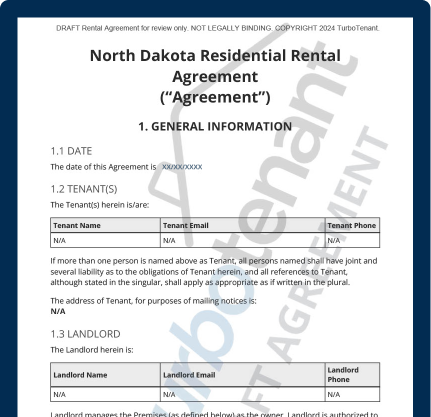
Learn MoreCreate a compliant North Dakota lease agreement in 15 minutes with TurboTenant's rental contract builder.
North Dakota Month-to-Month Lease Agreement
Learn MoreCreate your North Dakota month-to-month lease agreement in 15 minutes or less.
Types of Room Rental Contracts
Whether you’re renting out a single bedroom or moving in with roommates, the right agreement makes shared housing less stressful. In North Dakota, there are two main types of contracts to consider.
Room rental agreement: This is a formal contract between a landlord and tenant for renting a specific room within a home. In this case, the landlord lives in the same property. It should include:
- Rent amount and payment schedule
- Security deposit rules (up to 1 month’s rent, or 2 months with a pet, except service animals)
- Utilities, maintenance duties, and house rules
- Private access to the bedroom and use of shared common spaces
Landlords must return deposits within 30 days of move-out and provide an itemized list of deductions for damages beyond normal wear and tear (N.D. Cent. Code § 47-16-07.1).
Roommate agreement: This document is an agreement among tenants sharing the same rental. It typically covers:
- How all parties split rent and utilities
- Division of chores and household responsibilities
- Shared rules for guests, quiet hours, and use of space
While not enforceable under North Dakota landlord-tenant law in the same way as a lease, it creates a clear record of expectations and helps prevent conflicts.
Rental Agreement Breaches
Even with a clear lease in place, landlords and tenants aren’t immune to problems. North Dakota law outlines the procedures landlords must follow when handling issues such as late rent, lease violations, or abandoned property, while also protecting tenants’ rights throughout the process.
Failure to pay: If a tenant does not pay rent on time, the landlord may serve a 3-day written Notice to Quit. If the tenant does not pay within that period, the landlord can file for eviction in district court (N.D. Cent. Code § 47-32-01).
Lease violations: When tenants violate the lease, such as damaging the property, disturbing neighbors, or keeping unauthorized pets, the landlord may also issue a 3-day Notice to Quit. If the violation continues, the landlord can file for eviction. For more serious cases, such as illegal drug activity or endangering health and safety, the landlord may terminate the lease immediately and seek expedited eviction (N.D. Cent. Code § 47-16-30.1).
Lease abandonment: If a tenant abandons the rental property, the landlord may reclaim possession. They have a duty to make reasonable efforts to re-rent the property. The landlord can recover unpaid rent and damages from the tenant until they find a new renter but cannot collect double rent for the same period (N.D. Cent. Code § 47-16-13). If a tenant leaves personal property behind, landlords must store it and follow North Dakota’s abandoned property rules before disposal or sale.
Self-help evictions: North Dakota law forbids landlords from using “self-help” measures to remove tenants. Lockouts, cutting utilities, or removing belongings without a court order are illegal. Only a court can authorize an eviction, and law enforcement officers must carry out the order (N.D. Cent. Code § 47-32-01).
Following the proper legal process protects both landlords and tenants. Clear rules keep evictions fair and prevent costly mistakes or legal disputes.
Room Rental Landlord Access Laws
Balancing a landlord’s need to maintain the property with a tenant’s right to privacy is key to avoiding conflict. North Dakota law sets clear guidelines for when and how landlords can enter a rental unit.
Immediate access: Landlords may enter a rental unit without advance notice only in the event of an actual emergency. Emergencies include a fire, major water leak, or gas leak that poses a threat to life, safety, or property (N.D. Cent. Code § 47-16-07.3(1)).
Landlord harassment: North Dakota tenants have the right to quiet enjoyment of their rental home. Landlords cannot abuse their right of entry to harass, intimidate, or disrupt tenants. Repeated or unjustified entries may be considered harassment and could violate state landlord-tenant law.
Advance notice: Except in emergencies, landlords must provide adequate notice before entering a tenant’s premises. North Dakota law requires at least 24 hours’ written notice, and entry must occur at reasonable times and for valid reasons such as repairs, inspections, or showing the unit to prospective tenants (N.D. Cent. Code § 47-16-07.3(2)).
Create Your North Dakota Room Rental Agreement
TurboTenant makes it simple to create a North Dakota room rental (roommate) agreement that complies with state law. In just a few minutes, you can generate a customizable PDF form, update it with your rental terms, send it to tenants online, and complete the process with secure electronic signatures.