


A North Dakota lease agreement sets the rental terms between a landlord and a tenant. This vital legal contract clearly lays out expectations and responsibilities among all parties, and serves as the binding document by which the rental arrangement should operate.
Because the contract is the framework for the relationship, following it is crucial for landlords and tenants to avoid miscommunication. To get your next tenancy off on the right foot, TurboTenant’s state-specific lease agreements can help you establish a solid template and ensure understanding from the start.

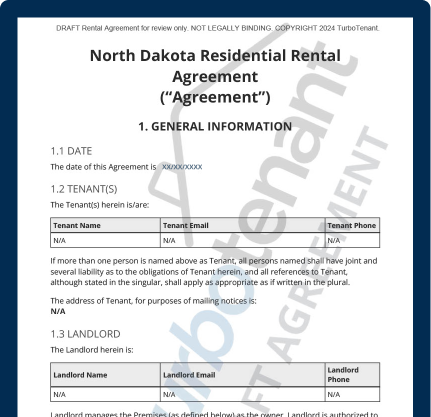
North Dakota Residential Lease Agreement
Current PageCreate a compliant North Dakota lease agreement in 15 minutes with TurboTenant's rental contract builder.
North Dakota Month-to-Month Lease Agreement
Learn MoreCreate your North Dakota month-to-month lease agreement in 15 minutes or less.
Room Rental Agreement North Dakota
Learn MoreRent your spare room with a North Dakota room rental agreement today.
Required Landlord Disclosures (2)
State and federal law require landlords to disclose important information about the rental property to prospective tenants. Landlords must make the following disclosures to tenants upon signing a rental agreement in North Dakota:
- Lead paint: According to federal law, North Dakota landlords must disclose the knowledge of any lead-based paint or lead-based paint hazards on most properties built before 1978 (42 U.S.C. § 4852d).
- Move-in checklist: All North Dakota rental agreements must include a checklist outlining the property’s condition when the tenant moves into the unit (N.D. Cent. Code § 47-16-07.2).
Security Deposit Regulations
Maximum security deposit amount: In most situations, security deposits for a North Dakota residential lease agreement are capped at 1 month’s rent. However, landlords may charge up to 2 months’ rent for lessees with felony convictions or a judgment against them for violating a previous rental agreement (N.D. Cent. Code § 47-16-07.1).
Pet deposit: If the landlord allows pets, they may charge an additional pet security deposit for non-service animals of up to $2,500 or two months’ rent, whichever is greater (N.D. Cent. Code § 47-16-07.1).
Receipt of deposit: No law in North Dakota requires landlords to provide a receipt for the security deposit, though it is good practice to do so.
Interest: North Dakota landlords must keep security deposits in a federally insured, interest-bearing savings or checking account for the tenant’s benefit and pay accrued interest to tenants for occupancies of at least 9 months (N.D. Cent. Code § 47-16-07.1).
Deduction tracking: Landlords may withhold funds from the security deposit to cover unpaid rent, cleaning costs, or other repairs beyond normal wear and tear. When returning the remainder of the funds, the landlord must provide a written list itemizing any deductions from the deposit. Landlords who withhold funds without reasonable justification face liability for treble the amount wrongfully withheld (N.D. Cent. Code § 47-16-07.1(3), § 47-16-07.1(4)).
Returning a tenant’s security deposit: The landlord must return the security deposit and an itemized statement within 30 days of lease termination and the tenant’s delivery of possession (N.D. Cent. Code § 47-16-07.1(3)).
Landlord’s Access to Property
Advance notice: Landlords in North Dakota must notify the tenant and obtain their consent before entering a rental unit. State law does not specify a required notice period, but landlords may enter only at reasonable times and in a reasonable manner. Tenants may not unreasonably withhold consent, and failure to object after receiving notice of a specific entry time constitutes implied consent (N.D. Cent. Code § 47-16-07.3).
Immediate access: North Dakota landlords may enter a rental unit immediately, and without prior notice, in three distinct circumstances: (1) an emergency; (2) the landlord believes the tenant abandoned the property; (3) the landlord believes the tenant has substantially violated the lease agreement. For all other entries (inspections, showings, repairs, etc.), the landlord must provide notice, obtain the tenant’s consent for an agreed-upon entry time, and not abuse the right to access. Consent to entry is presumed upon failure to object to the notice (N.D. Cent. Code § 47-16-07.3).
Landlord harassment: Landlords who repeatedly enter a tenant’s unit without permission could be held liable for landlord harassment. In these cases, tenants may be able to recover damages, obtain a court order to prevent future unauthorized entry, and potentially cancel the rental agreement.
Rent Payment Laws
Grace period: There is no mandatory grace period for late rent in North Dakota.
Late rent fees: There is no cap on the amount landlords can charge as a late fee for late rent payments. To be enforceable, the lease must clearly state the late fee.
Rent increase notice: For month-to-month tenancies, landlords must give tenants at least 30 days’ written notice before any rent increase takes effect (N.D. Cent. Code § 47-16-07).
Returned check fee: If a tenant’s rent check is returned for insufficient funds, landlords may charge a fee of up to $40 (N.D. Cent. Code § 6-08-16(2)(a)).
Payment method fees: North Dakota landlords may not charge tenants a fee to pay rent, or any other payment required under the lease, by cash, check, or money order (N.D. Cent. Code § 47-16-20.1).
Tenant’s right to withhold rent: If a landlord fails to make a necessary repair after the tenant gives reasonable notice, the tenant may arrange the repair themselves and deduct the cost from a future rent payment. In some cases, the tenant may also be able to vacate the property and cancel the rental agreement without penalty (N.D. Cent. Code § 47-16-13).
Breach of Rental Agreement
Missed rent payment: Once a tenant misses a rent payment, landlords in North Dakota may issue a 3-Day Notice to Pay or Quit (N.D. Cent. Code § 47-32-01(4)).
Lease violation: North Dakota landlords do not have to allow tenants to cure a lease violation; instead, they can issue a 3-Day Notice to Quit (N.D. Cent. Code § 47-32-02).
Self-help evictions: Landlords who attempt self-help evictions by shutting off utilities or changing locks may face civil and criminal penalties. These actions are illegal across all 50 states.
Lease abandonment: Tenants who end a North Dakota residential lease early and without proper cause may be liable for rent for the remainder of the lease term, as well as other damages related to the lease. North Dakota landlords have a statutory duty to mitigate the damages and make a reasonable effort to re-rent the unit (N.D. Cent. Code § 47-16-17.1(5)).
Ending a Lease
Month-to-month: Tenants and landlords can terminate a month-to-month lease agreement in North Dakota by giving the other party at least 1 calendar month’s written notice (N.D. Cent. Code § 47-16-15).
Fixed-term: Tenants who wish to end a fixed-term rental lease agreement early in North Dakota must meet a qualifying condition, such as entering active military duty, experiencing domestic violence, facing landlord harassment, or the unit becoming uninhabitable.
Property abandonment: Landlords must inform tenants of any personal property left behind and allow them 28 days to retrieve it. Landlords may deduct any associated moving or storage fees from the security deposit and return the remainder to the tenant when the tenant reclaims the property. Once the 28 days are up, landlords can dispose of or sell the property and use the funds to cover storage costs, returning the remainder of the sale proceeds to the tenant (N.D. Cent. Code § 47-16-30.1).
Renewing a Lease
Required renewals: Landlords are not legally obligated to renew a standard lease agreement in North Dakota after the lease term concludes.
Automatic renewal clause: If a lease contains an automatic renewal clause, the landlord must give the tenant written notice of the provision at least 30 days before the lease expires. Without this notice, the clause is unenforceable, and the lease converts to a month-to-month tenancy (N.D. Cent. Code § 47-16-06.1).
Required notice: Landlords must give tenants at least 1 calendar month’s notice when they plan to terminate a month-to-month rental lease agreement in North Dakota. No notice is necessary upon the expiration of a fixed-term lease (N.D. Cent. Code § 47-16-15).
North Dakota Residential Lease Agreement FAQs
Does a landlord have to provide a copy of the lease in North Dakota?
North Dakota law does not require landlords to give tenants a copy of the rental contract.
What is the grace period for rent in North Dakota?
North Dakota law does not require a mandatory grace period for overdue rent. Rent is due on the date listed in the lease unless the rental agreement gives the tenant extra time to pay.
Can a landlord refuse to renew a lease in North Dakota?
Yes. North Dakota landlords can refuse to renew a lease when the term ends unless the lease says otherwise. For periodic tenancies, landlords should follow the notice rules that apply to the rental period (N.D. Cent. Code § 47-16-15).
Does a North Dakota lease need to be notarized?
North Dakota residential lease agreements do not need to be notarized. Once the landlord and tenant sign the lease, the agreement binds both parties to its terms.
Can you withhold rent for repairs in North Dakota?
If the landlord neglects necessary repairs after receiving notice and a reasonable time to fix the issue, the tenant may repair the problem and deduct the cost from rent, recover the cost in another lawful manner, or vacate the premises (N.D. Cent. Code § 47-16-13).
Disclaimer: TurboTenant does not provide legal advice. This material has been prepared for informational purposes only. All users are advised to check all applicable local, state, and federal laws and consult legal counsel should questions arise.