


An Ohio lease agreement establishes a legally binding contract between a landlord and tenant for the rental of residential property. The agreement should outline each party’s duties, the rent amount and payment schedule, the lease duration, and other important terms. Before signing the lease, both parties should always take the time to review all terms and conditions.
Use TurboTenant’s easy-to-use rental lease agreement builder to create, customize, download, and share your next lease in 15 minutes or less.

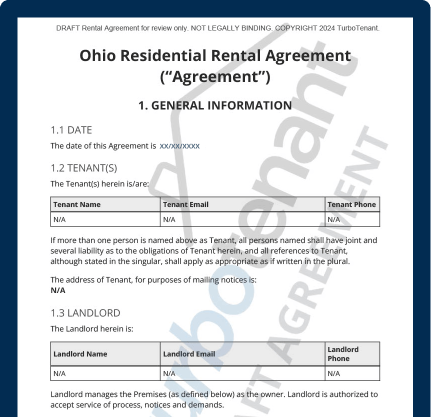
Ohio Residential Lease Agreement
Current PageCreate a compliant Ohio lease agreement with TurboTenant's rental contract builder in 15 minutes.
Ohio Month-to-Month Lease Agreement
Learn MoreBuild your Ohio month-to-month lease agreement in just 15 minutes.
Room Rental Agreement Ohio
Learn MoreThinking about renting out an extra room? Make it official with an Ohio room rental agreement.
Required Landlord Disclosures (2)
Ohio landlords must provide certain disclosures before or during lease signing. The following disclosures help tenants understand key property details, ownership information, and their rights under the rental agreement:
- Lead-based paint and hazards: Ohio landlords must follow the federal lead-based paint disclosure rules, which apply to most homes built before 1978. Landlords must provide a lead-based paint and hazard disclosure form, along with the EPA-approved pamphlet (42 U.S.C. § 4852d).
- Name and address of property owner: All standard residential lease agreement forms must include the property owner’s name and address, and the owner’s agent, if applicable. Even if the rental agreement is oral, the landlord must provide this information to the tenant in writing. If the landlord fails to do so, the landlord waives the tenant’s obligation tio provide the notices otherwise required under §5321.07 and § 5321.08 (Ohio Rev. Code Ann. § 5321.18).
Security Deposit Regulations
Maximum security deposit amount: Ohio law does not set a maximum security deposit amount.
Receipt of deposit: No Ohio statute requires landlords to provide tenants with a security deposit receipt or disclose where they keep the funds.
Interest: Landlords must pay 5% annual interest on the portion of a security deposit that exceeds $50 or 1 month’s rent, whichever is greater, if the tenant stays in possession for 6 months or longer. Landlords must compute and pay this interest annually (Ohio Rev. Code Ann. § 5321.16(A)).
Deduction tracking: Landlords must itemize any security deposit deductions in a written notice and deliver it to the tenant within 30 days after the rental agreement ends and the tenant delivers possession. The tenant must give the landlord a forwarding address in writing (Ohio Rev. Code Ann. § 5321.16(B)).
Returning a tenant’s security deposit: Landlords must return the tenant’s security deposit, minus any properly itemized deductions, within 30 days after the rental agreement ends and the tenant delivers possession (Ohio Rev. Code Ann. § 5321.16(B)).
Landlord’s Access to Property
Advance notice: Ohio landlords must give tenants reasonable notice before entering the property and may enter only at reasonable times. Ohio law presumes that 24 hours’ notice is reasonable (Ohio Rev. Code Ann. § 5321.04(A)(8)).
Immediate access: Landlords may enter the property immediately during emergencies or when giving advance notice is impracticable (Ohio Rev. Code Ann. § 5321.04(A)(8)).
Landlord harassment: Landlords cannot make unreasonable entries or repeatedly demand entry in a way that harasses the tenant. In these situations, the tenant may sue for damages, seek a court order to stop further harassment, or terminate the lease (Ohio Rev. Code Ann. § 5321.04(B)).
Rent Payment Laws
Grace period: Ohio law does not establish a grace period for rent payments. Landlords can send a 3-Day Notice to Leave the Premises if the tenant fails to pay rent by the due date (Ohio Rev. Code Ann. § 1923.04(A)).
Late rent fees: Ohio does not have specific regulations for late rent fees. Landlords may include a reasonable late fee schedule in the rental agreement, but they should avoid excessive fees that could violate Ohio’s prohibition on unconscionable terms (Ohio Rev. Code Ann. § 5321.14).
Tenant’s right to withhold rent: Tenants may deposit rent with the municipal or county court clerk if the landlord fails to remedy a qualifying violation within a reasonable time, not exceeding 30 days, after receiving written notice. To use rent escrow, the tenant must generally be current on rent (Ohio Rev. Code Ann. § 5321.07).
Breach of Rental Agreement
Missed rent payment: Once rent is past due, Ohio landlords may serve a 3-Day Notice to Leave the Premises before filing an eviction lawsuit. The notice must give the tenant 3 or more days to leave before the landlord begins the court eviction process (Ohio Rev. Code Ann. § 1923.04(A)).
Lease violation: If a tenant violates obligations that materially affect health and safety, the landlord may deliver written notice describing the violation and giving the tenant at least 30 days to fix it. If the tenant does not remedy the issue, the rental agreement terminates as stated in the notice (Ohio Rev. Code Ann. § 5321.11). In Ohio, all eviction notices must include this text: “You are being asked to leave the premises. If you do not leave, an eviction action may be initiated against you. If you are in doubt regarding your legal rights and obligations as a tenant, it is recommended that you seek legal assistance” (Ohio Rev. Code Ann. § 1923.04(A)).
Self-help evictions: Ohio state law prohibits self-help evictions. Landlords cannot shut off utilities or services, change the locks, remove a tenant’s belongings, or threaten a tenant to force them out (Ohio Rev. Code Ann. § 5321.15).
Lease abandonment: Ohio law does not clearly define the procedure for lease abandonment, but landlords may recover damages from tenants in court (Ohio Rev. Code Ann. § 5321.12). Landlords should include lease abandonment language in their residential lease agreements to help protect themselves.
Unenforceable terms: Ohio voids several clauses that landlords sometimes try to include. A residential rental agreement cannot contain a warrant of attorney to confess judgment, an agreement to pay either party’s attorney fees, a clause waiving the landlord’s liability or requiring the tenant to indemnify the landlord, or any waiver of the landlord’s duties under § 5321.04 (Ohio Rev. Code Ann. § 5321.13).
Ending a Lease
Month-to-month: In Ohio, tenants and landlords can terminate a month-to-month rental contract by giving the other party 30 days’ written notice (Ohio Rev. Code Ann. § 5321.17).
Fixed-term: Ohio tenants may have grounds to break a fixed-term standard lease agreement early if the landlord fails to meet legal duties, such as complying with health and safety codes, making necessary repairs, or providing access to utilities and services (Ohio Rev. Code Ann. § 5321.04). Tenants must first give written notice of the violation and allow the landlord a reasonable time to fix the issue, not exceeding 30 days, before using legal remedies (Ohio Rev. Code Ann. § 5321.07).
Property abandonment: Ohio does not specify what landlords must do when a tenant leaves abandoned property in the dwelling. Landlords cannot seize a tenant’s personal property to recover rent without a court order (Ohio Rev. Code Ann. § 5321.15).
Renewing a Lease
Required renewals: Ohio landlords do not have to allow tenants to renew their leases, but they cannot refuse to renew a lease in retaliation for a legally protected activity (such as reporting code violations) by raising rent, reducing servies, or pursing eviction (Ohio Rev. Code Ann. § 5321.02).
Required notice: For week-to-week leases, landlords who do not wish to renew the agreement must give 7 days’ written notice before termination. For month-to-month leases, landlords must give 30 days’ notice before terminating the rental agreement (Ohio Rev. Code Ann. § 5321.17).
Ohio Residential Lease Agreement FAQs
Does a landlord have to provide a copy of the lease in Ohio?
Ohio law does not require landlords to provide tenants with a written lease agreement in every situation. However, landlords must provide certain written disclosures, including the name and address of the property owner or the owner’s agent, even when the rental agreement is oral (Ohio Rev. Code Ann. § 5321.18).
What is the grace period for rent in Ohio?
Ohio law does not require landlords to provide a grace period for late rent payments in 2026, but landlords may choose to include one in the lease agreement before charging late fees or imposing penalties.
Can a landlord refuse to renew a lease in Ohio?
Yes. Ohio landlords can decline to renew a lease after the term expires, as long as the decision isn’t unlawful retaliation (Ohio Rev. Code Ann. § 5321.02).
Does an Ohio lease need to be notarized?
Most Ohio residential lease agreements do not require notarization. However, leases longer than 3 years must be acknowledged before a notary or another authorized official to satisfy Ohio’s real estate conveyance requirements (Ohio Rev. Code Ann. § 5301.01, § 5301.08).
Can you withhold rent for repairs in Ohio?
Yes. Ohio tenants may deposit rent with the municipal or county court clerk if a landlord fails to fix a habitability issue within a reasonable time, not exceeding 30 days, after receiving written notice from the tenant. The tenant must generally be current on rent to use this remedy (Ohio Rev. Code Ann. § 5321.07).
Disclaimer: TurboTenant does not provide legal advice. This material has been prepared for informational purposes only. All users should review applicable local, state, and federal laws and consult legal counsel with questions.