


An Oklahoma lease agreement is a legal document that defines the landlord-tenant relationship and clearly outlines each party’s rights and responsibilities.
When creating a rental contract, all applicable local, state, and federal laws must be considered, as it is a legally binding contract. To simplify the process, consider using TurboTenant’s state-compliant lease agreement builder to customize the lease to your exact needs.

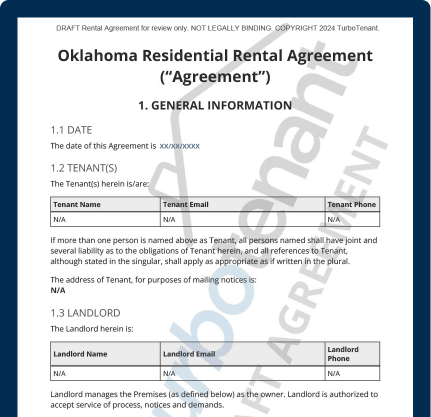
Oklahoma Residential Lease Agreement
Current PageCreate a compliant Oklahoma lease agreement in 15 minutes with TurboTenant's rental contract builder.
Oklahoma Month-to-Month Lease Agreement
Learn MoreGenerate a legally sound Oklahoma month-to-month lease agreement in just 15 minutes.
Room Rental Agreement Oklahoma
Learn MoreFind everything you need to know about room rental agreements in Oklahoma. Protect you and your tenants with a well-crafted legal document.
Required Landlord Disclosures (4)
Federal and state law require landlords to make certain disclosures to tenants when entering into a residential lease agreement in Oklahoma. Be sure to provide these disclosures alongside the lease form and other required documents, or use TurboTenant’s lease generator and take the guesswork out of the equation.
- Lead-based paint: For all units built before 1978, landlords must disclose any known lead-based paint and hazards, share any available records, include a Lead Warning Statement in the lease, and provide tenants with the EPA-approved lead hazard pamphlet. This federal disclosure applies in all 50 states (42 U.S.C. § 4852d).
- Landlord identification: Oklahoma landlords must provide the owner’s or landlord’s name and address in writing (Okla. Stat. tit. 41, § 116).
- Flooding: If the rental unit has flooded within the past 5 years and the landlord is aware of it, they must disclose this fact in writing (Okla. Stat. tit. 41, § 113a).
- Methamphetamine contamination: Oklahoma landlords must disclose any known methamphetamine manufacturing that previously occurred on the property. No disclosure is required if an assessment shows contamination does not exceed one-tenth of one microgram (0.1 mcg) per 100 square centimeters of surface material (Okla. Stat. tit. 41, § 118).
Security Deposit Regulations
Maximum security deposit amount: Oklahoma law does places no limit on the amount landlords can charge for a security deposit.
Receipt of deposit: No state statute requires landlords to provide a receipt for security deposits. However, landlords must keep deposit funds in a federally insured escrow account maintained in Oklahoma (Okla. Stat. tit. 41, § 115).
Deduction tracking: Oklahoma landlords may withhold money from a tenant’s security deposit for unpaid rent or damages resulting from lease violations. When returning the remaining deposit, landlords must also provide the tenant with a written, itemized list of any deductions (Okla. Stat. tit. 41, § 115).
Returning a tenant’s security deposit: Tenants must submit a written demand for the return of their security deposit within six months after the tenancy ends. Once the landlord receives the written demand, they have 45 days to return any remaining deposit after the tenant surrenders possession. If the tenant does not submit a written demand within six months, the landlord may retain the funds (Okla. Stat. tit. 41, § 115).
Landlord’s Access to Property
Advance notice: Oklahoma landlords must give tenants at least 1 day’s notice (commonly treated as 24 hours) before entering the property and may enter only at reasonable times. (Okla. Stat. tit. 41, § 128).
Immediate access: In an emergency, landlords may enter the rental unit without providing advance notice (Okla. Stat. tit. 41, § 128).
Landlord harassment: Landlords who repeatedly enter a tenant’s unit without proper notice or abuse their right of access may face legal liability. Oklahoma tenants may seek court orders preventing further unlawful entry, recover damages, or pursue other remedies permitted under state law (Okla. Stat. tit. 41, § 124).
Rent Payment Laws
Grace period: Oklahoma does not require landlords to provide a mandatory grace period for late rent payments.
Late rent fees: Oklahoma law does not limit late fees, but landlords must include the amount of the fee in the lease agreement for the charge to be valid and enforceable.
Tenant’s right to withhold rent: Tenants may notify the landlord in writing about a significant health or safety issue affecting the rental unit and allow 14 days for the problem to be resolved. If the landlord fails to make the repair within that time, the tenant may hire a professional to complete the repair and deduct the cost from the rent, provided the cost is equal to or less than 1 month’s rent (Okla. Stat. tit. 41, § 121).
Breach of Rental Agreement
Missed rent payment: Unless the lease includes a grace period, Oklahoma landlords may serve tenants with a 5-Day Notice to Pay or Quit once rent becomes overdue (Okla. Stat. tit. 41, § 131).
Lease violation: Landlords should provide tenants with a 15-day Notice to Cure or Quit for lease violations. If the tenant fails to correct the issue within 10 days, the lease terminates on the date stated in the notice, which can be as soon as the 15th day (Okla. Stat. tit. 41, § 132).
Self-help evictions: Landlords should never attempt self-help evictions, like changing locks or shutting off utilities, and should instead follow Oklahoma’s legal eviction process. Illegal self-help evictions may result in civil penalties or legal action.
Lease abandonment: Tenants who break an Oklahoma residential lease agreement early and without legal cause may be held responsible for the remaining rent due under the lease. With that in mind, Oklahoma landlords still have a duty to mitigate damages by making a reasonable effort to re-rent the unit (Okla. Stat. tit. 41, § 105).
Ending a Lease
Month-to-month: Landlords or tenants may terminate a standard month-to-month lease in Oklahoma with at least 30 days’ written notice (Okla. Stat. tit. 41, § 111).
Fixed-term: Oklahoma tenants may terminate a fixed-term lease early in certain situations. Active-duty servicemembers who receive qualifying military orders may terminate under the federal Servicemembers Civil Relief Act (50 U.S.C. § 3955). A victim of domestic violence, sexual violence, or stalking may terminate without penalty by giving written notice and a protective order within 30 days of the incident, unless the landlord waives that time period (Okla. Stat. tit. 41, § 111). A tenant may also terminate when a serious health or safety condition goes unrepaired, and the unit becomes uninhabitable (Okla. Stat. tit. 41, § 121).
Property abandonment: If a tenant leaves personal belongings of ascertainable value after moving out, the landlord must notify the tenant by certified mail to the last known address and may treat the property as abandoned if they are not retrieved within the stated time, which is at least 30 days. Landlords must store the property safely and may charge a reasonable storage fee (Okla. Stat. tit. 41, § 130).
Renewing a Lease
Required renewals: Oklahoma landlords are not obligated to renew a tenant’s Oklahoma residential lease agreement once the lease term expires.
Required notice: Landlords must provide notice when terminating a standard month-to-month lease. In most cases, landlords must give tenants at least 30 days’ written notice before termination. However, state law does not require advance notice when a landlord decides not to renew a fixed-term lease, which expires on its ending date without notice (Okla. Stat. tit. 41, § 111).
Oklahoma Residential Lease Agreement FAQs
Does a landlord have to provide a copy of the lease in Oklahoma?
No. Oklahoma law doesn’t require landlords to provide tenants with a copy of the lease agreement, though doing so is considered a best practice because it gives both parties a written record of the lease terms.
What is the grace period for rent in Oklahoma?
Oklahoma law does not require landlords to provide a grace period for late rent payments. Unless the lease states otherwise, landlords may enforce late fees or other penalties in accordance with the rental agreement.
Can a landlord refuse to renew a lease in Oklahoma?
Yes. Oklahoma landlords can generally refuse to renew a lease once the rental term expires, provided they comply with any applicable notice requirements.
Does an Oklahoma lease need to be notarized?
No, Oklahoma residential leases do not need to be notarized. A lease becomes legally binding once both parties sign the agreement.
Can you withhold rent for repairs in Oklahoma?
For repairs costing less than or equal to one month’s rent, tenants must first notify the landlord in writing and allow 14 days for the landlord to fix the issue. If the landlord fails to make the repair, the tenant may pay for it and deduct the reasonable cost from rent (Okla. Stat. tit. 41, § 121).
Disclaimer: TurboTenant does not provide legal advice. This material has been prepared for informational purposes only. All users should review applicable local, state, and federal laws and consult legal counsel if questions arise.