


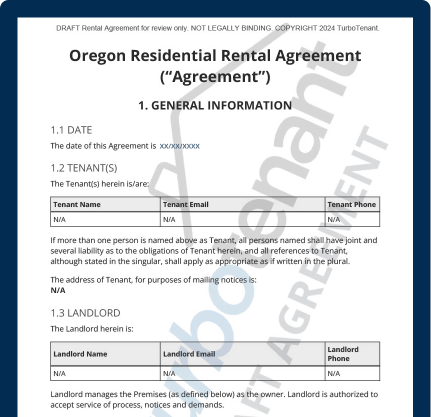

Oregon month-to-month lease agreements vary based on the type of tenancy. While fixed-term leases offer stability, a month-to-month lease — also known as a rental agreement — provides greater flexibility. These agreements automatically renew with each rent payment, but either the landlord or tenant can terminate them with proper notice.
Navigate Oregon Leases

Oregon Month-to-Month Lease Agreement
Current PageBuild your Oregon month-to-month lease agreement in 15 minutes or less.
Oregon Residential Lease Agreement
Learn MoreCreate a compliant Oregon lease agreement in 15 minutes with TurboTenant's rental contract builder.
Room Rental Agreement Oregon
Learn MoreUse a TurboTenant Oregon room rental agreement template to lock in your house hacking operation.
Required Landlord Disclosures (9)
- Lead-based paint: Federal law requires landlords to disclose known information on lead-based paint and its hazards before selling or leasing most housing built before 1978. Oregon legislation dictates all other landlord disclosures on this list.
- Landlord’s contact info: Oregon law requires landlords to give tenants their name and contact information, or that of an authorized representative, in writing at the start of the tenancy (ORS 90.305).
- Carbon monoxide alarm: Landlords must disclose the presence of carbon monoxide alarms and provide a working alarm in any rental unit with a carbon monoxide source. Examples of carbon monoxide sources include gas fireplaces or appliances. They must also inform tenants that they are responsible for maintaining the alarm (ORS 90.317).
- Shared utility costs: If tenants contribute to a shared utility bill that serves common areas, Oregon landlords must disclose how they calculate and allocate these costs (ORS 90.315).
- Flood plain: If a rental property is within a federally designated flood plain, Oregon law requires landlords to disclose this information to tenants in writing before they sign the lease (ORS 90.228).
- Pending legal action: Oregon legislation requires landlords to inform tenants of any pending legal action that may affect their tenancy, such as foreclosure proceedings (ORS 90.310).
- Recycling: Landlords must inform tenants about recycling programs and processes, including instructions on correctly sorting and disposing of recyclable materials (ORS 90.318).
- Smoke alarm: Every rental unit must have at least one working smoke alarm. Landlords must also inform tenants that the renter is responsible for maintaining them (ORS 479.270).
- Smoking: Landlords must provide tenants with a written disclosure of their smoking policy. This document should explain whether smoking is allowed or prohibited on the property and if any designated smoking areas exist (ORS 90.220).
Notice to Terminate Month-to-Month Rental Contract
Because Oregon month-to-month rental agreements don’t have a set end date, landlords and tenants must abide by state-specific rules when providing notice to terminate the contract.
Required notice for the landlord: In most cases, Oregon landlords must give tenants at least 30 days written notice to terminate a month-to-month tenancy (ORS 91.070).
If the tenant has lived in the unit for over a year, the landlord must give at least 60 days’ written notice (ORS 91.070).
Portland and Milwaukie have special rules requiring 90 days’ written notice for no-cause terminations, even within the first year of tenancy.
Legal note: If the landlord is terminating a tenancy for a specific reason allowed by law (e.g., non-payment of rent, lease violations), different notice periods may apply.
Required notice for the tenant: In Oregon, tenants terminating a month-to-month lease must give their landlord at least 30 days’ written notice (ORS 91.070).
Rent Increase Laws
Oregon’s state-wide rent control laws limit annual rent increases. Landlords cannot raise rent by more than 7% plus the current consumer price index (CPI) (ORS 90.323). For further details, visit our Oregon Rent Control article.
Create Your Oregon Month-to-Month Lease Agreement
Add your lease details, and TurboTenant will turn them into a legally valid document. Compliant, formatted, and ready for e-signature without the legal jargon.