


Landlords and tenants entering an Oregon lease agreement should first familiarize themselves with a few key basics. Such a contract, also known as a rental contract, is an agreement that outlines the terms, rights, and responsibilities of both landlords and tenants.
We’ll start by breaking down the disclosures that landlords must include with each lease agreement.

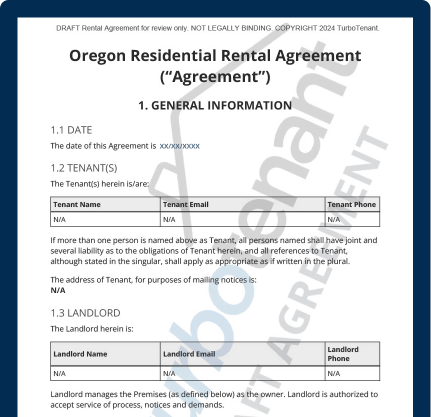
Oregon Residential Lease Agreement
Current PageCreate a compliant Oregon lease agreement in 15 minutes with TurboTenant's rental contract builder.
Oregon Month-to-Month Lease Agreement
Learn MoreBuild your Oregon month-to-month lease agreement in 15 minutes or less.
Room Rental Agreement Oregon
Learn MoreUse a TurboTenant Oregon room rental agreement template to lock in your house hacking operation.
Required Landlord Disclosures (9)
The only federally required landlord disclosure requires known information on lead-based paint and lead-based paint hazards before the sale or lease of most housing built before 1978. The Oregon legislature dictates the remaining required disclosures.
- Landlord’s contact info: Oregon law requires landlords to disclose their name and contact information, or that of their authorized representative, at the beginning of the rental agreement. This includes how to contact them for repairs or emergencies (ORS 90.305).
- Carbon monoxide alarm: Landlords must disclose and provide a functional carbon monoxide alarm in any rental dwelling where a source of carbon monoxide (like a fireplace or gas appliance) is present. Tenants should be informed of their responsibility to maintain the alarm (ORS 90.317).
- Common area utility: If a tenant has to pay for a utility that also serves shared spaces, landlords must disclose how the utility costs are calculated and allocated (ORS 90.315).
- Floodplain: If a rental property is located in a federally designated floodplain, landlords must disclose this information to tenants in writing before they sign the lease (ORS 90.228).
- Pending legal action: Landlords must inform tenants of any pending legal action that could affect their tenancy, such as foreclosure proceedings on the property (ORS 90.310).
- Recycling: Certain Oregon landlords are required to provide tenants with information about recycling programs, including instructions on how to properly sort and dispose of recyclable materials (ORS 90.318).
- Smoke alarm: Landlords must provide a working smoke alarm in every rental unit and ensure tenants understand their responsibility for maintaining the device (ORS 479.270).
- Smoking: Landlords must disclose their smoking policy in writing, including whether smoking is allowed or prohibited on the rental property and whether there are designated smoking areas (ORS 90.220).
TurboTenant includes these disclosures with each lease agreement you create.
Security Deposit Regulations
Maximum security deposit amount: Although there is no statewide cap on deposits, landlords in Portland, Oregon, should be aware of the city’s specific codes, which define a maximum amount (Portland City Code 30.01.087).
Receipt of deposit: Oregon law requires landlords to provide tenants with a receipt (ORS 90.300). It does not necessarily need to state the deposit’s location.
Deduction tracking: Oregon landlords must provide a written, itemized statement of any deductions made from the tenant’s security deposit, along with receipts for any repairs or expenses, within 31 days of the tenant’s move-out date (ORS 90.300).
Returning a tenant’s security deposit: Landlords must return security deposits within 31 days of the lease end (ORS 90.300).
Landlord’s Access to Property
Advance notice: Unless landlords have an immediate need to enter a property for an emergency, they must give tenants at least 24 hours’ notice before entering (ORS 90.322).
Immediate access: Landlords have a right to enter a property without a tenant’s consent in emergencies that would cause severe damage to the property. However, after such entry, landlords must provide a notice within 24 hours of entry detailing who entered the property, the cause of the entry, and when the entry occurred (ORS 90.322).
Landlord harassment: Under Oregon law, harassment includes unlawful entry, unreasonable lawful entry, and repeated demands for entry. Tenants may seek a remedy by either obtaining injunctive relief to prevent such occurrences or terminating the rental contract altogether. They may even be able to recover actual damages in such a scenario (ORS 90.322).
Rent Payment Laws
Grace period: In Oregon, tenants have a 4-day grace period after rent is due before landlords can charge late fees. This means landlords cannot impose late fees until the 5th day after rent is due (ORS 90.260).
Late rent fees: Oregon landlords can charge reasonable flat or daily late fees. The reasonable flat fee must be in line with market conditions. A daily late fee cannot exceed 6% of the reasonable late fee. Flat fees cannot exceed 5% of the total rent amount (ORS 90.260).
Tenant’s right to withhold rent: Tenants in Oregon have the right to withhold rent if the rental unit violates health or safety standards. They must first provide written notice to the landlord to make the necessary repairs. If the landlord doesn’t act within the specified time, the tenant can then withhold rent (ORS 90.365).
Breach of Rental Agreement
Missed rent payment: When a tenant fails to pay rent, a landlord may issue a notice that gives the tenant time to pay the rent or face eviction proceedings (ORS 90.394).
Lease violation: When a tenant violates their lease, an Oregon landlord can serve the tenant notice to cure the violation or vacate. That gives them time to remedy the issue. The landlord can pursue eviction if the breach goes uncorrected (ORS 90.392).
Self-help evictions: Self-help evictions, where a landlord changes the locks or removes a tenant’s belongings without permission, are illegal in Oregon (ORS 90.375).
Lease abandonment: If an Oregon tenant abandons their rental property before the lease ends, landlords must make a reasonable effort to find a new tenant (ORS 90.410).
Ending a Lease
Month-to-month: Oregon tenants must provide a 30-day written notice to terminate a month-to-month lease. Landlords, on the other hand, must give a 90-day written notice, unless certain exceptions apply (ORS 90.427).
Fixed-term: Tenants can legally break a fixed-term lease early under certain circumstances, such as domestic violence, sexual assault, or stalking (ORS 90.453).
Property abandonment: If a tenant leaves behind property in Oregon, the landlord must provide written notice detailing how to retrieve the items. After a specific period defined by law, the landlord may then dispose of the property (ORS 90.425).
Renewing a Lease
Required renewals: Oregon landlords are not legally required to allow tenants to renew their rental agreements upon expiration. Lease renewal is at the landlord’s discretion unless otherwise stated in the lease.
Required notice: Oregon landlords must provide written notice if they do not intend to renew a fixed-term lease. For leases longer than 1 year, landlords must give at least 90 days’ notice before the lease ends (ORS 90.427).
Disclaimer: TurboTenant does not provide legal advice. This material has been prepared for informational purposes only. All users are advised to check all applicable local, state, and federal laws and consult legal counsel should questions arise.
Oregon Residential Lease Agreement FAQs
Does a landlord have to provide a copy of the lease in Oregon?
Yes, landlords must provide tenants with a copy of their rental agreement (ORS 90.220).
What is the grace period for rent in Oregon?
Can a landlord refuse to renew a lease in Oregon?
Yes, a landlord can refuse to renew a lease in Oregon if they provide the tenant with the required notice (ORS 90.427).
Does an Oregon lease need to be notarized?
No, a lease that both parties sign is considered fully enforceable.
Can you withhold rent for repairs in Oregon?
Yes, tenants can withhold rent for certain repairs if the landlord fails to maintain the rental unit in habitable condition, but only after giving proper notice and following the legal process (ORS 90.368).