


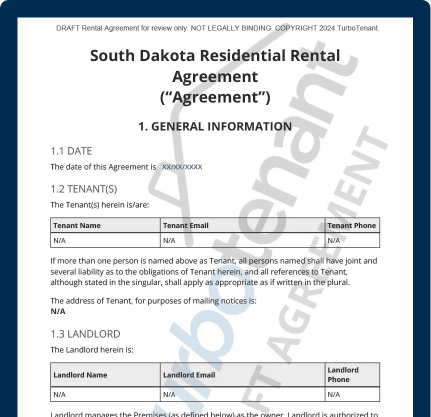

Sharing a home in South Dakota often means juggling utilities, dividing chores, and making sure everyone agrees on the house rules. Without a written plan, minor disagreements can quickly grow into bigger issues. A South Dakota room rental lease agreement provides a clear plan by spelling out responsibilities for rent, deposits, and shared spaces.
This guide explains how these agreements work, what the law requires, and how to create one in South Dakota that benefits both landlords and tenants.
Navigate South Dakota Leases

Room Rental Agreement South Dakota
Current PageRent your spare room with a South Dakota room rental agreement today.
South Dakota Residential Lease Agreement
Learn MoreCreate a compliant South Dakota lease agreement in 15 minutes with TurboTenant's rental contract builder.
South Dakota Month-to-Month Lease Agreement
Learn MoreCreate your South Dakota month-to-month lease agreement in 15 minutes or less.
Types of Room Rental Contracts
When people share a home, it helps to put the ground rules in writing. In South Dakota, there are two common agreements, each playing a distinct role in maintaining fairness.
Room rental agreement: A South Dakota room rental agreement is a legally binding contract between a landlord and a tenant who rents a room. This type of lease sets terms for rent, security deposits, utilities, and house rules. The tenant has private access to their bedroom and shares common areas. A South Dakota room rental agreement must comply with state landlord-tenant laws, including rules on security deposits (SDCL § 43-32-24), notices, and eviction procedures.
Roommate agreement: A roommate agreement differs. It’s not a lease with the landlord, but a set of guidelines between tenants sharing the same rental home. It defines how roommates divide rent, utilities, chores, and other responsibilities. A roommate agreement is not enforceable under South Dakota landlord-tenant law in the same way as a room rental agreement. However, it can still help prevent disputes and provide a written record of household expectations.
Rental Agreement Breaches
Even with a solid lease in place, breaches happen from time to time. South Dakota law provides a clear process for handling these situations. They aim to protect tenants’ rights while allowing landlords to safeguard their property.
Failure to pay: South Dakota law establishes a straightforward process for handling late rent payments. Landlords must give tenants a short window to pay before moving forward with eviction. Here’s how it works:
- The landlord serves a 3-Day Notice to Quit and Vacate if a tenant fails to pay.
- Tenant has 3 days to pay in full or move out.
- If unpaid, the landlord may issue an Unconditional Quit Notice and file for eviction (SDCL § 21-16-1(4)).
- Only the court and law enforcement can order and carry out an eviction.
Lease violations:
When tenants breach the lease, such as causing property damage, keeping unauthorized pets, or disturbing neighbors, the landlord may issue a 3-day Notice to Quit, providing a reasonable opportunity for the tenant to remedy the situation. If necessary, the landlord may then proceed with eviction. If the tenant engages in illegal activity on the property, landlords can issue a 3-day Unconditional Quit Notice to expedite eviction (SDCL § 2-16-1).
Lease abandonment: When tenants leave without providing notice, landlords have the right to recover losses; however, they must also comply with South Dakota’s rules for handling abandoned property.
- Landlords may pursue unpaid rent and damages, but they must also attempt to re-rent the unit.
- If property left behind is worth less than $500, landlords may consider it abandoned after 10 days and dispose of it.
- If property is worth over $500, landlords must store it for 30 days, hold a lien for storage costs, and then may dispose of it (SDCL § 43-32-26).
Self-help evictions: Landlords may not bypass court procedures by changing locks, shutting off utilities, removing belongings, or using force to remove a tenant. The only lawful way to evict in South Dakota is through a court order and proper enforcement.
Room Rental Landlord Access Laws
Balancing a landlord’s need to maintain their property with a tenant’s right to privacy is a crucial aspect of a rental agreement. South Dakota law sets clear rules for the reasons landlords can enter, the amount of notice they must provide, and what actions cross the line into harassment.
Immediate access: Landlords may enter without prior notice only in emergencies that threaten life or property. For instance, if a fire breaks out, a pipe bursts and causes flooding, or a gas leak is suspected (SDCL § 43-32-32).
Landlord harassment: South Dakota tenants are legally entitled to quiet enjoyment of their home. Thus, landlords cannot misuse their entry rights, such as showing up repeatedly without cause, entering at odd hours, or using entry to intimidate tenants. Engaging in these behaviors may constitute harassment and give the tenant legal grounds for action (SDCL § 43-32-32).
Advance notice:Outside of emergencies, South Dakota law requires landlords to give tenants reasonable notice before entering. By default, 24 hours’ written notice is presumed reasonable. However, landlords and tenants may agree to alternate methods or timelines.
The notice must include:
- The date(s) of intended entry
- A time frame during regular business hours
- The purpose of the entry
- A method for tenants to request rescheduling (SDCL § 43-32-32).
Create Your South Dakota Room Rental Agreement
Create a South Dakota-compliant room rental (roommate) agreement in minutes with TurboTenant. Customize terms, share online, and e-sign, everything in one secure platform.