


A South Dakota lease agreement provides landlords and tenants with a clear set of rules for the rental, defines the terms of the tenancy, sets expectations for both parties, and helps eliminate any mix-ups before move-in day. Strong leases cover rent, payment timing, maintenance responsibilities, property use, and other essential details that influence a landlord’s day-to-day operations.
Landlords who use TurboTenant’s legally compliant lease generator can create custom agreements as downloadable PDFs, but they should still understand what each section entails before signing. Keep reading for everything you need to know about rental lease agreements in South Dakota.

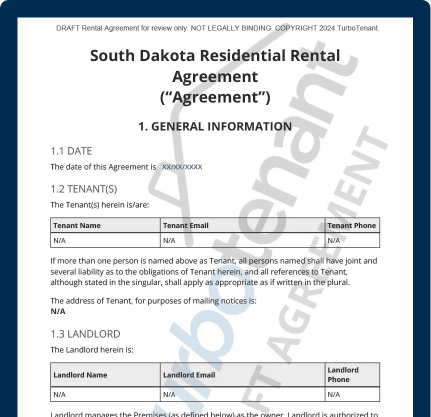
South Dakota Residential Lease Agreement
Current PageCreate a compliant South Dakota lease agreement in 15 minutes with TurboTenant's rental contract builder.
South Dakota Month-to-Month Lease Agreement
Learn MoreCreate your South Dakota month-to-month lease agreement in 15 minutes or less.
Room Rental Agreement South Dakota
Learn MoreRent your spare room with a South Dakota room rental agreement today.
Required Landlord Disclosures (2)
Under state and federal law, landlords must provide tenants with specific information about a rental unit. Before signing a South Dakota residential lease agreement, landlords must give tenants the following disclosures:
- Lead paint: The only federally required disclosure requires landlords nationwide to inform tenants of any lead-based paint or lead-based paint hazards in units built before 1978 (42 U.S.C. § 4852d).
- Methamphetamine contamination: If a landlord knows that a unit was previously used to manufacture methamphetamine, they must disclose that information to tenants (S.D. Codified Laws § 43-32-30).
Security Deposit Regulations
Maximum security deposit amount: South Dakota caps security deposits at 1 month’s rent. However, landlords and tenants may agree to a larger deposit if special conditions pose additional risk to the property’s condition (S.D. Codified Laws § 43-32-6.1).
Receipt of deposit: Landlords in South Dakota have no legal obligation to provide a receipt for the security deposit.
Deduction tracking: South Dakota landlords may withhold funds from the security deposit for unpaid rent or repairs needed to restore the unit to its original condition, excluding normal wear and tear. If they withhold funds, they must provide a written itemized accounting within 45 days after the tenancy ends, upon the tenant’s request (S.D. Codified Laws § 43-32-24).
Returning a tenant’s security deposit: If the landlord does not intend to use the security deposit for unpaid rent or repairs, the landlord must return it within 2 weeks after the tenancy ends and after receiving the tenant’s mailing address or delivery instructions (S.D. Codified Laws § 43-32-24). If a landlord keeps a security deposit in bad faith, the tenant may recover up to $200 (S.D. Codified Laws § 43-32-24).
Landlord’s Access to Property
Advance notice: Unless in cases of emergency, or notice isn’t practical, landlords must provide tenants reasonable notice of 24 hours before entry (S.D. Codified Laws § 43-32-32).
Immediate access: A landlord may enter a rental property without notice in an emergency (S.D. Codified Laws § 43-32-32).
Landlord harassment: South Dakota does not create a separate harassment remedy in the entry statute, but the law preserves a tenant’s other rights and remedies if a landlord continues to enter without proper notice or at unreasonable times (S.D. Codified Laws § 43-32-29, § 43-32-32).
Rent Payment Laws
Grace period: South Dakota has no mandatory grace period for late rent payments.
Late rent fees: State law does not limit late rent fee amounts, but landlords should always include late fee information in rental lease agreements in South Dakota.
Tenant’s right to withhold rent: If the unit requires repairs to be safe and habitable, the tenant must provide the landlord with notice and allow a reasonable amount of time to complete the repairs. If the landlord does not complete the repair, the tenant can either repair and deduct the cost from rent or withhold rent. If the amount exceeds 1 month’s rent, the tenant has the right to withhold and deposit it into a separate account they’re responsible for maintaining. They can continue to make deposits until the total covers the cost of the repair. Once the landlord completes the repair, the tenant must release the withheld money to the landlord (S.D. Codified Laws § 43-32-9).
Breach of Rental Agreement
Missed rent payment: Once rent is at least 3 days late, the landlord may initiate eviction proceedings; pre-suit notification is no longer required (S.D. Codified Laws § 21-16-2). The tenant will then have 5 days to file a written answer (S.D. Codified Laws § 21-16-7). If the lease agreement provides advance notice, the landlord must honor it.
Lease violation: Like in the case of a missed rent payment, pre-suit notifications are no longer required. Once a tenant violates the lease, commits waste, or uses the premises illegally, the landlord may file for eviction without giving the tenant a chance to cure (S.D. Codified Laws § 21-16-1). If the lease mentions a cure period, the landlord must honor it.
Self-help evictions: A self-help eviction occurs when a landlord tries to remove a tenant without following the legal eviction process. Self-help evictions are illegal, and landlords/property managers should never attempt them.
Lease abandonment: Tenants who break a lease early without a qualifying condition are liable for paying rent for the remainder of the lease term. Landlords in South Dakota do not have a “duty to mitigate” and may pursue all outstanding funds owed by the tenant.
Ending a Lease
Month-to-month: Landlords may terminate a month-to-month (at-will) tenancy by providing the tenant 15 days’ notice. If the tenant is a member of the military or an immediate family member of the active military member, the landlord must provide 2 months’ notice (S.D. Codified Laws § 43-8-8). Tenants, on the other hand, must provide 1 month’s notice to terminate the at-will tenancy (S.D. Codified Laws § 43-32-15).
Fixed-term: Tenants who wish to break a lease early, without penalty, must meet a legally qualifying condition, which includes entering active military duty (Servicemembers Civil Relief Act); a tenant or household member being the victim of domestic abuse, unlawful sexual behavior, or stalking (S.D. Codified Laws § 43-32-19.1); tenant death or incapacity (S.D. Codified Laws 43-32-23); or following written notice, the landlord’s failure to provide quet enjoyment of the property or keep in habitable condition (S.D. Codified Laws 43-32-19).
Property abandonment: Two rules apply to abandoned property. If the value of the property is less than $500, and remains at the property for more than 10 days, the landlord may dispose of it (S.D. Codified Laws § 43-32-25). If the property amounts to more than $500, the landlord must store it and has a lien for the reasonable costs of handling and storage. After 30 days of storage, the landlord may dispose of it (S.D. Codified Laws § 43-32-26).
Renewing a Lease
Required renewals: South Dakota landlords are not obligated to renew a tenant’s residential lease agreement when the term expires.
Required notice: Landlords do not have to notify the tenant when they do not intend to renew a standard, fixed-term lease agreement in South Dakota. However, month-to-month leases require at least 15 days’ written notice to terminate (S.D. Codified Laws § 43-8-8).
South Dakota Residential Lease Agreement FAQs
Does a landlord have to provide a copy of the lease in South Dakota?
South Dakota landlords are not legally required to provide tenants with a copy of the lease, but many landlords still do so for their own records and to avoid disputes later.
What is the grace period for rent in South Dakota?
South Dakota does not require landlords to provide a grace period for late rent, so rent is typically due on the date stated in the lease.
Can a landlord refuse to renew a lease in South Dakota?
Yes, South Dakota landlords can refuse to renew a rental lease agreement when the lease term ends, unless the lease says otherwise.
Does a South Dakota lease need to be notarized?
No. South Dakota leases do not need to be notarized to be valid as long as both parties sign the agreement.
Can you withhold rent for repairs in South Dakota?
In limited circumstances. If a landlord fails to fix a safety or habitability issue within a reasonable timeframe after receiving a tenant’s written notice, the tenant may repair the issue and deduct the cost from rent. They can also vacate the property without paying any further rent. The tenant may withhold rent only when needed repairs would equate to more than 1 month’s rent. Then, after written notice stating the reason, the rent must be deposited into a separate account and released to the landlord once the repair is made (or used to repair if enough accumulates in the tenant-maintained account (S.D. Codified Laws § 43-32-9).
Disclaimer: TurboTenant does not provide legal advice. This material has been prepared for informational purposes only. All users are advised to check all applicable local, state, and federal laws and consult legal counsel should questions arise.