


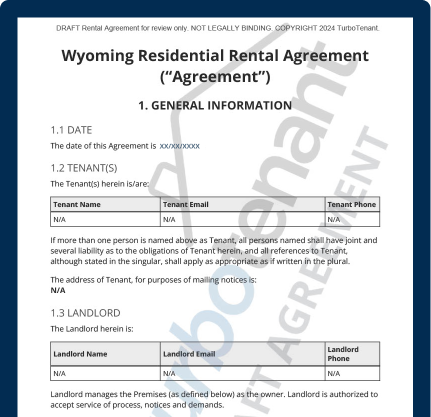

Renting a room in Wyoming can be tricky if the details are left unwritten. Questions about rent, utilities, or how to share common spaces can quickly cause problems without clear rules in place. A Wyoming room rental lease agreement addresses these challenges by putting expectations in writing and ensuring that both landlords and tenants comply with state law.
From college rentals in Laramie to ranch houses outside Casper, a solid agreement keeps everyone in the know. In this guide, we’ll examine what to include in a Wyoming lease agreement before giving you one simple, straightforward method to create your own in minutes.
Navigate Wyoming Leases

Room Rental Agreement Wyoming
Current PageRent your spare room with a Wyoming room rental agreement today.
Wyoming Residential Lease Agreement
Learn MoreCreate a compliant Wyoming lease agreement in 15 minutes with TurboTenant's rental contract builder.
Wyoming Month-to-Month Lease Agreement
Learn MoreCreate your Wyoming month-to-month lease agreement in 15 minutes or less.
Types of Room Rental Contracts
When multiple people live under the same roof, clarity matters. A well-drafted agreement can prevent disagreements over money, chores, or the use of shared spaces. In Wyoming, tenants and landlords typically use two types of agreements depending on the situation: a formal room rental agreement or a private roommate agreement.
Room rental agreement: A Wyoming room rental agreement helps set expectations when someone rents a single room in a shared home. The contract should clearly outline important details, including rent, utilities, deposits, and rules for shared spaces such as kitchens and bathrooms. Under Wyoming law, landlords must return security deposits within 30 days of lease termination or 15 days of receiving the tenant’s forwarding address, whichever comes later. If deductions are necessary for unpaid rent, damages, or cleaning, landlords have an additional 30 days to provide an itemized list, and deductions can only cover those specific costs (Wyo. Stat. § 1‑21‑1208).
Roommate agreement: These agreements outline standard rent terms between tenants and are separate from a landlord’s master lease. It helps lay out apartment/home rules, divides rent and utilities, and establishes shared responsibilities, like cleaning schedules. It’s not enforceable under Wyoming landlord-tenant law, but a roommate agreement can help prevent disputes and complement the main lease. It’s important, however, that it doesn’t conflict with lease terms or state law.
Rental Agreement Breaches
Even with a written lease, conflicts can arise if tenants miss payments, break rules, or leave unexpectedly. Wyoming law lays out clear procedures for landlords to follow in these situations.
- Failure to pay: In Wyoming, landlords must issue a 3-Day Notice to Quit for nonpayment of rent. This written notice provides tenants with 3 days to pay or vacate before eviction proceedings can commence. If the tenant fails to comply, the landlord can file a Forcible Entry and Detainer action in circuit court (Wyo. Stat. § 1‑21‑1002(a)(i), Wyo. Stat. § 1‑21‑1003).
- Lease violations: For lease violations, such as property damage, noise disturbances, or unauthorized occupants, landlords follow the same process: they serve a 3-Day Notice to Quit, demanding that the tenant remedy the breach or vacate. If unaddressed, eviction can proceed through the court.
- Lease abandonment: Wyoming does not have a detailed statute for abandoned tenant property. Generally, landlords should post a notice and proceed with court eviction if the tenant has vacated without notice. If the court grants the eviction, landlords should follow federal and local rules regarding the storage and disposal of personal property, which often require notice and payment of reasonable storage costs before disposal (Wyo. Stat. § 1-21-1210).
- Self-help evictions: Owners cannot evict tenants using self-help tactics, such as changing locks, shutting off utilities, or forcibly removing belongings. The only lawful method is through court-sanctioned eviction and enforcement by law enforcement (Writ of Restitution).
By following the legal process, landlords protect themselves from liability while giving tenants fair notice and due process. Skipping steps or attempting self-help eviction can quickly backfire and lead to costly penalties.
Room Rental Landlord Access Laws
In Wyoming, the law permits landlords to enter their rental units, but tenants are entitled to privacy in their homes. Finding the right balance is crucial. It helps avoid disputes and maintains a respectful relationship. State law and common practices outline the circumstances under which landlords can enter immediately for emergencies, the requirements for advance notice, and what types of entry may be considered harassment.
Immediate access: Landlords may enter the rental unit immediately, without notice, only in the event of an emergency, such as a fire, flooding, or a gas leak. Afterward, they should inform tenants as soon as possible about the entry (Wyoming Statutes § 1-21-1202 (d)).
Landlord harassment: Tenants in Wyoming are entitled to the right to quiet enjoyment of their homes. Landlords must not harass tenants by entering at disruptive hours, entering repeatedly without reason, or using entry as a means of intimidation. These actions may breach the tenant’s rights and could be legally actionable.
Advance notice: Although Wyoming law doesn’t specify a required notice period, best practices recommend providing at least 24 hours’ notice before entering for non-emergency reasons, such as repairs, inspections, or showings. Written or verbal notice is acceptable, and it should include basic details like date, time, and purpose.
Create Your Wyoming Room Rental Agreement
Creating a lease is easier than ever with TurboTenant. In just minutes, you can build a Wyoming room rental agreement tailored to state law. The agreement is customizable, and you can edit, share online, and finalize with secure e-signatures for a fast and stress-free process.