


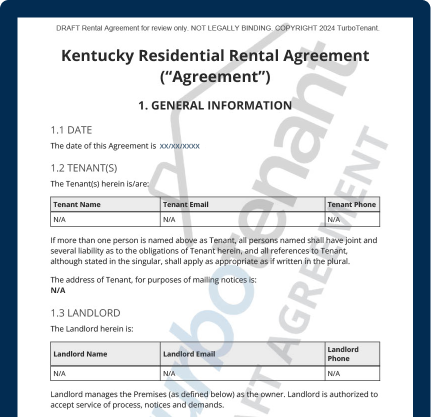
A Kentucky lease agreement is a formal contract that allows a prospective tenant to rent property from a landlord. It’s an essential document because it expressly outlines the relationship between the two parties, sets clear expectations and guidelines for the duration of the lease term, and contains important information relevant to the unit.
So while it may sound simple, lease agreements have a lot of legal nuance that landlords must understand. Let’s break it down.

Kentucky Residential Lease Agreement
Current PageCreate a compliant Kentucky lease agreement in 15 minutes with TurboTenant's rental contract builder.
Kentucky Month-to-Month Lease Agreement
Learn MoreBuild your Kentucky month-to-month lease agreement in just 15 minutes.
Room Rental Agreement Kentucky
Learn MoreRent your spare room with a Kentucky room rental agreement today.
Required Landlord Disclosures (4)
At the time of lease signing, Kentucky landlords must provide the tenant with the following disclosures:
- Lead-based paint: Landlords must disclose the knowledge of any lead-based paint or lead-based paint hazards on the property in all units built before 1978. Federal law mandates this disclosure.
- Landlord identification: Landlords in Kentucky must disclose the name and address of the property manager, landlord, or person authorized to manage the property (KRS § 383.585).
- Security deposit location: Landlords must inform tenants of the account number and location where their security deposit is stored (KRS § 383.580(1)).
- Move-in checklist: Kentucky law requires landlords to provide tenants with a complete list of existing damage in the unit. It also allows tenants to inform landlords of uncaptured damage in the initial form. When the tenancy ends, the landlord can compare the unit’s condition from move-in to move-out. They can deduct from the security deposit to cover any repairs beyond normal wear and tear (KRS § 383.580(2-3)).
Security Deposit Regulations
Maximum security deposit amount: In Kentucky, there is no cap on the amount a landlord can charge a tenant for a security deposit.
Receipt of deposit: Landlords in Kentucky must provide the location and account number for the bank storing the deposit. Landlords must deposit it in a separate bank account regulated by the state of Kentucky or the federal government (KRS § 383.580(1)).
Deduction tracking: Landlords may deduct funds from the security deposit to cover unpaid rent or the costs of repairs beyond normal wear and tear. Kentucky law also allows the security deposit to be used as the last month’s rent if both the landlord and tenant agree (KRS § 383.580).
Returning a tenant’s security deposit: The security deposit must be returned within 30 days of the termination of the rental contract (KRS § 383.580(6)).
Landlord’s Access to Property
Advance notice: Kentucky landlords must give tenants at least 2 days’ notice before entering a property. They may only enter at reasonable times, except in emergencies or when authorized by a court order (KRS § 383.615(3)).
Immediate access: In emergencies, the landlord may enter the property without advance notice (KRS § 383.615(2)).
Landlord harassment: If a landlord repeatedly enters a tenant’s property without proper notice, the tenant could get a court order to ban the landlord from entering. They could also potentially cancel the lease agreement while recovering the cost of any actual damages (KRS § 383.700(2)).
Rent Payment Laws
Grace period: Kentucky does not require a mandatory grace period for rent payments.
Late rent fees: There is no limit to late fees in Kentucky. However, if landlords charge them, the lease must list any fees.
Tenant’s fight to withhold rent: Tenants can deduct a reasonable amount for the repair of essential services that the landlord has refused or hasn’t done. These services include heat, running water, electricity, or gas (KRS § 383.640).
Breach of Rental Agreement
Missed rent payment: Once a tenant misses a rent payment, Kentucky landlords may issue a 7-day Notice to Pay or Quit (KRS § 383.660(2)).
Lease violation: Landlords can deliver a 14-day notice to cure or quit for lease violations. If a tenant violates the lease more than once within a six-month period, landlords are not obligated to allow the tenant to remedy the violation and may terminate the lease after 14 days. (KRS § 383.660(1)).
Self-help evictions: Self-help evictions (evicting the tenant yourself) are never allowed in Kentucky. Landlords should never attempt them.
Lease abandonment: Tenants who break the lease early, without cause, may be responsible for the full rent due for the remaining term. Kentucky landlords must make a reasonable effort to re-rent the unit, which releases the tenant from further responsibility (KRS § 383.660).
Ending a Kentucky Lease Agreement
Month-to-month: Either party can terminate a month-to-month lease with written notice of at least 30 days (KRS § 383.695).
Fixed-term: There are circumstances where state law allows tenants to end their lease early without penalty. Some of these situations include entering into active military duty, domestic violence, the death of the tenant, or landlord harassment.
Property abandonment: Kentucky has no specific laws regarding a tenant’s personal property after they leave the property. However, it’s reasonable to store the property for a set period of time and provide notice to the tenant.
Renewing a Lease
Required renewals: Kentucky landlords can refuse to renew a lease for any non-discriminatory or non-retaliatory reason.
Required notice: State law doesn’t require landlords to provide notice of their intent not to renew a fixed-term lease. However, they must give at least 30 days’ written notice when they intend to terminate a month-to-month agreement (KRS § 383.695).
Disclaimer: TurboTenant does not provide legal advice. This material has been prepared for informational purposes only. All users are advised to check all applicable local, state, and federal laws and consult legal counsel should questions arise.
Kentucky Residential Lease Agreement FAQs
Does a landlord have to provide a copy of the lease in Kentucky?
Kentucky landlords are not required to provide the tenant with a copy of the lease.
What is the grace period for rent in Kentucky?
Kentucky law doesn’t require a grace period.
Can a landlord refuse to renew a Kansas lease?
Yes, landlords can refuse to renew leases in Kentucky.
Does a Kentucky rental contract need to be notarized?
Leases in Kentucky do not need to be notarized.
Can you withhold rent for repairs in Kentucky?
Tenants in Kentucky may have the opportunity to withhold rent for repairs when a landlord fails to remedy a situation where essential services or utilities have stopped working (KRS § 383.640).