


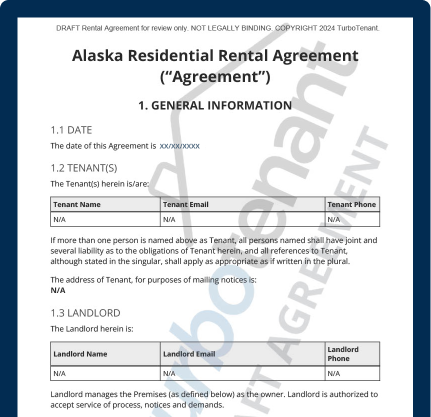
Renting property in The Last Frontier? You’ll need a rock-solid Alaska residential lease agreement to make it all official. The agreement, sometimes referred to as a rental contract, covers the lease duration, rent amount, landlord and tenant details, maintenance standards, eviction protocols, and more.
After the property owner and the tenant sign the rental lease agreement, it becomes a legally binding document that clarifies both parties’ rights and duties throughout the tenancy. To prepare their next contract, landlords can use TurboTenant’s lease agreement wizard to create a legally compliant rental agreement without relying on outdated templates. That said, it’s still important to understand the basics of these forms first. Let’s dive in.

Alaska Residential Lease Agreement
Current PageCreate a compliant Alaska lease agreement in 15 minutes with TurboTenant's rental contract builder.
Alaska Month-to-Month Lease Agreement
Learn MoreCreate your Alaska month-to-month lease agreement in 15 minutes or less.
Room Rental Agreement Alaska
Learn MoreRent your spare room with a Alaska room rental agreement today.
Required Landlord Disclosures (4)
Alaska law requires landlords to provide tenants with four disclosures when signing a residential lease agreement. These include:
- Lead paint: Under federal law, property owners must notify tenants of any lead-based paint or lead-based hazards in properties built before 1978 (42 U.S.C. § 4852d).
- Landlord name and information: The tenant must receive the landlord and/or property owner’s information for legal and logistical purposes (Alaska Stat. § 34.03.080(a)).
- Required lease provision: The lease must require tenants to notify their landlord of any anticipated absences exceeding 7 days, with notice provided as soon as reasonably possible (Alaska Stat. § 34.03.150).
- Security deposit withholding terms: When collecting a security deposit, landlords must provide tenants with the terms and conditions under which the landlord may withhold all or part of the deposit (Alaska Stat. § 34.03.070(c)).
Security Deposit Regulations
Maximum security deposit amount: When rent is $2,000 or less per month, the security deposit may not exceed 2 months’ rent. This limit does not apply to units in which the monthly rent exceeds $2,000 (Alaska Stat. § 34.03.070(a)).
Deposit of funds: Landlords must place security deposit funds in a trust account, bank, or savings and loan association. A licensed escrow agent can also hold it. Landlords must provide tenants with the terms and conditions under which the deposit, or portions of it, may be withheld (Alaska Stat. § 34.03.070).
Pet deposit: Landlords may collect an additional security deposit for a tenant’s pet (not a service animal), not to exceed one month’s rent. The pet deposit must be accounted for separately and may only apply to pet-related damages (Alaska Stat. § 34.03.070(h)).
Interest: State law does not require landlords to collect interest on security deposits. However, when a licensed real estate broker holds the deposit in a trust account, any interest earned must be disclosed to the tenant and does not belong to the broker (12 Alaska Admin. Code 64.210).
Deduction tracking: When a tenant provides a property move-out notice, and there are no damages to deduct from the security deposit, the landlord must mail an itemized statement and any refund within 14 days of the tenancy’s termination. If damages aren’t deducted, or the tenant fails to provide notice, the landlord has 30 days. (Alaska Stat. § 34.03.070(g)).
Returning a tenant’s security deposit: Landlords have 14 days to return the deposit after receiving a move-out notice, unless no damages were withheld. Otherwise, they have 30 days without a move-out notice, or damages were deducted (Alaska Stat. § 34.03.070(g)).
Landlord’s Access to Property
Advance notice: Landlords must provide 24 hours’ notice to enter a property in Alaska (Alaska Stat. § 34.03.140(c)).
Immediate access: Alaska landlords may enter a rental unit at any time in an emergency, upon a court order, or in the event of property abandonment (Alaska Stat. § 34.03.140).
Landlord harassment: Even though landlords can enter at will during a qualifying emergency, they are not permitted to harass tenants. By consistently entering the property without notice or outside regular hours, landlords could be engaging in harassment. Continued harassment may allow tenants to move out before the end of the lease without penalty (Alaska Stat. § 34.03.140(c)).
Rent Payment Laws
Grace period: Alaska has no grace period for late rent payments (Alaska Stat. § 34.03.020(c)).
Late rent fees: There are no laws governing late fees for rent payments in Alaska, so a landlord can set a reasonable fee as they deem appropriate, provided they outline it in the rental contract.
Tenant’s right to withhold rent: If a habitability issue affects the tenant’s health and safety and the landlord fails to address it promptly, the tenant can notify the landlord in writing. In this notice, the tenant should specify that the lease will end at least 20 days later if the landlord doesn’t resolve the issue within 10 days. Additionally, the tenant may withhold rent to address the problem, provided they give appropriate notice (Alaska Stat. § 34.03.160(a), § 34.03.180(a)(1)).
Breach of Rental Agreement
Missed rent payment: If a tenant is past due on rent, the landlord can issue a 7-Day Notice to Quit or Pay (Alaska Stat. § 34.03.220(b)).
Lease violation: Alaska landlords can send a notice to quit for lease violations, with the required notice period varying by the violation. For material breaches, the landlord must give the tenant 10 days to rectify the issue. The Alaska lease agreement will terminate if the tenant does not remedy the problem within the specified time frame (Alaska Stat. § 34.03.220).
Prohibited lease clauses: Alaska law voids any lease provision that waives a party’s rights under the Alaska Uniform Residential Landlord and Tenant Act, allows a confession of judgment against the tenant, limits landlord liability for failing to maintain the property, or makes the tenant liable for rent when the landlord fails to meet maintenance obligations. Landlords who knowingly include prohibited clauses may owe the other party actual damages (Alaska Stat. § 34.03.040).
Self-help evictions: Alaska landlords cannot use self-help eviction tactics to remove a tenant, which means they cannot change the locks, shut off utilities, remove the tenant’s belongings, block access to the rental, or take other direct action to force the tenant out without following the legal eviction process (Alaska Stat. § 34.03.210).
Lease abandonment: If a tenant moves out early and abandons a rental lease agreement in Alaska, they may be legally liable for paying rent until the original lease term expires or the landlord finds someone else to move in (Alaska Stat. § 34.03.230).
Ending a Lease
Month-to-month: Alaska landlords and tenants must give the other party 30 days’ notice to terminate a month-to-month lease (Alaska Stat. § 34.03.290(b)).
Fixed-term: Tenants can break a standard fixed-term lease agreement in Alaska early if they must relocate due to military service. They can also break the lease if they’re a victim of landlord harassment or unsafe living conditions (Alaska Stat. § 34.03.160(a)).
Property abandonment: When a tenant moves out and leaves behind personal property, the landlord must notify the tenant that they have 15 days to collect the property, or it will be disposed of or sold (Alaska Stat. § 34.03.260(a)(1)).
Renewing a Lease
Required renewals: Landlords are not required to let tenants renew Alaska residential lease agreements.
Required notice: In standard, month-to-month lease agreements in Alaska, landlords and tenants must give 30 days’ notice if they choose not to renew (Alaska Stat. § 34.03.290(b)).
Alaska Residential Lease Agreement FAQs
Does a landlord have to provide a copy of the lease in Alaska?
Yes. Alaska landlords must give tenants a copy of any written rental agreement. A signed copy helps both sides check the same rent terms, lease dates, property rules, and responsibilities (Alaska Stat. § 34.03.030).
What is the grace period for rent in Alaska?
Alaska law does not require a grace period for overdue rent. Rent is due at the time and place listed in the lease, unless the rental agreement gives the tenant additional time to pay (Alaska Stat. § 34.03.020(c)).
Can a landlord refuse to renew a lease in Alaska?
Yes. Alaska landlords can refuse to renew a lease when the term ends unless the lease says otherwise. For month-to-month tenancies, either party must give at least 30 days’ written notice before the rental due date listed in the notice (Alaska Stat. § 34.03.290(b)).
Does an Alaska lease need to be notarized?
Alaska residential lease agreements do not need notarization to be legally valid.
Can you withhold rent for repairs in Alaska?
If a landlord fails to supply running water, hot water, heat, sanitary facilities, or other essential services, the tenant may give written notice specifying the breach, immediately obtain reasonable amounts of those essential services, and deduct the actual and reasonable cost from rent (Alaska Stat. § 34.03.160(a), § 34.03.180(a)).
Disclaimer: TurboTenant does not provide legal advice. This material has been prepared for informational purposes only. All users are advised to check all applicable local, state, and federal laws and consult legal counsel should questions arise.