



Picture this: A landlord rents out their spare bedroom on a verbal agreement, with rent paid in cash and no paperwork signed. Because they skipped the Arizona room rental agreement, that casual arrangement unravels in a hurry: Rent arrives late, common areas are misused, and the toilet stays forever clogged.
It’s important to remember that renting out a room is still a tenancy. The same Arizona landlord-tenant rules that govern a full-unit lease apply, so both parties have real rights and responsibilities. A signed lease agreement protects everyone, and without one, you have no legal recourse.

Room Rental Agreement Arizona
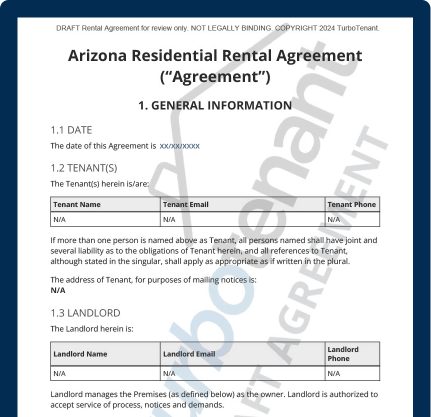
Current PageUse a TurboTenant Arizona room rental agreement template to lock in your house hacking operation.
Arizona Month-to-Month Lease Agreement
Learn MoreBuild your Arizona month-to-month lease agreement in 15 minutes.
Arizona Residential Lease Agreement
Learn MoreCreate a compliant Arizona residential lease agreement in 15 minutes with TurboTenant's rental contract builder.
Room Rental Agreement vs. Roommate Agreement
A room rental agreement is a contract between the property owner and a tenant renting one room. The owner sets the rent, identifies which areas are included with the room, keeps control of the property, and must follow Arizona’s formal court process to end the tenancy when needed. This contract functions as a lease for one room rather than the whole home.
A roommate agreement goes the other direction. Co-tenants who already share a lease use it to settle day-to-day details among themselves: who covers which share of the rent, how chores rotate, and what the guest policy is. It records expectations between roommates, but it does not bind the landlord or replace a signed lease.
Basics to Include in a Room Rental Contract
As with any standard lease, Arizona regulates what landlords can and cannot include in a room rental agreement. Leasing out a single room doesn’t let you skip the specifics. Make sure your agreement addresses these terms:
- Names of all parties: Identify full legal names of the landlord and the tenant, written exactly as they appear on each ID.
- Property address and room description: Identify the specific bedroom and any closets, storage, or parking that come with it.
- Rent amount and due date: List the monthly amount, the due date, and the payment methods you accept.
- Late fees: Arizona sets no statutory grace period, and no cap on late fees for standard residential rentals, so any fee must be reasonable and written into the agreement to hold up (Ariz. Rev. Stat. Ann. § 33-1368).
- Security deposit: Arizona caps deposits at 1.5 times 1 month’s rent. After the tenancy ends, and the tenant requests an itemized list of deductions and a refund, the landlord has 14 days to return it. Any wrongfully withheld amount exposes the landlord to double damages. When a tenant moves in, the landlord must provide a move-in damage form and notify the tenant of their right to attend the move-out inspection (Ariz. Rev. Stat. Ann. § 33-1321).
- Utilities: Note which utilities are included and how shared bills get split among everyone in the house.
- Lease term: State whether this is a fixed-term or month-to-month room rental agreement.
- Notice to vacate: Set how much advance notice each side owes before ending the tenancy. Arizona’s statutory minimum applies either way: 30 days’ written notice for month-to-month arrangements and 10 days for week-to-week (Ariz. Rev. Stat. § 33-1375)
- Access to common areas: Define which shared spaces (kitchen, living room, yard) the tenant may use.
For a more comprehensive dive, see our full guide to Arizona lease agreements.
Landlord Room Access Laws
Advance notice: Arizona landlords must give at least 2 days’ notice before entering the rental space for inspections, repairs, services, or showings, and may enter only at reasonable times. The agreement should also outline how to deliver notice (text, email, or written notice) to prevent disputes later (Ariz. Rev. Stat. Ann. § 33-1343).
Emergency access: During a real emergency, the landlord may enter immediately, without notice, to address a fire, burst pipe, gas leak, or another urgent threat to people or property (Ariz. Rev. Stat. Ann. § 33-1343).
Landlord harassment: Access has limits. A landlord may not abuse the right of entry or use it to harass the tenant. Repeated entry without proper notice, consent, or a valid reason may give the tenant grounds to seek court relief, terminate the agreement, or recover damages (Ariz. Rev. Stat. Ann. § 33-1376).
Shared Space and House Rules
Renting out a room works best when the everyday details are clear from the start. Before move-in, put the shared-house rules in writing so the agreement covers how people will actually live together:
- Kitchen: Assign fridge and cabinet space, decide who cleans what, and agree on a dish schedule.
- Bathrooms: Rotate cleaning duties and cap the amount of personal storage each person gets.
- Laundry: Set machine times, decide who buys detergent, and require clothes to come out promptly.
- Guests: Spell out how often visitors can come and the rules for overnight stays.
- Quiet hours: Specify the hours when noise should be reduced, especially on weeknights.
- Parking: Assign spots and say where guests can leave their cars.
- Smoking and vaping: State whether smoking and vaping are allowed on the property and, if so, where.
Add the completed house rules to the agreement and have both parties sign them before move-in, so everyone agrees on shared living expectations from the start.
Build Your Next Room Rental Contract Today
Ready to turn house rules into a lease you can actually use? Customize an Arizona room rental agreement in 15 minutes with TurboTenant.
Arizona Room Rental Agreement FAQs
Can I make a tenant leave without going to court if we share a home?
No. A tenant who signs a room rental agreement is generally a lawful tenant with eviction protections, even if they are under the same roof. To remove them, the landlord must follow Arizona’s special detainer process and obtain a court order. Changing the locks, removing belongings, or cutting off essential services can expose the landlord to damages of up to two months’ rent or twice the tenant’s actual damages, whichever is greater (Ariz. Rev. Stat. Ann. § 33-1377, § 33-1367).
Can I sublease a room in a house I'm renting myself in Arizona?
Maybe, but check the original lease first. Arizona does not broadly ban residential subletting, but many leases require the landlord’s written permission before a tenant rents space to someone else. Get written approval, keep a copy, and use a separate room rental agreement with the person taking the room.
Do I have to report the income from renting out a room?
Usually, yes. Rent collected from a room renter generally counts as taxable income and should be reported on federal and state tax returns. Landlords may also be able to deduct a reasonable share of expenses tied to the rented space, such as utilities, repairs, insurance, and depreciation. A tax professional can confirm the right split. Here’s one thing to keep in mind: Arizona abolished city transaction privilege tax (TPT) on residential rentals over 30 days as of January 1, 2025 (Arizona Department of Revenue — Residential Rental Guidelines).