


An Arizona lease agreement gives landlords and tenants a common starting point before a tenancy begins. It outlines the basics, like rent, deposits, lease length, property rules, and maintenance responsibilities, while also helping both sides understand exactly what Arizona law requires of them.
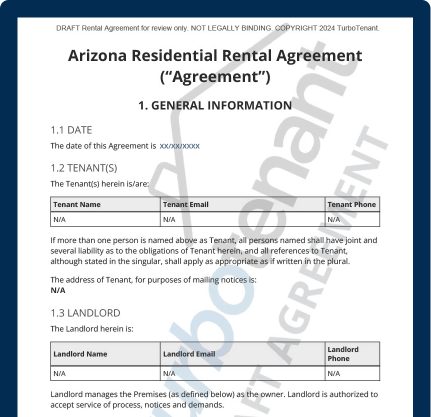
As you prepare for a new tenancy, make sure your lease includes the right terms, disclosures, and state-specific protections for 2026. Use TurboTenant’s template to create a downloadable PDF rental lease agreement that Arizona landlords can customize, send out for e-signatures, and store securely in the cloud.

Arizona Residential Lease Agreement
Current PageCreate a compliant Arizona residential lease agreement in 15 minutes with TurboTenant's rental contract builder.
Arizona Month-to-Month Lease Agreement
Learn MoreBuild your Arizona month-to-month lease agreement in 15 minutes.
Room Rental Agreement Arizona
Learn MoreUse a TurboTenant Arizona room rental agreement template to lock in your house hacking operation.
Required Landlord Disclosures (10)
In addition to the lease itself, Arizona landlords must provide certain disclosures so tenants understand who manages the property, which laws apply, and which property-specific conditions could affect the rental. These required disclosures help document important information before the lease begins and include the following:
- Landlord’s name and address: Arizona property owners, landlords, or authorized agents must disclose their name and address to the tenant in writing at or before the start of the tenancy (Ariz. Rev. Stat. Ann. § 33-1322).
- Lead-based paint: If a rental property was built before 1978, federal law requires landlords to disclose known lead-based paint or lead-based paint hazards and provide tenants with the required lead-based paint information (42 U.S.C. § 4852d).
- Access to landlord-tenant act: Landlords must notify tenants in writing that the Arizona Residential Landlord and Tenant Act is available on the Arizona Department of Housing’s website. Landlords can also provide tenants with a physical copy of the document, though they are not legally required to do so (Ariz. Rev. Stat. Ann. § 33-1322).
- Bed bug disclosure: Landlords must provide new and existing tenants with bed bug educational materials. Landlords cannot enter into a rental contract with a tenant if they know of a current bed bug infestation in the rental unit. Tenants who are aware of a bed bug infestation must provide written or electronic notice to their landlord (Ariz. Rev. Stat. Ann. § 33-1319).
- Non-refundable fees: The landlord must state the purpose of all non-refundable fees or deposits in writing. Any fee or deposit not specified as “non-refundable” is considered refundable by law (Ariz. Rev. Stat. Ann. § 33-1321(B)).
- Move-in/move-out condition checklist: Upon move-in, Arizona landlords must provide tenants with a signed copy of the lease, a move-in form to note existing damage, and a written notice that the tenant may attend the move-out inspection. If the tenant requests it, the landlord must notify the tenant of the move-out inspection date (Ariz. Rev. Stat. Ann. § 33-1321(C)).
- Residential pool safety notice: If a rental property has a pool, landlords must issue tenants an educational pool safety notice approved by Arizona’s Department of Health Services (Ariz. Rev. Stat. Ann. § 36-1681(E)).
- Shared utilities: If a landlord charges separately for gas, water, wastewater, solid waste removal, or electricity through submetering or a ratio utility billing system, the rental agreement must list the separately charged utilities and state any administrative fee, which cannot exceed the landlord’s actual administrative costs. If the landlord uses a ratio utility billing system, the rental agreement must specifically describe the allocation method used to divide utility costs (Ariz. Rev. Stat. Ann. § 33-1314.01).
- Notice of foreclosure: If a rental agreement is entered into after a foreclosure action has started, the landlord must include written notice of the possible foreclosure in the rental agreement. If the landlord receives a notice of trustee’s sale or other foreclosure notice after the tenant has entered into the rental agreement, they must provide written notice within 5 business days (Ariz. Rev. Stat. Ann. § 33-1331(A)-(B)).
- Completed lease blanks and signed copies: If landlords use a written rental agreement, they must deliver a signed copy to the tenant. The tenant must sign and return 1 fully executed copy to the landlord within a reasonable time after signing, and the written rental agreement must have all blank spaces completed (Ariz. Rev. Stat. Ann. § 33-1322).
Security Deposit Regulations
Maximum security deposit amount: Arizona landlords may require tenants to pay up to 150% of 1 month’s rent as a security deposit, including prepaid rent. With that in mind, tenants may voluntarily pay more (Ariz. Rev. Stat. Ann. § 33-1321(A)).
Receipt of deposit: No Arizona law requires landlords to provide tenants with a separate security deposit receipt. However, landlords must state in writing the purpose of all non-refundable fees or deposits (Ariz. Rev. Stat. Ann. § 33-1321(B)).
Interest: No Arizona law requires landlords to collect or pay interest on a tenant’s security deposit.
Deduction tracking: Landlords must provide tenants with an itemized list of deductions taken from their security deposit, along with any remaining amount due to the tenant. Tenants have up to 60 days after the landlord mails the itemized list to dispute the deductions (Ariz. Rev. Stat. Ann. § 33-1321(D)).
Returning a tenant’s security deposit: Landlords must return a tenant’s security deposit, adjusted for lawful deductions, within 14 days, excluding Saturdays, Sundays, and legal holidays, after the tenancy ends, the tenant delivers possession, and the tenant demands the deposit back (Ariz. Rev. Stat. Ann. § 33-1321(D)).
Landlord’s Access to Property
Advance notice: Arizona landlords must give tenants at least 2 days’ notice before entering a rental property for non-emergent reasons, unless it is impracticable to do so. Landlords may enter only at reasonable times (Ariz. Rev. Stat. Ann. § 33-1343(D)).
Immediate access: During emergencies, Arizona landlords can enter their rental properties without prior notice or tenant consent (Ariz. Rev. Stat. Ann. § 33-1343(C)).
Landlord harassment: Landlords cannot abuse their right of access to a rental unit or use it to harass the tenant. If a landlord makes an unlawful entry, enters in a lawful but unreasonable manner, or makes repeated demands for entry that harass the tenant, the tenant may have legal remedies, including possible lease termination (Ariz. Rev. Stat. Ann. § 33-1343(D), § 33-1376(B)).
Breach of Rental Agreement
Missed rent payment: If an Arizona tenant fails to pay rent by its due date, the landlord may issue a 5-Day Notice to Pay Rent or Quit. If a tenant fails to pay rent by the end of the notice period and does not move out, the landlord can file an eviction lawsuit against the tenant (Ariz. Rev. Stat. Ann. § 33-1368(B)).
Lease violation: If a tenant fails to maintain their rental unit in a manner that materially affects health and safety, the landlord may issue a 5-Day Notice to Cure or Quit.
If a tenant materially violates the terms of their Arizona residential rental lease agreement or provides false information on their rental application, a landlord can issue them a 10-Day Notice to Cure or Quit.
If a tenant violates the terms of their rental agreement for a second time in the same or substantially similar way during the same standard lease term, or materially falsifies their criminal record, prior eviction record, or current criminal activity on their rental application, the landlord may issue a 10-Day Notice without giving the tenant another opportunity to cure.
If a tenant commits certain serious criminal acts on the premises of their rental property, a landlord can terminate the rental agreement immediately and file for eviction (Ariz. Rev. Stat. Ann. § 33-1368(A)).
Self-help evictions: A landlord who attempts to evict a tenant without following the legal eviction process is committing an illegal self-help eviction. Tenants may recover possession or terminate the rental agreement and recover damages if the landlord unlawfully removes them from the property or excludes them from the property (Ariz. Rev. Stat. Ann. § 33-1367).
Lease/property abandonment: If a tenant has vacated a rental property for 5 days or more, rent has gone unpaid for 5 days or more, and no personal property remains in the unit, Arizona law considers the property abandoned.
If a tenant has been absent from the rental property for at least 7 days, rent has been outstanding and unpaid for 10 days, and there is no reasonable evidence, other than the tenant’s personal property, that the tenant is occupying the unit, state law considers the property abandoned.
If a tenant abandons a property before their lease expires, they are liable for rent until the lease’s end date has passed or the unit has been re-rented, whichever comes first.
Once they have terminated the tenancy, the landlord must make a reasonable effort to re-rent the unit at a fair rental value to mitigate potential financial damages to the tenant (Ariz. Rev. Stat. Ann. § 33-1370).
Ending a Lease
Month-to-month: Arizona landlords or tenants may terminate a month-to-month lease by providing a move-out notice at least 30 days before the periodic rental date specified in the notice (Ariz. Rev. Stat. Ann. § 33-1375).
Fixed-term: Landlords and tenants under standard fixed-term residential leases are legally obligated to fulfill the terms of their lease through its end date. Tenants can break the contract before its end date under the following circumstances:
- Victim of domestic violence or sexual assault (Ariz. Rev. Stat. Ann. § 33-1318)
- Law enforcement officer who is a victim of harassment because of their status as a law enforcement officer (Ariz. Rev. Stat. Ann. § 33-1318.01)
- Active duty military obligations (50 U.S.C. § 3955)
- Landlord abuse of access or unlawful entry (Ariz. Rev. Stat. Ann. § 33-1376)
- Landlord breaches the rental contract (Ariz. Rev. Stat. Ann. § 33-1361)
Property abandonment: If a tenant leaves their belongings at a property after abandonment, the landlord may store the tenant’s personal property in the abandoned unit, another available unit, landlord-owned storage space, or off the premises if necessary. The landlord must notify the tenant of the property’s location (Ariz. Rev. Stat. Ann. § 33-1370(D)).
If the tenant hasn’t claimed their abandoned property within 14 days after the landlord retakes possession, the landlord may sell the items and apply the proceeds toward unpaid rent and other allowable costs. The landlord must mail any excess proceeds to the tenant at their last known address (Ariz. Rev. Stat. Ann. § 33-1370(E)).
Prohibited lease clauses: Arizona rental agreements cannot require tenants to waive rights under the Arizona Residential Landlord and Tenant Act, pay the landlord’s attorney fees except as allowed by statute, or indemnify the landlord for the landlord’s legal liability. Arizona law makes prohibited rental agreement terms unenforceable, and tenants may recover damages if a landlord knowingly uses a prohibited clause (Ariz. Rev. Stat. Ann. § 33-1315).
Renewing a Lease
Required renewals: Arizona landlords do not have to allow tenants to renew their rental agreements after the lease has expired, provided the nonrenewal does not violate fair housing laws, retaliation protections, or other applicable laws.
Required notice: For standard residential leases, Arizona does not require a specific notice window when a fixed-term lease naturally expires. On the other hand, for month-to-month tenancies, landlords must give at least 30 days’ written notice before the periodic rental date specified in the notice (Ariz. Rev. Stat. Ann. § 33-1375(B)).
Arizona Residential Lease Agreement FAQs
Does a landlord have to provide a copy of the lease in Arizona?
Yes. If there is a written rental agreement, Arizona landlords must deliver a signed copy to the tenant, and the tenant must return one fully signed copy to the landlord within a reasonable time (Ariz. Rev. Stat. § 33-1322).
What is the grace period for rent in Arizona?
Arizona does not require a grace period for late rent. However, landlords must give tenants 5 days’ notice to pay before filing an eviction action for nonpayment of rent (Ariz. Rev. Stat. § 33-1368(B)).
Can a landlord refuse to renew a lease in Arizona?
Yes. Arizona landlords can refuse to renew a lease as long as they provide proper notice when required and do not violate federal fair housing laws. For month-to-month tenancies, landlords must give at least 30 days’ written notice before the periodic rental date (Ariz. Rev. Stat. § 33-1375).
Does an Arizona lease need to be notarized?
No. Arizona lease forms do not need to be notarized to be enforceable in 2026. State law requires both parties to sign the written rental agreement and exchange signed copies (Ariz. Rev. Stat. § 33-1322).
Can you withhold rent for repairs in Arizona?
Sometimes. If a landlord fails to provide essential services, tenants may have legal remedies after giving proper notice, including securing reasonable substitute services and deducting certain costs from rent. For other habitability issues, tenants may use Arizona’s repair-and-deduct process, but they must comply with the statute’s notice, timing, and cost limits (Ariz. Rev. Stat. § 33-1363, § 33-1364).
Disclaimer: TurboTenant does not provide legal advice. This material has been prepared for informational purposes only. All users are advised to check all applicable local, state, and federal laws and consult legal counsel should questions arise.