


You need a written Delaware lease agreement if you plan to rent your property in Delaware for a year or longer. It’s a legal requirement.
After you and your tenant(s) sign the residential lease agreement, it becomes legally binding and outlines the parties’ rights and responsibilities. To start, we’ll introduce you to the list of disclosures that Delaware requires landlords to provide to tenants.

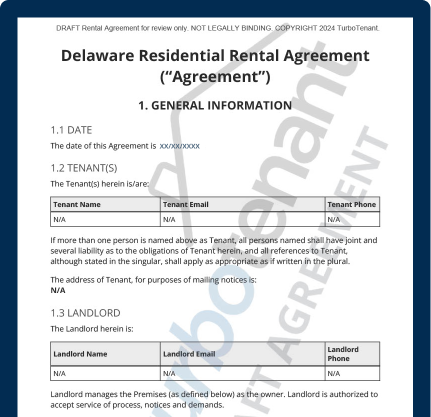
Delaware Residential Lease Agreement
Current PageCreate a compliant Delaware lease agreement in 15 minutes with TurboTenant's rental contract builder.
Delaware Month-to-Month Rental Agreement
Learn MoreGet the flexibility you need with a Delaware month-to-month lease agreement.
Room Rental Agreement Delaware
Learn MoreConsidering renting out your spare room? Make it official with a Delaware room rental agreement.
Required Landlord Disclosures (5)
Delaware requires landlords to give a tenant a series of disclosures when signing a Delaware residential lease agreement.
Below are the five required disclosures:
- Lead paint: Per federal law, landlords must notify tenants of any lead-based paint or lead-based paint hazards in homes constructed before 1978.
- Owner disclosure: All Delaware rental agreements must include the property owner or landlord’s name and address (§ 5105(a)).
- Landlord-Tenant code: When the lease starts, the landlord has to give the tenant a summary of the Landlord-Tenant Code (§ 5118).
- Bed bugs: Landlords must check the property for bed bugs and provide a written statement if they find bed bugs and information on actions taken to prevent them in the future (§ 5317).
- Legal representation: If a tenant’s income stays below 200% of the federal poverty guidelines, they could be entitled to legal representation in eviction cases. Conditions may apply. For instance, the landlord must own at least four units and not have an attorney (§ 5602).
Security Deposit Regulations
Maximum security deposit amount: For leases of 12 months or longer, the security deposit may equal the monthly rent amount. Landlords can charge any amount as a security deposit for month-to-month rental agreements. However, the difference between that amount and one month’s rent will be credited back to the tenant after they have lived at the property for 12 months. Security deposits for furnished units may vary (§ 5514(a)).
Deposit location: Landlords must place security deposit funds in a separate FDIC-insured institution and provide the tenant with the banking name and location (§ 5514(b)).
Receipt of deposit: Landlords must give tenants a receipt showing where their security deposit is in escrow. This account can only hold security deposit funds (§ 5514(b)).
Deduction tracking: If a landlord has to make any deductions from a tenant’s security deposit, they must provide the tenant an itemized list of deductions no later than 20 days after the lease end date (§ 5514(f)).
Returning a tenant’s security deposit: Landlords have 20 days to return a security deposit to a Delaware tenant (§ 5514(f)).
Landlord’s Access to Property
Advance notice: A Delaware landlord should give tenants a minimum of 48 hours’ notice before entering. If the tenant requests a repair, that timeline varies. The landlord may only enter the property between 8 am and 9 pm (§ 5509(b)).
Immediate access: Landlords in Delaware do not have to provide entry notice in an emergency. (§ 5509(b))
Landlord harassment: In non-emergency situations, a landlord must provide 48 hours’ notice. If they do not give notice or enter between 8 am and 9 pm, tenants have a reason to terminate the lease early (§ 5509(b)).
Rent Payment Laws
Grace period: Tenants have 5 days to pay rent after the due date before a landlord can charge late fees (§ 5501(d)).
Late rent fees: Landlords can charge a late fee of no more than 5% of the total monthly rent (§ 5501(d)).
Tenant’s right to withhold rent: Tenants cannot withhold rent if the property needs repair (§ 5505(a)).
Breach of Rental Agreement
Missed rent payment: A landlord can charge a late fee if the rent is unpaid after 5 days. After this period, the landlord must provide the tenant with a written notice stating that the lease agreement will terminate no more than 5 days after the notice is given (§ 5501(d), § 5502(a)).
Lease violation: The landlord should give the tenant a written notice about lease violations, allowing them 7 days to remedy the situation. Otherwise, the lease will terminate if the tenant does not cure the violation by the date mentioned in the written notice. For more significant lease violations, the landlord can fix the violation, send the tenant a bill as necessary, and end the rental contract (§ 5513).
Self-help evictions: Landlords cannot perform self-help evictions in Delaware (§ 5313).
Lease abandonment: If a tenant in Delaware moves out before their lease ends, they may be responsible for paying the remaining rent for the lease term. Additionally, they could be liable for any repair costs for the property, the difference between the fair rental rate and the rent specified in the last signed lease, and any expenses related to finding a new tenant for the property (§ 5507(d)).
Ending a Lease
Month-to-month: Delaware tenants/landlords can terminate a month-to-month lease by providing 60 days’ written notice (§ 5106(d)).
Fixed-term: Delaware tenants can legally break a fixed-term lease early for a few reasons. These include a significant illness or death of a tenant or a close family member who lives in the unit with them, moving into a senior living community, domestic violence, active duty military orders, and other qualifying reasons. A 30-day notice must be given in all circumstances regarding the early termination of the lease (§ 5314((b)).
Property abandonment: If a tenant abandons personal belongings, the landlord may take them off the property immediately and charge the tenant for storing them. The landlord must keep the property for 7 days and may dispose of it afterward (§ 5507(e)).
Renewing a Lease
Required renewals: Delaware landlords are not required to let tenants renew their leases.
Required notice: Tenants are entitled to 60 days’ notice if a landlord opts not to renew the lease (§ 5106(d)).
Disclaimer: TurboTenant does not provide legal advice. This material has been prepared for informational purposes only. All users are advised to check all applicable local, state, and federal laws and consult legal counsel should questions arise.
Delaware Residential Lease Agreement FAQs
Does a landlord have to provide a copy of the lease in Delaware?
If the agreement is in writing or lasts a year or more, the landlord must provide a copy of the lease. If it is an oral agreement, the landlord only has to provide a written copy if asked for it (§ 5105(b)).
What is the grace period for rent in Delaware?
The grace period for rent is 5 days in Delaware (§ 5501(d)).
Can a landlord refuse to renew a lease in Delaware?
The landlord can choose not to refuse to renew a lease in Delaware, as long as the proper notice is provided (60 days’ notice in writing) (§ 5106(d)).
Does a Delaware lease need to be notarized?
Delaware leases do not need to be notarized.
Can you withhold rent for repairs in Delaware?
Tenants cannot withhold rent for repairs (§ 5505(a)).