


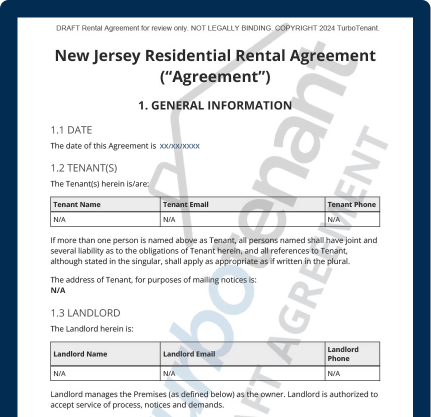
A New Jersey residential lease agreement helps landlords and tenants start on the same page by outlining the rules, responsibilities, and expectations for the tenancy. Since New Jersey has its own landlord-tenant laws, you should understand the necessary terms and disclosures, as well as how to avoid common mistakes that could undermine your business.
To get started, customize your next downloadable residential lease agreement with TurboTenant, or keep reading to learn key New Jersey rental requirements Garden State landlords should know.

New Jersey Residential Lease Agreement
Current PageCreate a compliant New Jersey lease agreement in 15 minutes with TurboTenant's rental contract builder.
New Jersey Month-to-Month Lease Agreement
Learn MoreBuild your New Jersey month-to-month lease agreement in 15 minutes.
Room Rental Agreement New Jersey
Learn MoreRent your spare room with a New Jersey room rental agreement today.
Required Landlord Disclosures (7)
New Jersey landlords must share certain disclosures with tenants before or during the lease process. Landlords should provide the following disclosures in writing, include them with the lease when required, and keep copies for their records:
- Lead-based paint: The only federally required landlord disclosure is the requirement to disclose known information about lead-based paint and lead-based paint hazards before the sale or lease of most housing built before 1978 (42 U.S.C. § 4852d).
- Landlord identity registration certificate: New Jersey landlords must provide each tenant or occupant with a copy of the landlord registration certificate at the start of a new tenancy. If the landlord files an amended certificate, the landlord must provide tenants with a copy within 7 days of filing or receipt of the validated amended certificate (N.J. Stat. Ann. § 46:8-29).
- Flood risk: New Jersey landlords must notify tenants before lease signing or renewal whether the rental property sits in a FEMA Special or Moderate Risk Flood Hazard Area, whether the landlord has actual knowledge of past flooding, and that renters may be able to obtain flood insurance (N.J. Stat. Ann. § 46:8-50).
- Truth in Renting Guide: New Jersey landlords covered by the Truth in Renting Act must distribute the Truth in Renting statement to tenants at or before lease signing. Landlords must also provide an updated copy within 30 days after the Department of Community Affairs makes revisions available (N.J. Stat. Ann. § 46:8-46).
- Window guard: New Jersey landlords of multiple dwellings must inform tenants of their right to request window guards and must install them upon written request when a child aged 10 or younger lives in or regularly spends time in the unit. Landlords may charge no more than $20 per window guard (N.J. Admin. Code § 5:10-27.1).
- Information on crime insurance: Landlords of multifamily dwellings must provide tenants with information about crime insurance available through the New Jersey Insurance Underwriting Association. They must advise tenants that the landlord’s policy does not cover the tenant’s personal property (N.J. Stat. Ann. § 46:8-39).
- Lead in drinking water: When a landlord receives lead-related health and safety information from a public water system, they must distribute it to all tenants and post it within 3 business days. Leases must include a statement explaining this duty (N.J. Stat. Ann. § 58:12A-12.4 to -12.6).
Security Deposit Regulations
Maximum security deposit amount: A landlord cannot charge more than 1.5 months’ rent as a security deposit or increase the deposit by more than 10% of the current deposit in any 1 year (N.J. Stat. Ann. § 46:8-21.2).
Receipt of deposit: New Jersey landlords must notify tenants in writing within 30 days after receiving a security deposit. The notice must include the name and address of the bank or investment company holding the deposit, the type of account, the current interest rate, and the amount deposited (N.J. Stat. Ann. § 46:8-19).
Interest: New Jersey landlords must place security deposits in an interest-bearing account or qualified investment, unless a statutory exception applies. The interest or earnings belong to the tenant, and the landlord must pay or credit that amount annually as required by law (N.J. Stat. Ann. § 46:8-19).
Name and location of bank account: New Jersey landlords must provide the name and address of the banking institution or investment company holding the security deposit, the account type, the current interest rate, and the amount deposited (N.J. Stat. Ann. § 46:8-19(c)).
Deduction tracking: If New Jersey landlords deduct from a security deposit, they must send tenants an itemized list of deductions by personal delivery, registered mail, or certified mail within 30 days after the tenancy ends. The landlord must also return any remaining deposit balance and the tenant’s portion of interest or earnings (N.J. Stat. Ann. § 46:8-21.1).
Returning a tenant’s security deposit: New Jersey landlords must return the tenant’s security deposit, plus the tenant’s portion of interest or earnings and minus lawful deductions, within 30 business days after the tenancy ends. Shorter deadlines may apply after fire, flood, condemnation, or certain domestic violence lease terminations (N.J. Stat. Ann. § 46:8-21.1).
Landlord’s Access to Property
Advance notice: New Jersey landlords cannot enter a tenant’s rental premises without the tenant’s consent, a valid lease provision, or a court order (N.J. Stat. Ann. § 2A:39-1).
Immediate access: New Jersey housing officials may enter and inspect multiple dwellings at reasonable times when enforcing health and safety rules. Landlords should limit immediate entry to emergencies or dangerous conditions that threaten people in or near the property, such as fire, flooding, gas leaks, or other urgent safety risks (N.J. Admin. Code § 5:10-1.1 et seq.).
Landlord harassment: New Jersey law doesn’t have a statewide advance-notice statute for landlord entry. However, tenants residing in properties with three or more units must provide access for inspection and maintenance upon reasonable notice, typically 1 day. Immediate access is allowed in emergencies. For other rentals, entry is governed by tenant consent and the lease agreement. Repeated entry without consent, a valid reason, or a court order may interfere with the tenant’s possession and support legal claims (N.J. Stat. Ann. § 2A:39-1).
Rent Payment Laws
Grace period: New Jersey does not require a statewide rent grace period for every tenant. However, covered tenants, including certain seniors and recipients of disability, SSI, Work First New Jersey, or similar benefits, get a 5-business-day grace period when rent is due on the 1st of the month. During that period, landlords cannot charge late fees (N.J. Stat. Ann. § 2A:42-6.1).
Late rent fees: New Jersey does not set a statewide maximum late fee for standard residential leases. As a courtesy, landlords should keep late fees reasonable and clearly state them in the contract.
Tenant’s right to withhold rent: Tenants may withhold rent if a landlord fails to maintain habitability standards for vital services, such as heat, plumbing, hot water, or electricity. Tenants should give the landlord proper notice and a reasonable opportunity to fix the issue first (N.J. Stat. Ann. § 2A:42-85).
Breach of Rental Agreement
Missed rent payment: If a tenant misses a rent payment, landlords can pursue eviction for nonpayment of rent. New Jersey does not require landlords to serve a notice to quit before filing for eviction based on nonpayment of rent (N.J. Stat. Ann. § 2A:18-61.1).
Lease violation: If tenants violate the terms of a residential rental lease, landlords can pursue eviction by serving the required notice to cease and/or the notice to quit. If the tenant does not correct the issue or vacate, the landlord can then file an eviction complaint in court (N.J. Stat. Ann. § 2A:18-61.1).
Self-help evictions: These evictions are illegal in New Jersey. Landlords must follow the court process and cannot lock tenants out or otherwise remove them without a legal eviction order (N.J. Stat. Ann. § 2A:39-1).
Lease abandonment: If a tenant leaves the property before the lease ends, landlords must make reasonable efforts to re-rent the unit and mitigate their losses. If the landlord cannot find a suitable tenant, the tenant may still owe rent for the remainder of the lease (Sommer v. Kridel).
Prohibited lease provisions: New Jersey landlords cannot include lease terms that waive tenant rights under the Truth in Renting Act or violate clearly established legal rights and responsibilities. Landlords should review custom lease terms carefully before adding waiver clauses, penalty clauses, or language that conflicts with state landlord-tenant law (N.J. Stat. Ann. § 46:8-48).
Ending a Lease
Month-to-month: Before moving out, a tenant on a residential month-to-month lease must provide written notice to terminate the lease at least 1 full month in advance (N.J. Stat. Ann. § 46:8-10).
Fixed-term: New Jersey tenants may legally terminate a standard fixed-term lease before its end date under certain circumstances, including disability, domestic violence, military service, or unit uninhabitability (N.J. Stat. Ann. § 46:8-9.2, § 46:8-9.4 et seq., § 2A:42-88).
Property abandonment: If tenants leave property behind after vacating the unit, the landlord must send a written notice and give them at least 30 days after delivery or 33 days after mailing to reclaim the belongings before disposing of or selling them (N.J. Stat. Ann. § 2A:18-72, § 2A:18-73).
Renewing a Lease
Required renewals: In most covered New Jersey residential tenancies, landlords cannot refuse to renew a lease unless they have good cause under state eviction law. Landlords should not treat the expiration of a fixed term alone as sufficient to end a covered tenancy (N.J. Stat. Ann. § 2A:18-61.1).
Required notice: Landlords must provide proper notice to terminate a tenancy when they have a lawful basis to do so. Tenancies not protected by the Anti-Eviction Act require 3 months’ notice for year-to-year tenancies and 1 month for month-to-month or at-will tenancies (N.J. Stat. Ann. § 2A:18-56). For tenancies covered by the Anti-Eviction Act, the notice period depends on good-cause grounds (N.J. Stat. Ann. § 2A:18-61.2).
New Jersey Residential Lease Agreement FAQs
Does a landlord have to provide a copy of the lease in New Jersey?
No, New Jersey law does not require landlords to provide tenants with a copy of the signed lease form. With that in mind, tenants can request a printed or PDF copy of the residential lease agreement for their records.
What is the grace period for rent in New Jersey?
New Jersey does not give all tenants a general rent grace period. However, covered tenants, including certain seniors and recipients of disability, SSI, Work First New Jersey, or similar benefits, are entitled to a 5-business-day grace period before landlords may charge late fees (N.J. Stat. Ann. § 2A:42-6.1).
Can a landlord refuse to renew a lease in New Jersey?
In most covered residential tenancies, landlords cannot refuse to renew a lease unless they have good cause, like nonpayment of rent or another legally recognized reason (N.J. Stat. Ann. § 2A:18-61.1).
Does a New Jersey lease need to be notarized?
No, New Jersey rental lease agreements do not need notarization to be legally enforceable in 2026.
Can you withhold rent for repairs in New Jersey?
Yes, tenants may withhold rent if the landlord fails to make essential repairs that affect habitability. To stay within the law, tenants must follow proper legal procedures and should give the landlord notice and a reasonable opportunity to fix the issue (N.J. Stat. Ann. § 2A:42-85).
Disclaimer: TurboTenant does not provide legal advice. This material has been prepared for informational purposes only. All users are advised to check all applicable local, state, and federal laws and consult legal counsel should questions arise.